
Behind the 'local enterprise' Project Beehive supplying Royal Navy with drone boats to 'transform' force

The Royal Navy is pushing to secure various autonomous vessels and drones to supplement the fleet
Sophisticated drone boats will soon be added to the Royal Navy’s arsenal in an effort to “transform” the fleet.
Project Beehive will see 20 un-crewed vessels procured to develop the hybrid navy. There is a push from government to supplement conventional warships with autonomous drones, aircraft, vessels, and submersibles, to make the fleet more agile and reactive to the current threats it faces.
Designed and built in Kraken Technology Group’s Concorde Close base in Whiteley - as part of a £12.3m contract - the vessels will be primarily used by the Coastal Forces Squadron and 47 Commando Royal Marines for operations training and development activities. Much of the testing has been conducted at Portsdown Technology Park in North Hill.


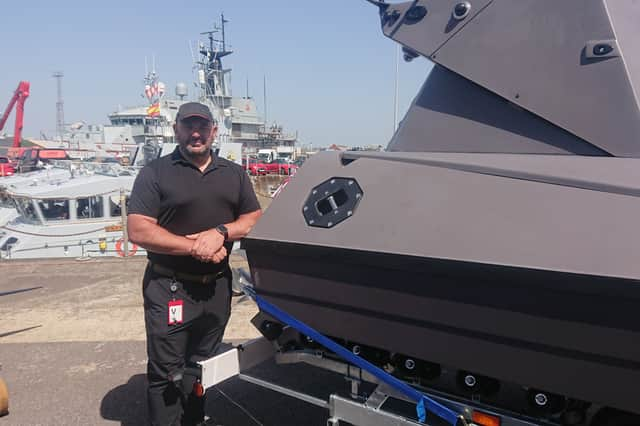
Integration trials for the command and control systems were undertaken by experts at QinetiQ. This included testing to see if the communication systems can be spooked or jammed.
QinetiQ’s senior campaign manager James Anderson told The News: “Beehive is a completely local enterprise. Mine-hunting is a very obvious area to drive first. It gives you life insurance. Going out and looking for mines is fundamentally dangerous. If we can do that with autonomous systems, there’s a big step there.
“I think the main thing for the Royal Navy is choice. It’s about giving uncertainty in the enemy's mind. We can’t get 20 ships out there, but we can get 20 beehives out there. They don’t know what’s on them. They don’t know if there’s a sense package or an effect package. As we get more capabilities on the un-crewed systems, we’ll see more uncertainty being driven into the enemy.”
“Transform maritime capabilities”
The move towards autonomy was originally outlined in the Strategic Defence Review (SDR) last year. Former defence secretary John Healey then visited HMNB Portsmouth to formally announce Atlantic Bastion, which aims for conventional warships and autonomous capabilities to patrol the North Atlantic and High North in response to Russian activity.
The recently published Defence Investment Plan (Dip), a report which garnered controversy from former personnel and experts over funding and a lack of immediate support, fleshed this out further. Plans for a Type 83 destroyer were scrapped, but it was announced that six Common Combat Vessels would be created and rolled out in the 2030s.

This is alongside a pledge to construct Type 91 un-crewed missile platforms, Type 92 autonomous underwater sensing platforms, Type 93 Extra-Large Uncrewed Underwater Vehicles, and Type 94 un-crewed sensor platforms. A further £5bn was set aside to develop drones. The Dip said the process to “transform maritime capabilities” has begun.
“Our hybrid capabilities are already being fielded with £120m invested this financial year to support the Multinational Hormuz Mission - including highspeed, autonomous drone boats to sense, track, identify, and defeat potential threats,” it said. “Around the UK, Project Beehive will deliver Uncrewed Surface Vessels for the Royal Navy and Royal Marines to deliver security in British waters.”
It’s hoped that Project Beehive will act as a proving ground for future hybrid technologies, while procuring systems with immediate operational capability. Mr Anderson said the hybrid navy should allow the force to tackle more operations at once, depending on the rollout.
“We help the Royal Navy understand their capability before deploying it,” he added. “We can react quickly and emulate what sailors are going to see. There’s a committed date for rolling this out, and we will flex the navy to make sure they meet those dates.”
What are the Project Beehive boats?
The 20 vessels are Kraken K3 Scouts, which can carry up to 600kg in a modular payload. With a range of up to 650 nautical miles at 25 knots, they use an inboard diesel engine and a stern drive. They can be used for anti-submarine warfare missions, patrols, and other operations.
Kraken Technology Group was founded five years ago and has created various systems for the Ministry of Defence (MoD) and NATO Task Forces-X (Baltic).
Chief marketing officer Ed Tilston said the company has been transformed by the contract and is expanding. “They’re using the K3s to integrate lots of capabilities,” he told reporters at HMNB Portsmouth’s Nato Plenary.


“We’re testing out different elements. We employed 25 to 30 people last January, and we’re now working out of a second facility. That’ll allow us to produce 500 units a year. The platforms are dual use. We’re making each boat as consistently as we can to drive volumes.”
Nearly all of the Project Beehive ships have been procured. Giving an update in response to a parliamentary written question in June, minister for defence readiness and industry Luke Pollard said: “The Ministry of Defence continues to take delivery of Project Beehive craft in line with the approved programme schedule. Of the 20 vessels on order, 18 have already been delivered, with the remaining craft expected shortly.”
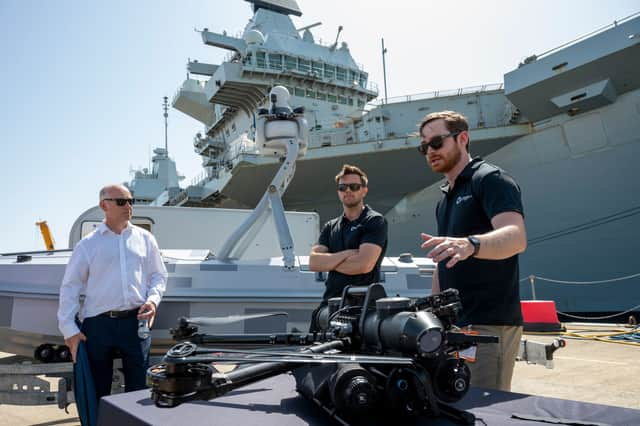
Several revolutionary trials have taken place recently on the experimental ship XV Patrick Blackett. This included the firing of a one-way effector sea drone.
Chief Petty Officer Daniel Phipps said: “From the things we work on, I can see there are a lot of applications and people would be itching to get involved if given the chance. We love to showcase some of the things we’ve been doing and working towards. There are a broad range of things we’re looking at.”