
'Birthplace of maritime power' hosts historic Nato event as Portsmouth showcases latest Royal Navy technology

This is the first time the UK has hosted the Nato plenary this century
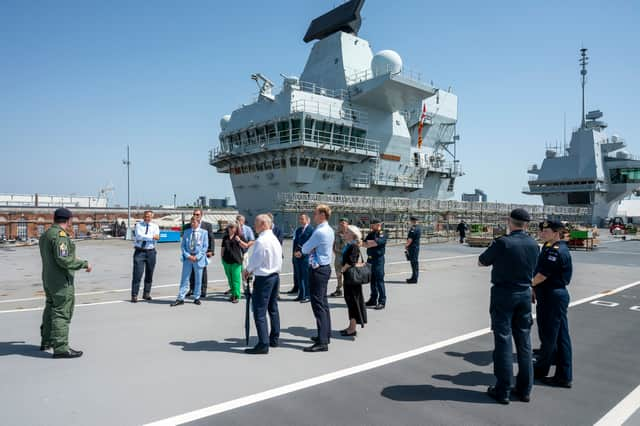
High-profile Nato meetings have been hosted in Portsmouth this week as the city became a landmark for a historic event.
Global defence leaders and other dignitaries visited the city for the alliance’s Industrial Advisory Group (NIAG) Plenary. Taking place between June 23 and 25, it’s the first time this century that the UK has hosted the high-level gathering - aimed at preparing the alliance against the threats from adversaries such as Russia.
Samira Braund, defence director for ADS - a defence and aerospace trade association - said it was a huge privilege to welcome Nato to Portsmouth. She described the city as the “birthplace of maritime power” and the home to a “thriving defence industrial heritage”.

She told The News: “This city is rich with innovative companies that are developing the capabilities that our armed forces rely upon day in, day out. As an industry, our primary purpose will always be to strengthen our deterrence posture but in doing so, our industry adds huge economic value to places like Portsmouth and supports thousands of highly skilled, highly paid jobs across the country.
“This week, we have showcased what this city - and the UK as a whole - brings to the Alliance. A strong NATO, requires a strong industry and Portsmouth will long remain a central tenant of that. That is what a NATO-first approach should involve.”
What the Nato plenary means for Portsmouth
Significant figures in government and top brass in the armed forces will attend. Key topics up for discussion included the industrial challenges facing the alliance amid Russia’s ongoing invasion of Ukraine, and the increasing threat posed by Moscow on Europe.
National armaments director Rupert Pearce said the plenary is an opportunity to highlight the critical connection between national industrial transformation and the strength of the alliance. He added: “Guaranteeing our deterrent means collaboration between governments, armed forces and industry partners at an unprecedented scale.
“Nato’s engagement with industry in response to these threats – through initiatives such as the Nato Defence Production Action Plan and the Rapid Adoption Action Plan – is beginning to reflect this reality. But it needs to do more and do so with greater speed and impact.”
The Royal Navy has been pushing to create a hybrid force. Outlined in the Strategic Defence Review published last year, conventional warships will be joined autonomous vessels and un-crewed systems to carry out various operations. RFA Lyme Bay is currently in the Middle East after being converted into a mothership for drones and mine-hunting technology. She’s preparing for a possible mission to keep the Strait of Hormuz open.
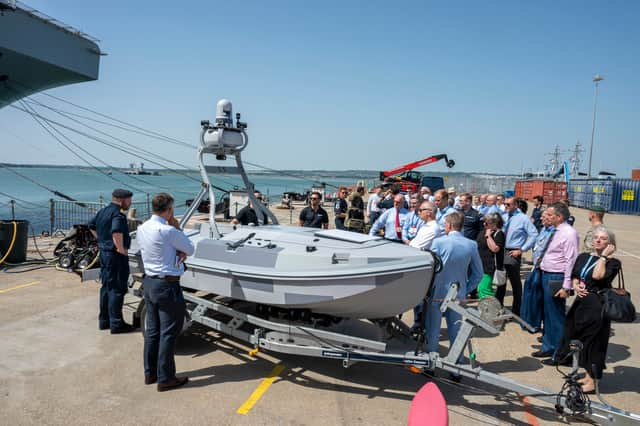
Large companies in the city were showing their presence, including Airbus, QinetiQ, and BAE Systems. Mike Knott, BAE Systems’ programme director for the Hybrid Navy Campaign, said Nato is focusing on industrial resilience. He said a nation needs to produce armaments and supplies at speed in response to threats and attacks.
“We need an industrial base that suddenly hits a go button and suddenly increases manufacturing at speed,” he added. “What we’ve learnt from Ukraine, instead of warfare being about high-end capabilities, they needed to take greater advantage of drones. Where do they come from and how can you scale that really quickly?
“When Nato is thinking about resilience, it’s thinking about what is my capability from day one and how can we keep that going through attritional warfare? How can I create an industrial base to do that?”
BAE Systems showcased various autonomous technologies, from the Archerfish mine disposal system to the Extra Large Autonomous Underwater Vehicle (XLAUV) Herne. When asked if Portsmouth’s defence industry and workforce can be improved with more focus from Nato, he said: “When you’re making your investment decisions about what capabilities you’re going to generate, if you’ve got a clear sign to where the return comes from, that makes it much easier to invest.”
“An amazing opportunity”
Chief Petty Officer Daniel Phipps knows about the push for new technologies all too well, as part of the ship’s company for XV Patrick Blackett. The Portsmouth-based NavyX vessel has been the base for trialling various technologies, from controlling drone boats to testing one-way effector drones.
He said: “Everybody that joins here loves being here and the work we do. It’s the future technology, and the team that supports us ashore makes us more agile. We can get after things a lot easier, knowing we have their backup. There are a lot of companies out today, so it shows we’re looking at lots of different technologies and not just one specific point.”
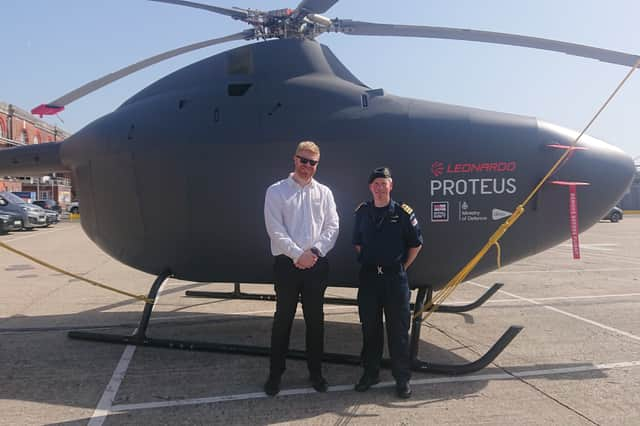
Another one of these capabilities is an entirely un-crewed helicopter Proteus. Developed by Leonardo, the aircraft was designed as a demonstrator for the Royal Navy to test how a ‘hybrid air wing’ could work in the future. It was highlighted as a key tenant of Atlantic Bastion, using conventional warships alongside drones and un-crewed systems to hunt down submarines.
Royal Navy Commander Chris Wood said: “This is ground-breaking stuff for UK industry. The company has delivered various demonstrations of increasing complexity. We hope to see how our current state-of-the-art piloted systems can work alongside autonomous collaborative platforms.
“The hybrid navy is about increasing mass and lethality as far as we can, through the adoption of autonomous systems at its heart. Something like this reduces the need for flying personnel and expensive training. It gives us capability at a much lower price point.
“The trials have been really interesting. We’ve learned a lot and gained a huge amount of perspective. The size and scale of the aircraft is impressive, and we’ve learned so much about the autonomous technology and the wider implications of certification of such an aircraft.”
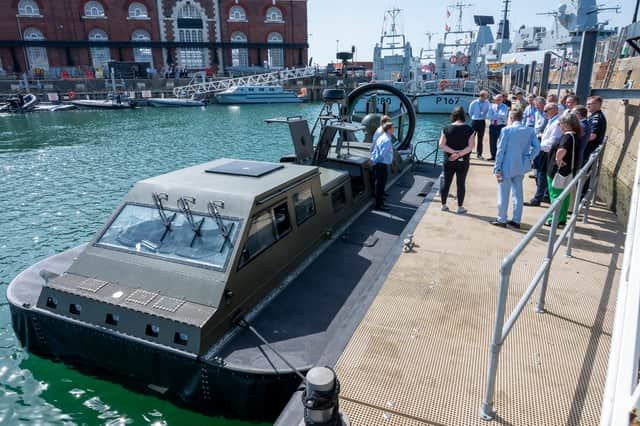
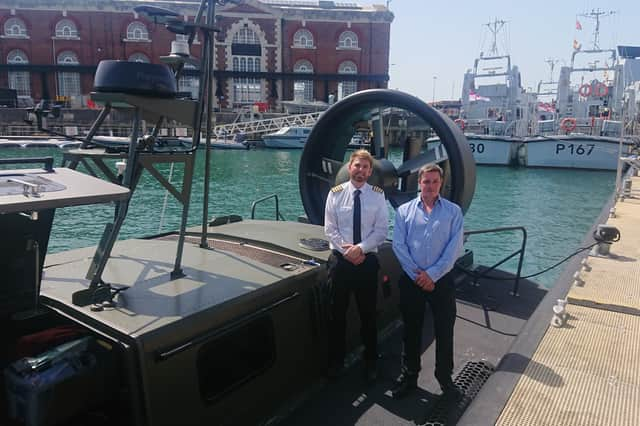
Portchester-based Griffon Marine was among the companies at the plenary, showcasing the 2000 TD hovercraft. Currently used by forces in Finland, Poland, Estonia, and Lithuania, engineers can produce up to 14 at once.
Chief pilot and marine operations manager, Ben Avery, said the plenary was an amazing opportunity. He added: “To show a vessel not as common as others, and they’re still relevant, is great. We can fit drones and other things to these. It can act as a mobile command post and get to places inaccessible to other vehicles.”