
"Pioneering" hi-tech future Royal Navy force showcased to oppose Russia with Portsmouth as testing heartland

Futuristic hi-tech naval crafts will be used to oppose Russian submarines and protect British undersea cables - with Portsmouth being the hotbed for tests and trials.
The initial stages of the hybrid naval force, named Atlantic Bastion, were showcased at HMNB Portsmouth. This multi-million pound programme will develop various un-crewed vessels and submersibles, deployable alongside conventional warships in the North Atlantic to protect undersea infrastructure from interference.
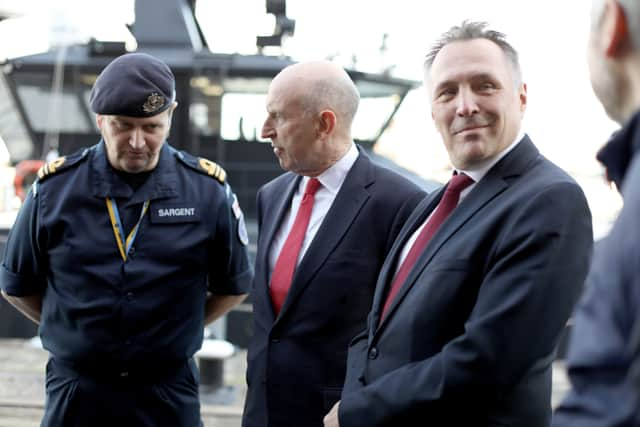
Defence secretary John Healey, his Norwegian counterpart Tore O. Sandvik, and First Sea Lord General Sir Gwyn Jenkins, believe the push towards a hybrid Royal Navy needs to accelerate to keep up with escalating threats from Russia.


“We can be in no doubt that Russia is developing its capabilities to target our critical undersea cables and networks,” Mr Healey told the press on December 4. “This first part of Atlantic Bastion is the response to that growing threat. We’ve opened up a glimpse of the potential and power of new technology to combine with our traditional way of doing things.”
How will Atlantic Bastion work?
Plans for Atlantic Bastion were first announced in the Strategic Defence Review in June. The aim is to produce a suite of autonomous vessels, submersibles, and drones, all connected together with crewed warships.
Submarine-hunting Type 26 frigates, due to join the fleet from the late 2020s, are set to be integral to this strategy. A total of 26 firms have already submitted proposals to the Ministry of Defence (MoD) to develop anti-submarine sensor technology. The Atlantic Bastion sector projected to be worth £350bn globally.
The equipment seen in Portsmouth showcased half a billion worth of investment. Mr Healey said this is necessary so Russian submarines threatening undersea cables can be found, tracked, and responded to accordingly.

“Industry is stepping up alongside us, recognising that our Royal Navy is pioneering the transformation of new hybrid navies,” Mr Healey added.
“When I say I want the British military to be the leading innovation in Nato, this is what I mean. Unless we accelerate the development of these technologies, e will not give our forces that technological upper hand on the battlefield.”
These capabilities will be integrated together through a digital targeting web – a pioneering network of weapons systems that allow battlefield decisions for targeting enemy threats to be made and executed faster.
All the systems will communicate with each other through AI-powered acoustic detection technology. Much of this testing takes place at Portsdown Technology Park in Portsmouth, with many trialled at Ocean Basin in Haslar Technology Park, Gosport.
The UK and Norway signed a defensive pact last week to hunt Moscow’s spy ships and submersibles. Tore O. Sandvik, Oslo’s defence secretary, said Putin is prioritising the Russian submarine fleet by building new strategic multi-role submarines armed with cruise missiles.
“Russian deep water capability continues to pose a serious threat to western underwater infrastructure,” he added. “They believe these assets can operate covertly, but we can track them and follow their movements. Any attempts to harm our undersea infrastructure will not be accepted.”
“We’re definitely in competition”
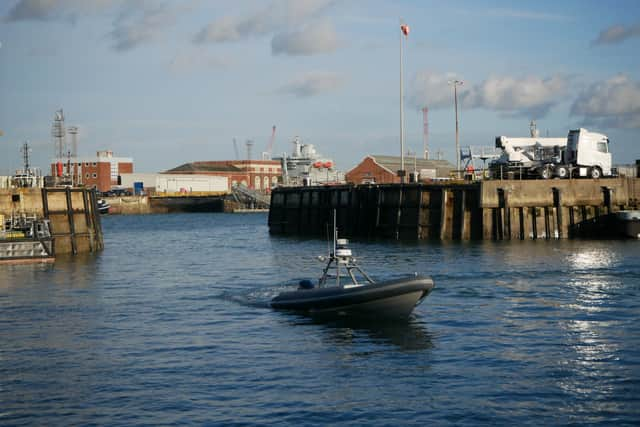
Among the technology showcased were the Rattler-class boats, remotely controlled from the Portsmouth-based experimental ship XV Patrick Blackett. Sailors using PlayStation controllers were at the helm of the vessels, with some being sailed at the base simultaneously as others in Wales.
Others include the XV Excalibur, a large un-crewed submarine which will serve as a testbed for maritime technology. The SG-1 Fathom, an autonomous AI-powered underwater reconnaissance glider created by Helsing, was another platform on display.
The First Sea Lord said the first gliders will be in the water next year, with the next stage of funding through contracts being issued in 2026. He added that Atlantic Bastion is “pioneering on a number of fronts”, as it focuses on an area where the UK needs an advantage against its opponents.
“We’re definitely in a competition in the Atlantic,” Sir Gwyn said. “If you look at Russian capabilities, their funding has continued to grow despite the war in Ukraine. They consider it an area of expertise and advantage for them. We’re trying to stay ahead.
“I wouldn’t say we’re behind them at the moment, but we are stretched. I think we should always be testing the Russians. We will deploy our capabilities where we are entitled to deploy them. We’ll not be intimidated by the Russian rhetoric.
“We have the freedom of the seas which is enshrined in law that we believe in as law-abiding nations. We can’t afford to be hemmed in by the rhetoric and escalatory language you see coming out of President Putin’s regime. We should have some confidence in the capabilities we’ve got. We need to continuously evolve, develop, and pioneer new capabilities so we can prove that we can stay a step ahead of where the Russians are.”
How will this programme impact Portsmouth?
Various trials of autonomous ships have already taken place in the Solent. Communications systems so the boats can be in contact with XV Patrick Blackett and other platforms are rigorously tested at Portsdown Technology Park.
James Anderson, senior campaign manager at QinetiQ, said this is integral to Atlantic Bastion’s success - with the firm conducting various tests alongside Helsing. “If you can't get all of the capabilities to talk to the ships and to the shore, then Bastion won’t work and the hybrid navy won’t work,” he added.
“It’s that element that will attract more work into the Portsmouth area as they head towards the hybrid navy. “Portsdown is an intrinsic part of the future plans to develop the capability, and Haslar will become part of the various trials firms will need to do. A lot of the work to get Rattlers on the water was supported from Portsdown.
“As they build that wider network, whether it’s autonomous surface platforms, aircraft, or subsea vehicles, they all need that connectivity. Portsdown comes into its own as it allows for the initial integration and testing.”
Among the tests carried out include whether the vessel’s signals can be jammed. Mr Anderson said it’s possible the systems can be jammed, but he is assured that the Royal Navy will have gone through everything they can before getting into those scenarios.
“We can’t go out in the Solent and jam them, but we emulate jamming in a controlled environment to understand the impact of it and test the comms system to show it’s survivable in action,” he added. “We do everything we can to make sure all the capabilities are assured, operable, and nothing will go wrong, so personnel can trust them.”