
Swarm of drone boats controlled from 500 miles away surrounds Portsmouth Royal Navy ship HMS Tyne in Scotland

A Royal Navy warship swarmed by drone boats controlled hundreds of miles away while operating at sea.
Five un-crewed boats remotely piloted from 500 miles away surrounded HMS Tyne in a demonstration of how the Royal Navy could utilise such technology on operations. The real-life scenario of escorting a warship was played out during 72 hours of training off the coast of Scotland.


The Royal Navy reported the milestone for the Navy’s Disruptive Capabilities and Technology Office, in which seven 7.2m autonomous Rattler boats have been trialled over the past few months, with their latest test pushing the boats and their controllers to their limits. While on board XV Patrick Blackett, an experimental ship for new technologies located at HMNB Portsmouth, sailors, Royal Marines and Army personnel remotely piloted five of the boats as they sailed in Scotland 500 miles away.
The demonstration saw the vessels work with P2000 HMS Biter of the Coastal Forces Squadron, a Merlin helicopter, HMS Tyne and HMS Stirling Castle in a proof-of-concept exercise. With cameras, sensors and other data being fed back to Patrick Blackett, the Rattlers were able to successfully and safely escort Tyne and Stirling Castle, which were playing the role of foreign warships.

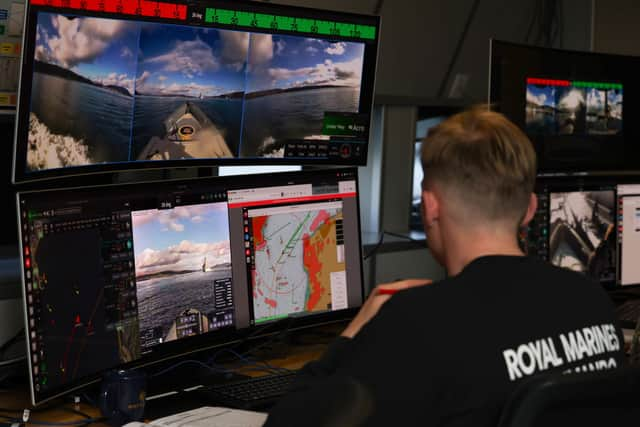
The Royal Navy said: "Unlike previous drones operated by the navy they have been designed to be fully un-crewed. Each vessel can operate individually or as part of a swarm. They can be pre-programmed with mission profiles, navigational routes and can work together as a ‘wolf pack’ on operations. In time they will be able to operate without direct human control."
Commander Michael Hutchinson Royal Navy, Commanding Officer of both the newly formed Fleet Experimental Squadron and Experimental Vessel Patrick Blackett, said: "In recent years we have seen the effect that autonomy and un-crewed systems can have at sea, on land and in the air, especially in Ukraine. In the maritime domain in particular the effect has been remarkable, with simple, cheap, one-way effectors used to defeat complex and capable warships and deny them freedom of manoeuvre at sea.
"USVs are also being used for reconnaissance, patrol, constabulary and survey tasks, so they are incredibly versatile and it is critical that the Navy develop these systems and train people with the skills to operate them to match the threat of our adversaries and ensure that we remain ready to lead, fight and win."