
What are the 'adaptable' drone hub Common Combat Vessels due to replace the Royal Navy's Type 45 destroyers

It has long been earmarked that the Type 45 destroyers will be replaced similar ships, but that plan has been shelved
The Royal Navy will procure at least six so-called “common combat vessels” (CCVs) as the Government looks to modernise the force and prioritise drones.
The new vessels will act as hubs for uncrewed systems and are part of efforts to expand the Navy’s reach and firepower without a “proportional increase” in crew or cost, the Ministry of Defence (MoD) said. Plans to replace a fleet of six Portsmouth-based Type 45 destroyers with a new class of guided-missile warship called the Type 83 destroyer have been scrapped.

What are the new Common Combat Vessels?
The new defence investment plan (Dip) means the Navy will commission drawings and designs for new, uncrewed, drone-compatible vessels which are expected to be delivered in the early 2030s. As such, details on their size, shape, capability and cost is currently unknown.
The MoD said the new vessels will “act as a control hub for uncrewed systems – extending the Navy’s reach, resilience and firepower without a proportional increase in crew or cost”.
A report by specialist publication Navy Lookout said that in one concept of how the CCVs would operate, each crewed CCV was “flanked by at least two large uncrewed surface vessels, fulfilling diverse roles such as air defence or anti-submarine warfare as missions demanded”.
Defence secretary Dan Jarvis said: “These CCVs will provide our dedicated sailors with hybrid ships that are designed and built for the increasing threats we face. Developed with exceptional British innovators, the new ships will be British-built, supporting jobs across the nation and giving the Royal Navy a capability built for modern warfare.”
The MoD added that their “adaptable design” will mean the CCVs can be exported globally.
How will the Common Combat Vessels be used?
The Ministry of Defence (MoD) said at least six new ships will be built. “Rather than concentrating capability in a small number of large, expensive ships, the Royal Navy’s shift to a hybrid navy will mix crewed and uncrewed capabilities and be more suited to the pace and nature of modern warfare,” they added. “The funding announced in the DIP allows the National Armaments Director Group to commence the design work that will underpin the fundamental shift in how to deliver Air Defence at and from the sea.”
The government body said the CCVs will work alongside the eight Type 26 frigates and five Type 31 warships already under construction. They will also be joined by Type 91 un-crewed missile platforms, Type 92 autonomous underwater sensing platforms, Type 93 Extra-Large Uncrewed Underwater Vehicles, and Type 94 un-crewed sensor platforms.
The MoD said this represents a ‘once in a generation investment in new maritime capability’. Mr Jarvis added: “Our Royal Navy is a formidable force, operating to protect our nation and our allies in the Atlantic and beyond. These Common Combat Vessels will provide our dedicated sailors with hybrid ships that are designed and built for the increasing threats we face.
“Developed with exceptional British innovators, the new ships will be British-built, supporting jobs across the nation and giving the Royal Navy a capability built for modern warfare.”
Why was the Type 83 programme scrapped?
The Type 83 destroyer was originally planned to replace the Type 45 and come into service in the mid-to-late 2030s. It was previously described by Commodore Michael Wood, Senior Responsible Owner (SRO) for the programme in Navy Command, as an evolution of the Type 45 which could utilise laser weapons, electronic propulsion, and more digital systems - powered by AI and machine learning.
The guided-missile warship, which was first mentioned by the then-Conservative government in 2021, was still in the concept phase of development and no specifics of the design had been confirmed publicly. Earlier this year, the government confirmed that the programme was “under review”.
In April, minister defence minister Luke Pollard said that when Labour inherited the concept for the Type 83 fleet it was “underdeveloped”. He also revealed that around £1m had been spent on platform-specific design over the past three financial years for the now abandoned Type 83 fleet.
It was proposed that the Type 83 would work with other weapons systems to protect the fleet from air attack as part of the Future Air Dominance System (FADS) – which former defence minister James Cartlidge dubbed a “system of systems”.
Timeline for Type 45 retirements
The Daring-class warships have a provisional decommissioning timeline for the late 2030s. The Portsmouth vessels are set to go through Power Improvement Project (PIP) enhancements, alterations aimed at fixing a design flaw in the Rolls-Royce WR-21 gas turbine intercooler unit has been causing power issues.

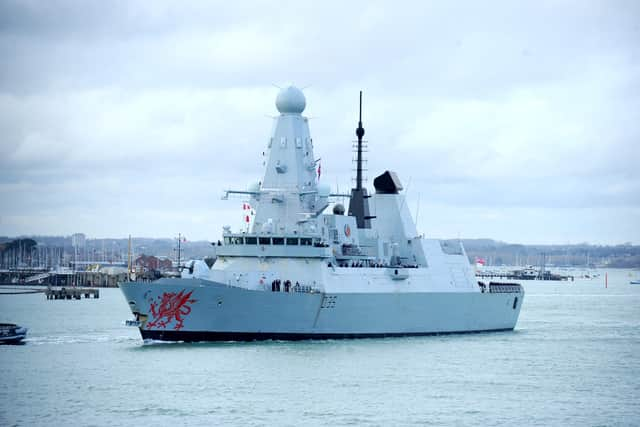
Each ship is 152 metres in length, can travel at 30 knots with a range of 7,000 nautical miles and specialises in anti-aircraft and anti-missile warfare. The vessels have a flight deck and an advanced radar system which can track objects in the air and on the surface at a range of up to 250 miles.
Centred around the Sea Viper air-defence missile system which can launch eight missiles in under 10 seconds, each destroyer has a wealth of weaponry including two 7.62mm miniguns and six general purpose machine guns. Pressure has been building to secure a path for replacements.
The Royal Navy is struggling to handle this situation with the current crop of Type 23 frigates. Commissioned throughout the 1990s and early 2000s, many are in a deteriorating state after serving in the force for decades. The frigate force is shrinking as a result.
Their replacements, advanced Type 26 and 31 variants, are still years away and due to be commissioned in the late 2020s and early 2030s.