
‘Huge for Portsmouth’: New ‘capability accelerator’ launched to get tech into Royal Navy hands faster

Rather than waiting months or years for new technology, the new hub can get equipment to the frontline within weeks
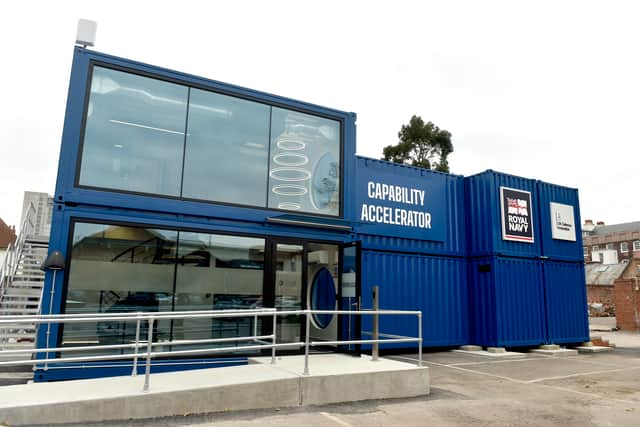
A new ‘capability accelerator’ has been launched to get advanced technology into the hands of Royal Navy sailors faster.
Based at HMNB Portsmouth, the hub brings local defence businesses and military figures together to develop fresh equipment. It aims to develop, demonstrate and assess emerging technologies at a faster rate than traditional processes.
Second Sea Lord Vice Admiral Paul Beattie told reporters on November 5: “As the world adapts and the enemy continues to adapt, we’ve got to be quicker. That means a different approach to innovation, a different relationship with industry and a different approach to risk.


“It means taking something, developing it and when we’re comfortable that it’s safe and secure, deploying it so we don’t wait for months and years for something to make it to the frontline. There’s been many examples of success already, and we’re scaling up.
“Ukraine has shown that in conflict, the nations that adapt the quickest succeed. We’ve been guilty in the past of sitting there in the Ministry of Defence trying to find a solution for weeks, months, years or even decades, and then engaging with industry.
“If you bring in industry from day one, you work together. We’ve got great people in this country, we can find a solution and get it out there. That’s a recipe for success.”
The capability accelerator is a Royal Navy Capability Directorate, aimed at producing new kit for sailors alongside the National Armaments Director Group. One example of a sped-up programme is Project Beehive, where 20 un-crewed vessels were procured for the hybrid navy by Kraken Technology Group in Whiteley.
Despite Chinese cameras being spotted on the vessels and later replaced, the vessels were in the hands of sailors at a rapid rate, with various trials taking place around Portsmouth. The Royal Navy worked alongside the company during the procurement process.
The Second Sea Lord said the Ministry of Defence (MoD) needs act fast, as the risk of being slow is losing. He backed the businesses in the Portsmouth area to succeed. He added: “What surprised me was how many providers we have locally, all these companies that have been built up in the last few years providing for Ukraine, so when we reached out, they were there.
“Everyone can see in the real world that if it takes you ten years to procure a new piece of equipment, don’t bother. By the time it gets into the hands of the users, it’s not going to be of any use at all.”
The accelerator has already equipment which can be fitted to vessels, as well as modular containers which can be attached and detached to new warships. Medical pods have developed by Force Development Services in Fareham, with the company supporting the new accelerator.
Royal Navy Commander James Wagstaffe said: “We’re a key part of that delivering the hybrid navy. We want to provide capability at the point of relevance, and get things in the hands of the users. That comes with risk, but we understand those and have people who hold risk alongside us.”
Ben Keith, former Royal Navy Commander who served for 23 years, is now a client director for Frazer-Nash Consultancy in Portsmouth. he said the new hub will fix a key problem he faced when serving, where expensive weapons like missiles had to be used to target cheap drones. Alternatives can be developed here.
“Industry partners can come in, experiment and get stuff to the frontline,” he added. “The principle is to adapt quickly to get something there and play around with it.
“It might be at 80 per cent capability, not 100 per cent, but you’re getting it in six weeks not two years. Time is a currency.”
During a visit to HMNB Portsmouth, prime minister Andy Burnham promised to reindustrialise the city’s defence sector and provide it with the tools it needs to succeed. Mr Keith said the accelerator lives and breathes defence reform where businesses work alongside the armed forces all the way through developing new technology so they can avoid sunk costs and future problems.


“The industry doesn’t want a lot of requirements that come out in the later stages that they haven’t managed to shape,” he added. “Bringing them in early, we can solve that quicker. You shouldn't have sunk costs as you haven’t developed something the navy doesn’t want.
“This is huge for Portsmouth and elsewhere. Let's throw boats in the water and play around with them, and if they don’t work, we’ll adapt and change them.”
Small businesses can access the accelerator, as well as larger firms including BAE Systems. Combat Systems Director for Naval Ships Steve Carter said: “Through collaboration between industry partners, including BAE Systems and specialist SMEs such as NquiringMinds, new ideas can be assessed in realistic operational contexts and their interoperability with wider naval systems better understood.
“This approach is an important step towards delivering a Hybrid Navy, accelerating innovation while reducing risk and enabling the rapid adoption of emerging technologies.”