
'Formidable' HMS Prince of Wales and HMS Queen Elizabeth defended by MP after brazen Donald Trump 'toys' jibe

An emboldened defence minister have defended the Royal Navy’s aircraft carriers following an insulting remark from Donald Trump.
Al Carns, parliamentary under-secretary for defence, responded to claims made by the US President that HMS Prince of Wales and HMS Queen Elizabeth were ‘toys’ compared to American warships.
Speaking to LBC, he said: “I’ll leave the American president to say what he needs to say. I was the Chief of Staff of a carrier strike force. I’ve spent a lot of time on those carriers. They’re formidable capabilities. We have some of the best sailors, airmen, marines, and Army on board them.
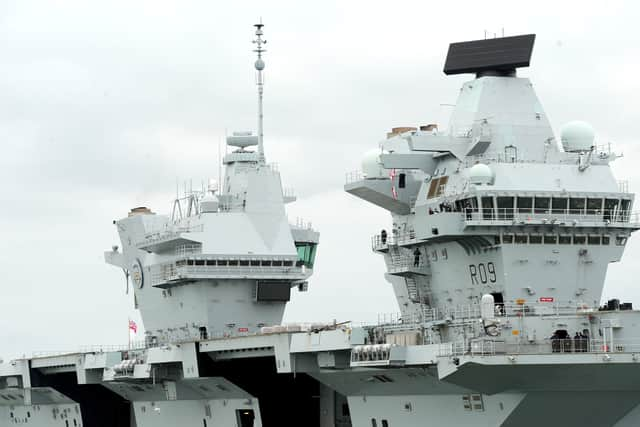

“When you package them together with all the different assets around them, they’re a formidable capability. I’m deeply proud of Great Britain. It’s exactly that, it’s great. We have a right to decide when we get involved and when we don’t.”
Mr Trump has made several provocative comments about Britain and its armed forces: begging for help to reopen the Strait of Hormuz after previously stating he did not need the UK’s support. He made a repulsive jibe made to British members of the armed forces who served in Afghanistan, wrongly claiming they ”stayed a little back” and didn’t get involved on the frontlines. There were 457 fatalities of British Forces personnel in Afghanistan between 2001 and 2021.
The war in Iran is ongoing after a US-Israeli coalition conducted several strikes over Tehran and other parts of the country on February 28. Iran’s Supreme leader, Ayatollah Ali Khamenei, was assassinated in the bombing campaign and has since been replaced by his son, Mojtaba Khamenei. Since the initial attack, which Britain declined to join, Iran’s retaliatory actions have involved striking oil refineries belonging to Gulf states and other military and civilian targets.


A stranglehold has been wrapped round the Strait of Hormuz, where 20 per cent of the world’s oil supply travels through. Cargo ships have been attacked by drones and missiles near the strategic waterway, and mines have reportedly been laid. Given the escalating threat in the Middle East, attention has turned to the shrinking Royal Navy fleet.
Defence secretary John Healey struggled badly to find his words when asked how many frigates and destroyers Britain has at its disposal. He wrongfully declared 17, when it was 13 - soon to be 12. Mr Carns said the Royal Navy has six destroyers, seven frigates, eight OPVs (offshore patrol vessels), two aircraft carriers, four nuclear submarines, and six attack submarines, all accompanied by Royal Fleet Auxiliary support and around 6,000 Royal Marines.
When asked how many are in service and if the country has enough vessels to clear the Strait of Hormuz, the Labour MP for Birmingham Selly Oak said: “The reality is that the last time we tried to reopen the Strait of Hormuz in 1987, it took 30 ships of a coalition force. We’re now faced with an unprecedented level of threat. We have a major crisis brewing primarily due to Iran’s escalatory response including ten different countries, with ballistic missile strikes and drone strikes which have struck everything from airports to ports to civil centres. The blockage of the Strait of Hormuz is an exceptionally complex problem to deal with, in the midst of a conflict.”
He said missile strikes on the UK from Iran isn’t a credible threat, as a missile being fired and travelling over all of Nato would have to go through a suite of defences. When asked if there is a drive to increase defence spending further, he added: “If I was driving any faster,
“I would get done with a speeding ticket. I’m pushing as hard as I can to get as much defence spending as I can. More importantly, we need to spend it in the right way to get the best kit. We need to make money go the furthest and the fastest it can for our armed forces.”
It hasn’t been plain sailing for US ships in the region. The world’s largest aircraft carrier, USS Gerald R Ford, is currently alongside Crete in maintenance after a fire broke out on board earlier this month - setting alight in the main laundry area. The incident was not related to combat and was “contained” by crew members. The Guardian reported that sailors sustained injuries and approximately 100 beds were destroyed.