
'An outright lie': Bumbling defence secretary claims Royal Navy has 17 frigates and destroyers - it doesn't

The defence secretary has claimed the Royal Navy has more destroyers and frigates than it does in a car crash interview - where he was accused of spreading ‘an outright lie’.
John Healey MP was struggling to find his words when speaking to LBC Radio this morning (March 26). When asked how many frigates and destroyers the fleet has at its disposal, he was lost for answers and mistakenly overestimated the numbers.
“We have 17 figures and destroyers,” he told presenter Nick Ferrari. “It’s down from 23 at the end of the last Labour government. The number of minehunters have been cut by more than half.”
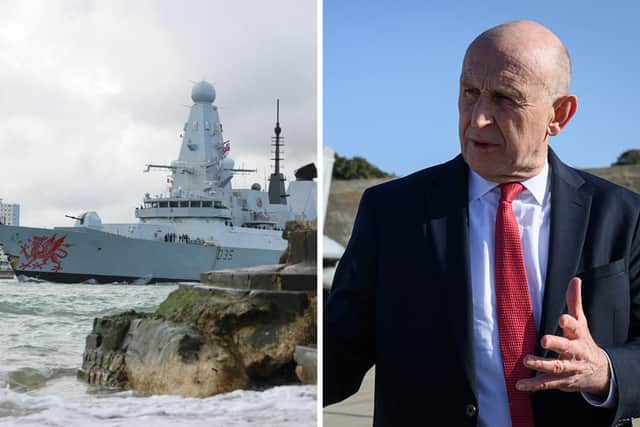

The Labour politician later added: “With every nation and every piece of its military kit, we have some in operation. Some on deployment. Some in states of readiness. Some being repaired and maintained. It’s a regular rhythm that is common to military planning.”
Captain Simon Booth, who served in the Royal Fleet Auxiliary for 37 years, was bewildered by Mr Healey’s comments and the state of the shrinking fleet. He told The News: “It’s an outright lie isn’t it. The figures do not support that statement. We’re an island nation that relies on 95 per cent of trade from overseas. If we can’t protect our own beaches and waterways, then what is the point of defence?”
Former First Sea Lord Admiral Sir Lord West, current Labour peer in the House of Lords, added: “John is a good man and he’s been a good defence secretary. he must have been tired and overstretched. It was a train crash of an interview.
“He knows the Navy has been cut and cut and cut, and needs new ships. He got the number wrong. By my calculations, we’re down to 12 or 13 ships. If you don’t get a rolling programme going, and ships ordered in a timely manner, the old ships are going to drop off before the new ones are ready.”
How many destroyers and frigates does the Royal Navy actually have? What are these vessels doing?
HMS Dragon was due to take charge of Nato’s Standing Maritime Group 1 and conduct various allied patrols in the Baltic and High North - protecting undersea infrastructure from the growing Russian threat.
That was changed when the Type 45 destroyer was taken out of maintenance and deployed from HMNB Portsmouth within six days. She’s tasked with patrolling the eastern Mediterranean after RAF Akrotiri in Cyprus was hit by a kamikaze drone, believed to be from a pro-Iranian militia in Lebanon or western Iraq.
The Daring-class warship reached the area more than two weeks after leaving on March 10. No other British vessels took over Nato’s role, with a the German frigate Sachsen being used instead, leading to Mr Healey being quizzed on the fleet’s size and readiness.

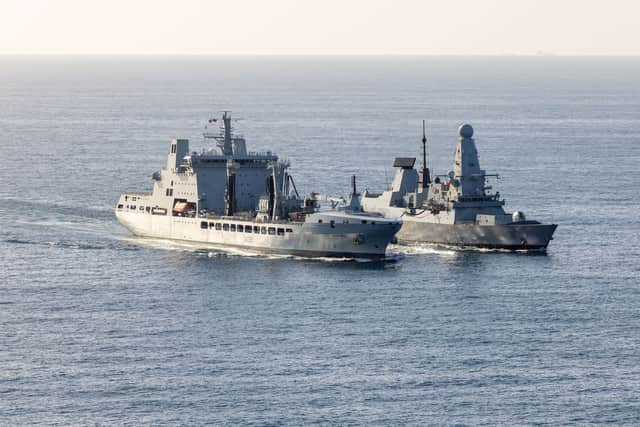
The UK has six Type 45 destroyers, 8,500 tonne guided missile vessels designed for air defence operations. Three of them, HMS Daring, Defender, and Diamond, are being refitted under the Power Improvement Project (PIP) programme. The project aims to fix longstanding propulsion issues by replacing the ships‘ engines. HMS Daring has been out of action for more than 3000 days.
HMS Duncan and Dauntless were placed into maintenance earlier this year. The situation with the seven Type 23 Duke-class frigates is more startling. Despite state-of-the-art replacements being on the horizon - Type 26 and 31 vessels - the older ships are struggling to remain seaworthy.
HMS St Albans is currently deployed, with HMS Somerset and Sutherland being active. HMS Portland and Iron Duke are in maintenance, with the latter not being expected to return, though no official confirmation has been given. HMS Kent is undergoing a full refit, and has been out of action since the summer of 2024. This number also includes HMS Richmond, who previously sailed alongside HMS Prince of Wales on Operation Highmast.
She has not been officially decommissioned, but a retirement ceremony was held in Yorkshire in January where Commanding Officer Commander Richard Kemp insinuated that she would be retired. “She’s had a really good innings,” he told ITV News.
How does the Royal Navy deal with the lack of resources?
Dr Matthew Heaslip, Senior Lecturer in Naval History at the University of Portsmouth, said Mr Healey could have included of the new four ships that are in initial trials and refitting. “If that’s the case, it’s very much creative accounting,” he added.
“He could have included ships which are afloat rather than in crewed commission. Historically, that is not an approach any defence secretary has taken. I wouldn’t like to say it’s done on purpose, he’s possibly just skimmed a briefing note and misread something, but the end result is the same. It’s misleading and is overstating the strength of the Royal Navy fleet.”

Capt Booth said when he was serving, decisions revolved around managing the capability, taking things on risk, and working with British allies - which effectively meant trying to do more with less. He added that he’s concerned by the lack of permanently deployed warship in the Middle East, and there are still a lack of vessels to patrol the North Atlantic. “We’re in a position where we can barely get a frigate or a destroyer out of the door to do the job that defence is mandated to deliver,” he said.
“They always say we’ll take it on risk, but I’m afraid the risks have come home to bite us. The North Atlantic is a very big piece of ocean we’re sharing with the Americans and Canadians. You put one ship east, west, and north, you need to have at least six as you need to relieve them. When you do the maths, it very quickly adds up to more than they’ve got, especially given how poor the maintenance facilities are at turning round ships and getting them back into service.”
Capt Booth said the fleet is too small to react to emergency scenarios, with the Type 45 problems being a disaster which has cost the taxpayer millions of pounds. “That has left us with ships that haven’t been able to go to sea for most of their entire career so far,” he said. “The fleet has shrunk to such an extent where it can’t manage. You can argue it can just about manage if everything is focused in the North Atlantic, but it certainly can’t deal with strategic shocks. It has no strategic capability at all.”
The Ministry of Defence has been approached for comment.