
"Successful" investment bolstering radar upgrades for HMS Prince of Wales and Royal Navy destroyers at pace

Critical investment is allowing for Royal Navy aircraft carriers and warships to be bolstered with upgraded radar technology.
Millions of pounds invested into Project Eagle has meant the Queen Elizabeth-class carriers - HMS Prince of Wales and HMS Queen Elizabeth - and Type 45 destroyers are having their detection systems constantly improved. Various upgrades have been developed since 2023.
With the Royal Navy pushing to modernise its fleet amid growing threats from Russia and other adversaries, advanced radar systems will become ever more crucial. These upgrades are being tested and rolled out from the BAE Systems radar facility in Cowes, Isle of Wight, under a £270m agreement with the Ministry of Defence (MoD).


The company’s head of radar, Steve Newnham, said the scope of the sector and technology are completely different to three years ago. Speaking to The News during a tour of the facility, he said: “It allows us to update and upgrade existing systems, while focusing on future radar systems.
“This was a major step for us getting this contract in place. It was a win-win for us and the MoD, creating a budget for upgrades and future technology. The benefits of this are now being realised.”
Project Eagle combines the ongoing support and improvements of several capabilities under one contract. This includes the Artisan 300 radar, a medium-range surveillance target designation and air traffic management system currently fitted to the Queen Elizabeth-class carriers.

Other technology includes the Sampson radar, that can detect and track hundreds of targets simultaneously from a Type 45 destroyer, the AWS-10 is a medium range surveillance system fitted to many Royal Fleet Auxiliary (RFA) ships, and the Long Range Radar (LRR) capability. These developments will also be fitted to the submarine hunting Type 26 City-class frigates currently under construction.
Both parties in Project Eagle jointly invested a further £50m into new technologies to develop the next-generation of radar technology, so the Royal Navy can tackle emerging threats such as ballistic missiles and drones. HMS Diamond came under fire from both of these while operating in the Red Sea in recent years.
This growth has caused the firm’s turnover in radar to double in three years, amid plans to add 107 new jobs, including graduate and apprenticeship roles.
Improvements made to these systems include software and firmware upgrades, helping sailors make decisions faster and with more accuracy. The programme not only focuses on the Isle of Wight, but also supports jobs in Portsmouth, Essex, and Hillend near Edinburgh.
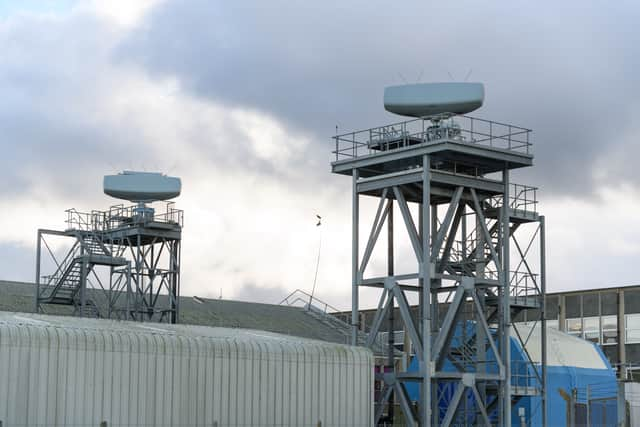
Mr Newnham said the progress will soon go beyond these improvements. He added: “Project Eagle has given us the confidence to further invest and gain that investment. We’ve been investing in the Next Generation Transmit Receive Module (NGTRM) and other projects. We’ve now got additional scope to take that module and build a radar around it. We’re now working on that at pace.”
Mr Newnham said the benefits of Project Eagle will see the firm develop a scalable next generation multi-functional radar (MFR), which could be fitted to the aircraft carriers, Type 45 destroyers, and Type 26 frigates.
Business development manager Bryan Hore said the project has alleviated frustrations in the Navy, and made sure they got the upgrades to Sampson they wanted.
“They were going around in a circle fighting for funding,” he added. “With the bucket of money, it gave far more focus on development and benefits. It has been really successful. It gave certainty. With lots of support contracts expiring at different times for different focuses, you didn’t have any of that certainty.
“Bringing it together meant you had a flatline of funding, allowing us to deliver future capabilities. Despite its age, Sampson is a high performing radar. From a signal processing point of view, people are impressed with the way we do things.”