
'Hard truth' of Royal Navy not having enough ship slammed by MP as he calls on government to 'wake up'

The government has outlined the need to protect waters near Britain against a growing Russian force, but there are currently “glaring” capability gaps
Politicians and the public need to the “wake up” to the fact that the Royal Navy does not have enough ships to defend Britain.
Chair of the Defence Select Committee, Tan Dhesi, said the gaps in the number of frigates, destroyers and submarines was a “glaring” weakness that needs addressing urgently. The cross-party group published a report earlier this week stressing the growing threat from Russia in the High North, with Vladimir Putin increasing the number of spy ships and submersibles in the region.


Mr Dhesi said the government needs to act quickly with increased spending and more warships. The Labour MP told The News: “The nation needs to wake up to the hard truth that there are glaring capability gaps. The number of frigates, destroyers and submarines is not sufficient to meet the vast operational requirements of the High North.
“If we rewind back to 2010 to the Strategic Defence and Security Review of that time, it identified at least 19 frigates and destroyers. At this point, forget 19, we only have 11 frigates and destroyers. Unfortunately, many of those are not towed arrayed sonar powered frigates which are crucial for detecting submarines. We need to ensure that future frigates have that capability.”
The Strategic Defence Review (SDR) published in 2025 set out the plan to bolster the North Atlantic and High North in response to adversaries. This was followed up by the Defence Investment Plan (Dip), which set out aims to build Common Combat Vessels (CCVs) to replace the Type 45 destroyers when they retire. No definitive date has been given for when these will be in the fleet, with planners stuck in the concept phase.
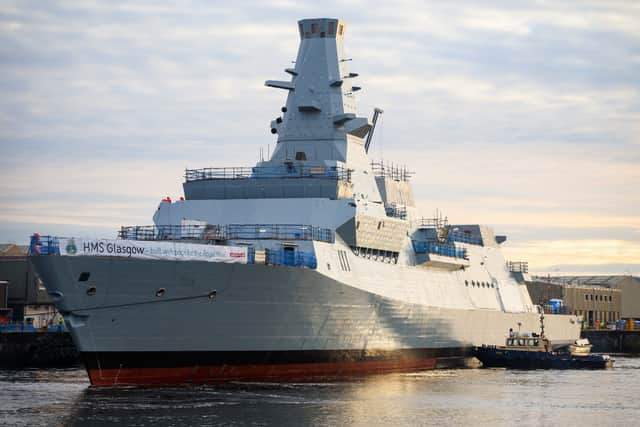
The SDR also said Type 26 submarine-hunting frigates will be used as part of a hybrid force: conventional warships combined with autonomous vessels and drones. HMS Glasgow and Cardiff, the first two of eight ships, are in the fitting out phase - with key systems being installed.
Fears are growing that the pipeline of ships won’t be completed fast enough. The first of the Type 26s is not expected until 2028 at the earliest, with most being rolled out in the 2030s. This is the same for the five Type 31 frigates and several other crewed and uncrewed warships.
In the meantime, the fleet has shrunk to a low of five Type 23 frigates and 11 Type 45 destroyers. The quintet of remaining Duke-class ships have served in the force since the 1990s, far beyond their expected lifespan.
Mr Dhesi said availability was a serious problem in the force, with vessels routinely stuck in maintenance or deep maintenance. He added that it was “disconcerting and a huge concern” that most of the Astute-class nuclear attack submarines, or none at all, have been available for deployment due to mechanical problems.
The MP for Slough said the defence committee is pushing for more investment in under ice capabilities to meet the growing Russian threat. “We’ve allowed these capabilities to lapse,” he added. “We need this, otherwise we won’t be able to detect or deter.”
The report called on the government to increase operations with the Joint Expeditionary Force (JEF) in the High North, and bolster the presence of the British Army in Estonia. Mr Dhesi said cross-party politicians in the committee have repeatedly called on the government to reach three per cent of GDP on defence spending by 2030, and “not kick the can down the road to the next parliament”.
The threats are here and now,” he added. “We’re living in a much more volatile and dangerous world. To ensure Britain as a global naval power, we need to assure our allies we have the capabilities. They’re expecting leadership from us. JEF nations are expecting us to take the lead, and we can’t if we’re not investing in that capability.
“If we don’t invest in further vessels, and are not meeting the demands from 2010 when the level of threat is nowhere near what it is now, then that should be a wake up call to the British public and the government that we need to invest in our defence. To protect the High North, we need to invest in our naval vessels.”
In response to the committee’s report, a Ministry of Defence (MoD) spokesperson said: “We are clear-eyed about the threat Russia poses. During his recent visit to Iceland, the Defence Secretary saw firsthand how HMS St Albans helps track and deter Russian submarine activity across the North Atlantic.
“Through the UK-led Joint Expeditionary Force, we are leading allied activity across the High North, strengthening Nato’s northern flank and increasing our ability to respond rapidly to emerging threats. This government is also investing in the capabilities needed to meet those threats, with £1.5bn backing Atlantic Bastion to deliver a next-generation Hybrid Navy and a further £330m to strengthen the protection of critical undersea infrastructure.”