
Covermounts: How a simple marketing tool on magazines led to the soundtracks of our lives

This article contains affiliate links. We may earn a small commission on items purchased through this article, but that does not affect our editorial judgement.
Whatever happened to those CDs we used to get on the front of magazines, and why did the marketing tool die out?
- They were the means by which many music fans discovered what would become their favourite acts.
- The covermount, the CD on the front of magazines, saw a golden age in the ‘90s, yet digital technology once again affected a physical format.
- Benjamin Jackson looks back the the history of the marketing tool, and offers his ‘holy bible’ CD he’s kept for nearly 30 years.
It was the foremost way before digital technology that we ended up discovering our favourite new acts without sitting through commercial breaks on the radio and television.
And for those of us who used to grab old cassette tapes and cover the holes at the top, it was one of the ways we could have our favourite songs without the start or end being interjected by a radio host.
Yeah, home taping was killing music, but having a DJ ask you to ‘sing along’ live on air before the drop to ‘Bohemian Rhapsody’ was a worse crime in our minds. The irony being you’re piecing together a Queen album to replace the one you copied over with Bone Thugs -n-Harmony and Skee-Lo.
That probably is just me on that occasion. Sorry, mum – didn’t want you to find out this way.
But I digress; covermounts are those CDs that you would find on the front of, well, every magazine in the ‘90s and early ‘00s, be it the best that the metal world had to offer or retrospectives on ‘Cool Britannia’ and the artists that influenced a newer generation of artists.
They, ultimately, were a promotion tool, though in hindsight, at the time, some of us felt it was altruistic in our young age that record labels would give us music, for free, without commercial interruptions.
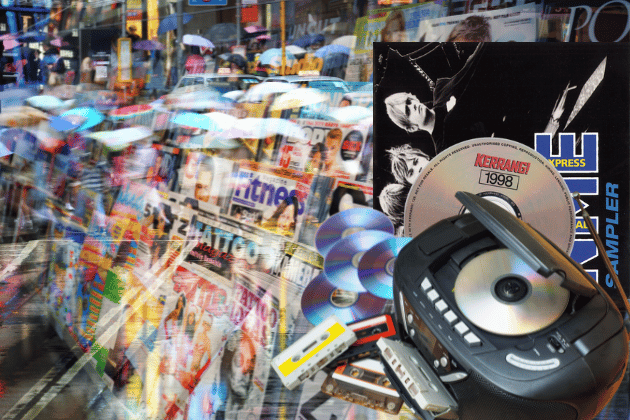

But it worked – those acts that graced the covers of the CDs on the covers of magazines did end up getting a lot more attention than, say, those within the back pages of the NME and the like.
Some of us still own those very CDs that became a formative experience in a world of musical discovery, something cranks like me complain doesn’t feel like that experience really exists anymore. Excuse me while I shake my fist at the sky. Now I’m in my 40s.
So, how did the covermount first come to fruition? Why did it die out, and Benjii – what is the CD sampler that you still own from way back in 1998 that you considered your ‘holy bible’ when it came to the metal scene?
Join me as we wade through the excessive amount of plastic and revisit the halcyon days of the covermount. That is, unless you had it taken from the front of the publication before even purchasing said item…
C86 and the dawn of covermount stars
Though the boom of the covermount occurred much later, its roots can be traced back to the late '70s and early '80s, but at that stage, they weren’t used for music.
Instead, during the dawn of the home computer, magazines such as Your Sinclair or Amstrad Action would regularly provide covermounts that were vital for hobbyists and programmers. Though they were not compact discs, they were instead in the form of cassette tapes (remember loading those up on the Commodore 64?) and then later floppy disks.
Unlike record labels, which often gave away samplers, publishers would offer full versions of games, applications, and utilities. Considering that learning programming like BASIC was often a tedious, trial-and-error approach, these covermounts served as a kind of guaranteed ‘day-one’ working version, a far cry from the patches and updates gamers expect today.
The success of the early computer covermounts didn't go unnoticed, as the music press saw the potential in using a similar model to promote new and often obscure artists directly to their readers. The first iconic example of this was the C86 cassette, released by the British music magazine NME in 1986 - hence the ‘punny’ name.
What started as a simple compilation of independent British bands became an accidental landmark; featuring 22 tracks including the likes of Primal Scream and The Wedding Present, it was meant to be a snapshot of the emerging underground guitar pop scene.
Instead, it was a massive success, and the collection of jangly guitars, melodic hooks, and a distinctly DIY aesthetic became a defining moment for a new sound. It inadvertently gave a name to an entire subgenre: 'C86 indie pop'.
However, unlike those found on the front of magazines in the future, readers instead had to order the cassette by mail, sending in a coupon and a small fee. But the idea was a hit, and it proved that a magazine could not just write about a musical movement, but actively create and define it by putting the music directly into the hands of the fans.
The Golden Age of the Covermount
The success of C86 proved that the covermount was a powerful tool, but it was the arrival of the compact disc that truly ushered in its golden age. In the late '90s and early 2000s, the CD was the dominant music format, and magazines seized the opportunity, plastering them onto the front of nearly every publication imaginable.
Magazines like NME, Q, and Mojo were the pioneers, turning the free CD into an art form. These weren't just collections of random tracks; they were often meticulously curated compilations that served as a musical education.
They could be a tribute to an iconic artist, a "best of the year" roundup, or an introduction to a new wave of bands, giving readers a tangible snapshot of a moment in music history. For a generation of fans, a covermount CD from a trusted magazine was the fastest and most efficient way to discover a new favourite band or genre.
This was a win-win for everyone involved. For publishers, a covermount could instantly boost sales—a Sunday newspaper once sold an extra half a million copies with a single Beach Boys compilation.
For record labels, it was a low-cost, high-impact way to promote new acts and sell albums. And for us, the readers, it was a gateway to new musical worlds, a physical object that became a cherished part of our collections and, ultimately, the soundtrack to our lives.
But the concept was not without its detractors; one of the biggest concerns was, as we all became environmentally conscious, the sheer volume of single-use plastic was seen as a wasteful burden, with the production of the CDs and their non-recyclable elements becoming difficult for consumers - and therefore publishers - to ignore.
Some arguments giving away music merely ‘devalued’ it, and by bundling the hottest hits to come our way, music became ‘throwaway’ rather than the piece of art people paid for.
This sentiment grew especially fierce as artists were hit by a double blow; while covermounts offered little in the way of royalties, the dawn of digital piracy in the late '00s was seen by some as an even greater threat than the practice of giving away music had only helped enable.
In an age where people craved something new and shiny, covermounts just weren't cutting it anymore. The thrill of having a new album on a disc was quickly replaced by the even greater excitement of album leaks, which became more and more prominent.
These weren't just new; they were incredibly "shiny"—unpolished files not yet fit for human consumption, a form of contraband that felt more valuable than the perfectly curated CD.
The digital age and the decline of the Covermount
The final nails in the covermount's coffin were logistical and technological. The production and distribution of millions of CDs became an increasingly expensive and cumbersome burden for publishers.
As the convenience of digital downloads and eventually streaming services like Spotify took over, the sheer volume of single-use plastic became an unsustainable and wasteful burden that was difficult for both publishers and consumers to ignore.
Magazines that would regularly feature covermounts, such as NME or Q Magazine, eventually stopped giving them away in the early 2010s.
Publishers, seeing that CDs had become a simple expense no longer tenable in a digital landscape, decided to shift their focus more toward digital platforms than print. After all, where would you mount a CD on a newsletter in your inbox?
Answers on a postcard, please.
While the golden age of the covermount is now a distant memory for most, it never truly died. For some, like those who still buy Classic Rock magazine, the practice lives on as a nostalgic nod to a bygone era, and there are still publications out there that offer covermounts, be it to celebrate a musical occasion or as part of a special edition of a publication.
But for everyone else, it remains a memory of a time when the music you loved was delivered to your door or from a corner shop once a month, a physical object that served as a gateway to the soundtracks of our lives.
What was on that covermount CD that made you keep it, Benjii?
Thanks for making it all this way, and glad that you asked – though I'd have mentioned it anyway. Chekhov’s covermount, am I right?
The CD in question, though, would be Kerrang! 1998, from issue #728, which featured System of a Down, Limp Bizkit, Korn, and Garbage... pretty much, all the bands I still listen to and love today. Check out the Deezer playlist above to get a feel for just how important that covermount was for me and other like-minded metalheads of the time
Did you have a favourite sampler CD or covermount that influenced the music that you would end up still listening to years later? Drop the writer of this article an email to share your experiences and maybe collaborate on a great ‘Now That’s What I Call A Covermount CD’ in the near future.