
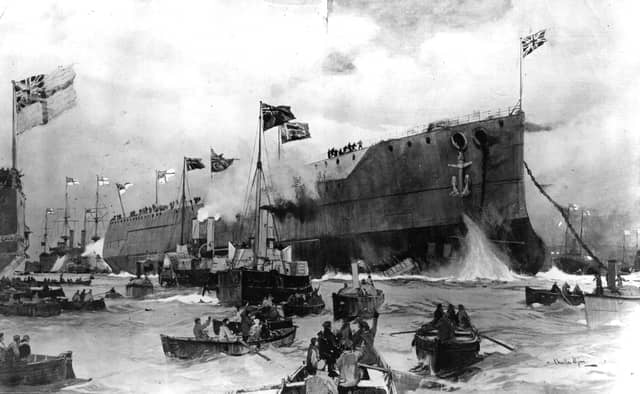


Many of these vessels have played vital roles in both world wars and The Falklands War. One of these ships introduced a new standard in firepower and propulsion that redefined naval design globally.
Another, completed after the Second World War, marked the end of Britain’s battleship era. Though never used in combat, it represented the final stage of capital ship development before the rise of missile systems and air power rendered the type obsolete.
Aircraft carriers developed in parallel with these changes. Purpose-built designs introduced in the interwar period supported fixed-wing operations in the Atlantic and Mediterranean during the Second World War. These ships launched air strikes, escorted convoys, and played roles in major engagements. Later examples were converted to operate helicopters and V/STOL jets, extending operational reach in the nuclear age. One carrier served as the Royal Navy’s flagship during a conflict in the South Atlantic, coordinating air operations over 8,000 miles from home.
Cruisers and destroyers carried out a wide range of tasks. Some were involved in early engagements of the Second World War, including a well-known South Atlantic battle that resulted in the scuttling of a German commerce raider. Others operated in the Arctic and Far East, escorting convoys and engaging enemy forces under frequent attack. One destroyer gained recognition for rescuing British prisoners held aboard a German supply ship in Norwegian waters.
Many of these ships were lost in action or scrapped in the post-war years. A few were preserved as museum vessels, offering a public record of Britain’s naval heritage.
Together, these warships reflect the evolution of British maritime strategy over the century — from imperial patrols and fleet actions to Cold War deterrence and limited regional conflicts. Their construction, deployment and service history chart the decline of battleship dominance, the rise of naval aviation, and the continuing demand for flexible surface combatants in a changing geopolitical landscape.
We asked ChatGPT for the most powerful Royal Navy warships of the 21st century, and this is what it came up with.
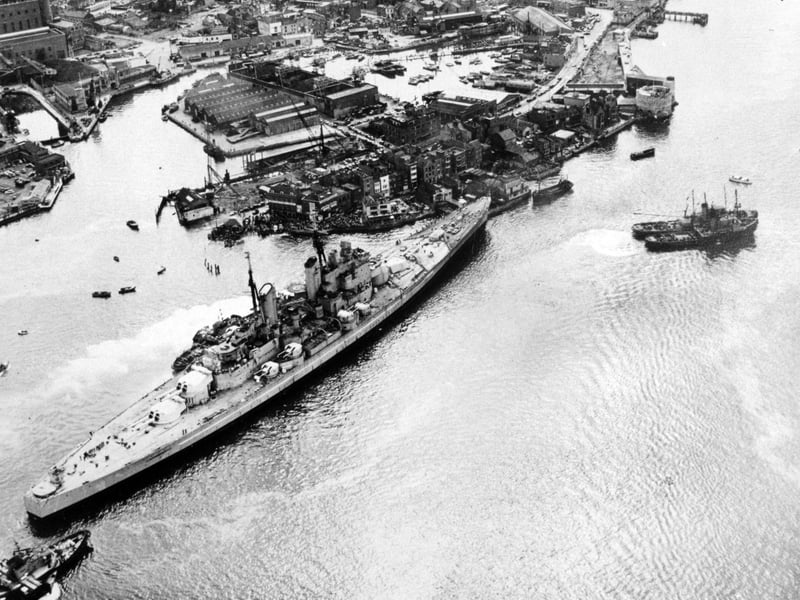
5. HMS Vanguard
The last and largest battleship ever built for the Royal Navy, HMS Vanguard was completed after WWII and never saw combat. Designed to mount 15-inch guns from earlier ships, she combined traditional firepower with modern systems. Serving as flagship during royal tours and fleet duties, she represented the end of the battleship era. Despite being the most advanced British battleship, she was decommissioned in 1960, and her scrapping in 1962 closed a significant chapter in naval history. | The News Portsmouth
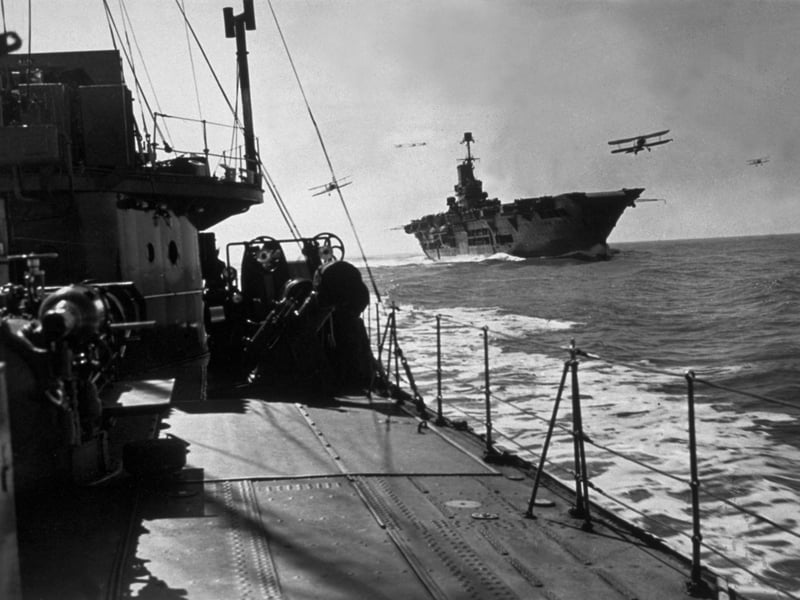
6. HMS Ark Royal
Launched in 1938, the fourth Ark Royal was a modern aircraft carrier at the outbreak of WWII. She played a key role in operations against Bismarck, whose rudder was crippled by her Swordfish aircraft. Operating extensively in the Atlantic and Mediterranean, she was torpedoed by U-81 in November 1941. Despite efforts to save her, HMS Ark Royal capsized and sank, though most of her crew survived. Her loss was a blow to British naval air power during the war. | Keystone/Getty Images
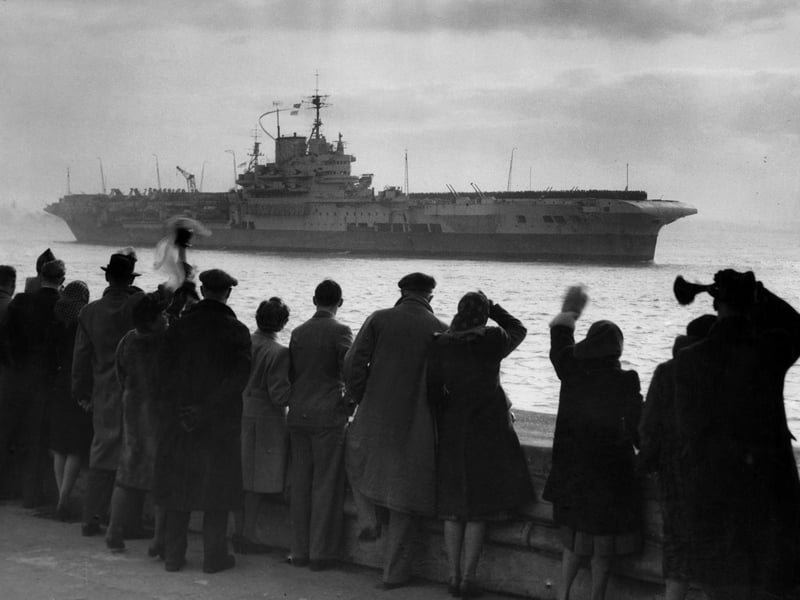
7. HMS Formidable
Commissioned in 1940, HMS Formidable was an Illustrious-class fleet carrier designed with an armoured flight deck for better protection. She saw service in the Mediterranean, striking at the Italian fleet and supporting operations in North Africa. Later deployed in the Indian Ocean and Pacific, she withstood kamikaze attacks at Okinawa, suffering only minor damage. Her service spanned multiple theatres, showcasing the versatility of British carriers. She was decommissioned in 1953 and scrapped shortly after. Pictured: HMS Formidable returning to Portsmouth. | Central Press/Hulton Archive/Getty Images
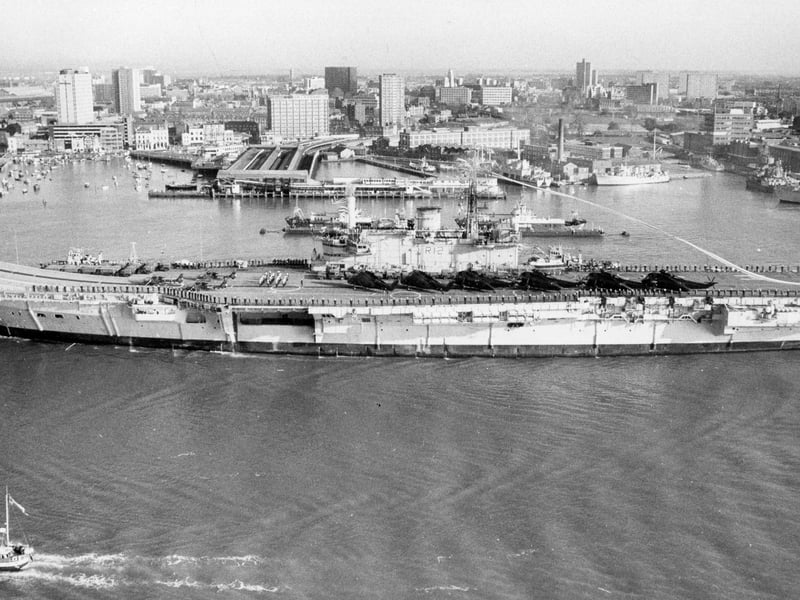
8. HMS Hermes
Commissioned in 1959, HMS Hermes was a light fleet carrier that underwent multiple modifications throughout her career. Originally built for conventional aircraft, she was later converted to operate helicopters and V/STOL jets. She famously served as the Royal Navy's flagship during the Falklands War in 1982, launching Sea Harriers and helicopters in support of the land campaign. After the conflict, Hermes was sold to India, where she served for decades as INS Viraat until decommissioning in 2017. | The News Portsmouth