
Portsmouth100: How Portsmouth Guildhall was reborn after being destroyed in the Blitz - and the part it plays in today's city
In the second in a series of pieces of Portsmouth history, to mark the city’s centenary, historian Leo John Davies looks at Portsmouth Guildhall
An LJD Histories Article celebrating Portsmouth100
“We can’t allow buildings as vital to a community as the Guildhall to diminish in time” - Andy Grays, CEO of The Guildhall Trust, speaking to LJD Histories (2026)


What happens when the very symbol of who we are is reduced to ash? Where people once stood in awe, gazing at what their city and its citizens had carved into stone, there was now only rubble, smoke, and despair.
What had been a monument to the aspiration and civic pride of Portsmouth became a charred shell, swallowed by flames and its future uncertain…
As we saw in the story of Canoe Lake, Portsmouth has never been a city content with standing still. In the nineteenth century, Portsea Island underwent rapid transformation.
Dockyards expanded, quayside districts engulfed neighbouring areas, and ambitious public infrastructure projects reshaped the skyline.
With this newfound status was the need for even greater aspiration. It was not enough to merely spread out, Portsmouth wanted to build upward, to build boldly, to build grandly.
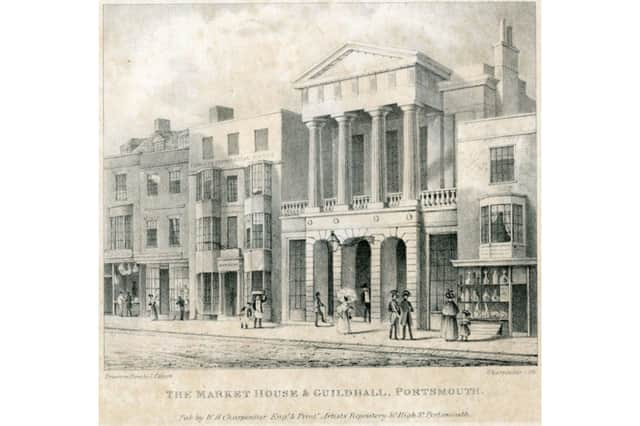
Up until this point, the civic heart of the town had been the Market House. A striking structure with four tall columns and a proud gable, standing confidently among the tightly packed shops and stalls of the High Street.
Opened on the day of Queen Victoria’s coronation in 1838, it had served well as an impressive town hall for a growing community. But by the closing decades of the nineteenth century, it no longer matched the pace of change around it. As this seaside settlement surged forward, the Market House felt rooted in a previous chapter.
Portsmouth needed something that reflected its scale, its energy, and its unstoppable momentum. It needed more.
The result? In 1890, the new Town Hall was opened by the Prince and Princess of Wales.
It was a multi-purpose civic building in the heart of the town, close to the main Portsmouth & Southsea railway station. Every decision in its design is revealing, even where it stands.
What we now know as Guildhall Square was once the residence site of the Commanding Officer of Artillery. It was purchased as part of an Act of Parliament with the sole intention of building the Town Hall.
When crowds gathered on opening day, it may have been the first time in many of their lives that they stepped foot on this part of the island.
This marked a new chapter in Portsmouth’s development. It was no longer only about strength, but civility and culture. Carved into the stone was also the story of Portsmouth’s prosperity.
The grand façade features Corinthian columns, a sculpted pediment depicting “Britannia receiving the trades of the world,” and an impressive clocktower.
This made the old Market House look humble in comparison and the grandeur revealed something deeper.
Portsmouth’s rapid expansion was inseparable from its role as the birthplace of the Royal Navy and its growth was fuelled by imperial trade networks and exploited wealth extracted across the British Empire. Before you even step inside the Town Hall, the architecture makes that connection unmistakable. A visual reminder of maritime power and global authority in what would have been Portsmouth’s most iconic structure at the time.

Magnificence. Splendour. Opulence. The building became a beloved centre of the town.
In 1926, when Portsmouth was granted city status, a century ago this year, it was renamed what we now know today… Guildhall.
However, during the Second World War, the ideals of the nineteenth and early twentieth century had to be put on hold as Britain stood against tyranny.
The Guildhall continued to stand proudly throughout this time, still embodying Portsmouth’s chapter of development. Until one winter day, when the cold city streets turned hot with flames.
London, Liverpool, Coventry, Hull. The Blitz reduced many of Britain’s biggest cities to rubble.
Portsmouth was no outlier. In January 1941, incendiary bombing struck the Guildhall. Its main body collapsed, its glass shattered across the surrounding streets. The heart of Portsmouth had been broken.

Yet the people of the city did not allow it to stop beating… Like an onlooker from a forgotten age, the hollowed-out Guildhall stood for years as the city, and the country, slowly rebuilt around it.
However, rather than choose to tear down what survived, as had been the case with many other ruined Victorian buildings in Portsmouth, the decision was made to rebuild.
It would not be until 1959, some 18 years after the bombing, that the Guildhall was finally restored. A child born when the city was at war would have reached adulthood before its restoration was even complete.
Much of the surviving exterior wall was salvaged. Rather than replicating an older age, efforts were made to modernise the interior of the Guildhall, representing a new chapter in Portsmouth’s journey.
The great hall was redesigned, transforming it into one of the most significant performance venues on the south coast. The interior reflected post-war modernity, yet it still carried echoes of Victorian ambition. The rebuilt Guildhall did more than replace what had been lost.
Out of the ashes, the city’s pride and culture scratched the heavens once again; now, with less focus on Portsmouth’s imperial role, but making space for the arts, education, and community.
“[It’s] a great space which is used for a wide variety community events. I think often the people of Portsmouth forget that it’s OUR Guildhall! It’s place for us to use and celebrate.” - Terence Carvalho, Portsmouth Ambassador, speaking to LJD Histories (2026)

But the Guildhall has also been at the heart of Portsmouth’s efforts in times of crisis. In 2021, as the world was in lockdown during the Covid-19 pandemic, the space was transformed into a large-scale test centre.
“I’ll never forget when Covid-19 hit and I was asked to assist with management of the Covid test centre situated at the Guildhall from February 2021 till May 2021. It was extremely strange times and it was so strange to see a usually buzzing auditorium made into a medical centre!” - Terence Carvalho, speaking to LJD Histories (2026).

This new chapter of the Guildhall has shown that it is not just a space that enforces Portsmouth’s community spirit, through civic ideals and local politics. It is a space that helps the city express itself in times of crisis. But also in times of celebration…
Today, the Guildhall still beats life into Portsmouth’s city centre. Each winter, the façade, once designed to symbolise imperial might, now looks out over families gathered on the ice rink below. First dates, family outings, or friends having fun. All personal stories, not rooted in maritime dominance, but in laughter and shared moments.
Each summer, students from the University of Portsmouth throw their caps into the air outside its steps. A celebration of journeys completed.
Of people who came from across the world to study in this seaside city and, for a few formative years, call it home.
It also hosts a range of large-scale conferences, placing Portsmouth at the heart of important moments and decisions…
“Some fantastic memories for me as I’ve been involved with conferences, events like Shaping Portsmouth conference each year, award ceremonies and of course huge events like Comic Con! Also the outdoor concerts which take each summer are absolutely amazing…” - Terence Carvalho, Portsmouth Ambassador, speaking to LJD Histories (2026).
And where once there were flames and rubble, there are now fireworks and dancing. Each summer, the Guildhall Concerts wash the white stone in vibrant colour.
This is not just a building. It is a gathering point. A source of pride. A stage for joy.
It is a reason. A reason for the people of Portsmouth to be proud, to be happy, to be important. It embodies the city’s culture, using its historic structure as a platform, but beating through its loud, expressive communal moments.
“The Guildhall’s heritage is part of its DNA as a concert venue. Today the world is full of modern arenas, many I feel are characterless, preserving and improving the Guildhall allows us to give it a strong local voice.” - Andy Grays, CEO of The Guildhall Trust, speaking to LJD Histories (2026).

What are the Portsmouth100 celebrations?

This year marks the centenary of Portsmouth being granted city status.
As part of the Portsmouth100 celebrations, I will be publishing pieces exploring different chapters of the city’s long and layered history. This is a year-long collaboration with Portsmouth Ambassador Terence Carvalho, who will offer reflections and personal connections throughout every edition.
Special thank you to Andy Grays, CEO of The Guildhall Trust, and Kelly Haswell, Head of Marketing at The Guildhall Trust, for their contributions to this article.