
From bombed-out Guildhall to the open terraces of Fratton Park: Portsmouth man recalls memories of city over the last 70 years
Robert Rowe has seen the city change over the decades
A born-and-bred Portsmouth man has shared his story of growing up in the city.
Robert Rowe was born in St Mary’s Hospital, Milton in December 1947, and his lived in the area all of his life.
His childhood memories of the city are of a community trying to cope with the aftermath of World War Two.
“I vividly recall as a child seeing the bombed out Guildhall with hoardings all around,” he said. “I would stand with my parents at the bus stop at the bottom of the steps and be intrigued by the Lions high up on their plinths.”
He started Paulsgrove Secondary Modern School for Boys in 1959 and started exploring the city with his friends.
He said: “My teenage years revolved around music, if I wasn’t buying records in Weston Harts I would be at Hillside Youth Club on a Sunday night watching bands or at The Grove Club doing the same thing.


“At every opportunity I would go to The Guildhall, for a show. I first went to a pop concert as a thirteen-year-old. It was November in 1961. Billy Fury was the then high-profile star on stage along with Eden Kane and Karl Denver and this concert strengthened my love affair with live music.
“The Beatles were due to appear there in late 1963 and I bought tickets for me and my girlfriend. I can’t recall how much I paid around 7/6 each but the show was cancelled because Paul McCartney was ill and it was re-scheduled for November.
“We could not make the new date and I was asked if I would like to sell my tickets for a small profit and I did. I never did get to see the Beatles live!
“As for the other music venues it was Kimbell’s and later the Mecca which were our two main haunts, leaving The Birdcage and The Tricorn to others.”

Alongside his love for music, Mr Rowe also found a passion for football, supporting his hometown team.
He said: “I started going to Fratton Park in 1959 when I was 11 and Pompey has been a big part of my life since then. My two sons came along with me at a young age and then my grandson did the same and he is just as keen now as how I was at that age.
“After most games back in the 1960s my friends and I would walk to North End and along the way in Fratton Road was a Radio Rentals Shop and we would stand and look in the window seeing the football results come up on a TV screen. Now those scores are in our pockets.
“People will remember Sunday football and how popular it was in the 60s and 70s and Vectis Sports was my team from 1963 until 2002. After playing for twenty years I got into managing the club and the youngsters coming though, which I found the most enjoyable.”

After leaving school in 1964, Mr Rowe started on a career in construction. He married his wife of 58 years, Marilyn Rowe, in St Mary’s Church in 1968.
“I started work as Junior draughtsman back in 1965 carried all the way through working for building companies and retiring in 2014,” he said. “My working life revolved around commercial projects including pubs and many Portsmouth schools.”
However, beyond his career, Mr Rowe was always devoted to commemorating the history of the city and its people. A story he was told by his mother led him into fundraising for a plaque to commemorate lives lost in Portsmouth during World War Two.
He said: “On January the 10th, 1941, my mum and her friends Barbara and Pearl had been roller skating and were on their way home when an air raid started. Mum and Barbara decided to stand in a shop doorway while Pearl went on to the shelter.

“That shelter took a direct hit and Pearl died, along with her mother and another sister. I realised this was a twist of fate for me and I always wanted to have those who died remembered.
“So, in 2010 I raised a plaque in Arundel Street to remember those 80 or more people who perished in that Air Raid Shelter on that fateful night. I am very proud of that. The plaque can be seen on the wall of the petrol station forecourt kiosk.”
Mr Rowe also organised a tribute in memorial of those who died in the Falklands conflict in 1982, arranging a ceremony attended by Sam Salt, Captain of HMS Coventry, The Lord Mayor John Kitchen and families who had lost loved ones in the war.
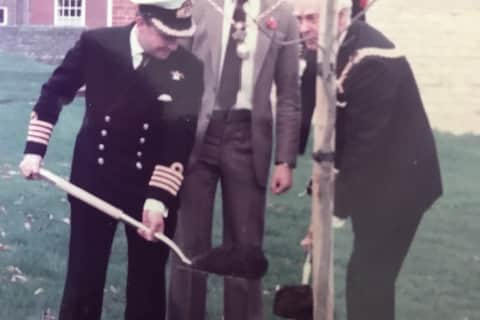
He said: “Members from the British Junior Chamber got together in the September of that year and worked on the tribute. The Chambers were Liverpool, Sheffield, Coventry, Plymouth, Southampton and Portsmouth. All these places lost something or someone during that April. May and June.
“Our memorial was positioned in the grounds of Portsmouth Anglican Cathedral and was the first in the city to commemorate those who lost their lives. It consisted of a granite base and a stainless steel inscribed plaque.
“I drove to Dartmoor with a trailer and collected two chunks of granite, one for Southampton and one for Portsmouth. It felt like I was for near on 4 hours pulling more than a ton of weight.

“I have always tried to support events in Portsmouth as the city does anniversaries, parades and commemorations better than anyone and Southsea Common lends itself to those types of occasions.”
Mr Rowe has seen the city change massively over the years. “I think it was better without the University,” he said. “It was slow to recover after the war, and the building of so many high-rise blocks of flats was a mistake.
“People complain about our Island City and there are things to complain about and it has changed beyond all recognition since I was growing up, but Portsmouth and the surrounding areas are where I have always lived and I would not want to move anywhere else.”