
As Suella Braverman vows to abolish the Equality Act after joining Reform, what is it and when was it brought in?

Suella Braverman MP has vowed to abolish the Equality Act - if Reform comes to power.
The Fareham and Waterlooville MP has been unveiled as Reform UK’s new shadow education and skills secretary by party leader Nigel Farage.
Braverman, who defected from the Conservative Party last month, has also been named as Reform’s spokeswoman for equalities - and has immediately laid out her plans for the role.
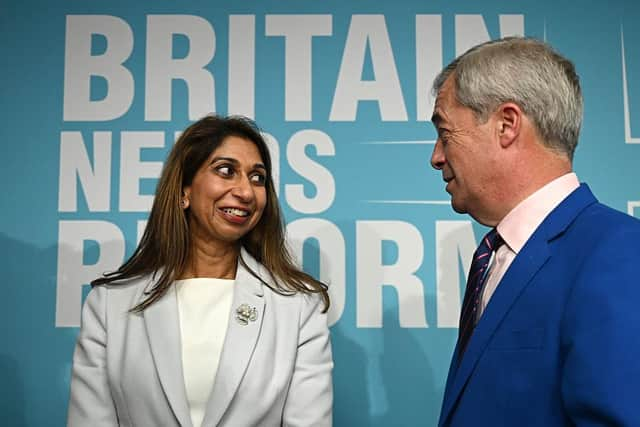

Should Reform end up leading the government at the next general election, she wants to abolish the Equality Act.
Speaking at an event in London, Braverman said: “Well, on day one, we will get rid of the equalities department, we will scrap the equalities minister - yes, I'm doing myself out of a job. We will repeal the Equality Act.
“Because we are going to work to build a country defined by meritocracy not tokenism, personal responsibility not victimhood, excellence not mediocrity, and unity not division.
“The Britain that I love is being ripped apart by diversity, equality and inclusion (DEI); the truth is, that DEI has become less about diversity and more about conforming to left-wing ideology. Less about equality and more about prejudice against white people. Less about inclusion and more about exclusion of those who dare to challenge the dogma.”
Prior to joining Reform, the Fareham and Waterlooville MP held many high-profile roles in the old Conservative government, including serving as attorney general and being appointed home secretary during Liz Truss’ ill-fated tenure as Prime Minister.
Her plans to abolish the Equality Act has drawn fierce criticism from those who represent minority groups, from charities and organisations alike.
Responding to Braverman’s proposals, Alba Kapoor from Amnesty International said: “The Equality Act is vital – it is not a slogan or a culture-war talking point. It is the legal guarantee that you cannot be sacked for being pregnant, refused housing because of your race, or harassed at work because you are disabled or gay. That is not ideology. That is basic fairness.
“Cutting it would not simplify the law - it would strip away protections people rely on in their workplaces, schools and communities, making discrimination easier and accountability harder.
“This law was built over decades by people who experienced discrimination first-hand. Repealing it would not solve the country’s problems. It threatens the rights of millions.”
When was the Equality Act brought in?
The Equality Act was enacted in April 2010, as one of the final acts of the Labour Party before the Conservative-Liberal Democrat coalition took power, spearheaded by David Cameron.
The idea for this act was drawn up as far back as 2005, in Labour’s election manifesto. A discrimination law review was established to develop the legislation.
What is the Equality Act?
The Equality Act was brought in to protect UK citizens from discrimination and harassment, both in the workplace and out in public. It consolidated all previous discrimination laws into one single piece of legislation.
The Act covers nine characteristics for which people can be discriminated for. These are age; disability; gender reassignment; marriage or civil partnerships; pregnancy; race; religion or beliefs; sex; and sexual orientation.
Under the Equality Act, people are also protected if they are discriminated against for being affiliated with a protected person - such as being the parent of a disabled child.