
'Big bad Royal Navy' insulted by US defence secretary - Trump associate urges Strait of Hormuz Iran action

The US defence secretary has taken aim at the British Royal Navy as he calls for warships to act against Iranian blockades.
Pete Hegseth has become the latest American politician to take aim at UK forces. He rounded on the Royal Navy for failing to send warships to reopen on the Strait of Hormuz - a strategic waterway currently being blockaded by Iran.
A statement from President Donald Trump on his much-maligned Truth social platform, which said countries that “refused to get involved in the decapitation of Iran” should “build up some delayed courage, go to the strait and just take it”.

“You’ll have to start learning how to fight for yourself, the USA won’t be there to help you anymore, just like you weren’t there for us. Iran has been, essentially, decimated. The hard part is done. Go get your own oil!”
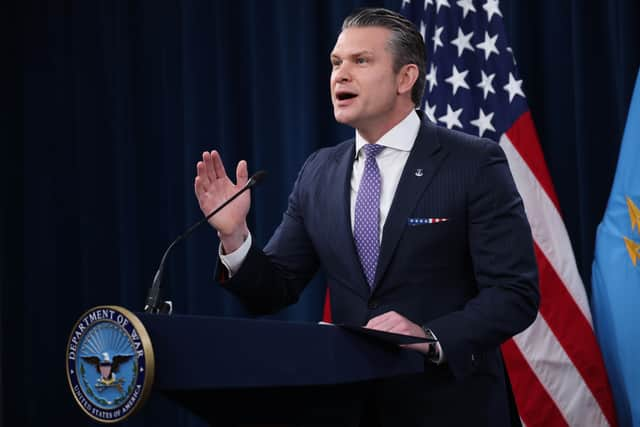
Speaking at a Pentagon news conference, he said: “I think the president was clear this morning in his Truth (Social post) that there are countries around the world who ought to be prepared to step up on this critical waterway as well. It’s not just the United States navy. Last time I checked, there was supposed to be a big, bad Royal Navy that could be prepared to do things like that as well.
“He’s pointing out, this is an international waterway that we use less than most. In fact, dramatically less than most. So the world ought to pay attention to be prepared to stand up. President Trump has been willing to do the heavy lifting on behalf of the free world to address this threat of Iran. It’s not just our problem set going forward, even though we have done lion’s share of preparation to ensure that strait will will be open.”
The conflict in Iran began after a US-Israeli coalition battered the country with airstrikes on February 28. Supreme leader Ayatollah Ali Hosseini Khamenei was killed, later replaced by his son, Mojtaba Khamenei.

Retaliatory strikes from Tehran have targeted infrastructure sites belonging to Gulf states - including oil refineries - allied military establishments, and civilian buildings. The US has consistently changed its aims for the war, ranging from regime change to eradicating Iran’s military capability. The country’s proxy Houthi rebels in Yemen have joined the conflict and are targeting Israel with a barrage of ballistic missiles.
The UK has sent various RAF aircraft to the Middle East to patrol allied airspace, shooting down drones and missiles. A total of 14 targeting the allied base of Erbil were destroyed in a single day.
The Royal Navy has deployed HMS Dragon to the eastern Mediterranean, after RAF Akrotiri was struck by a drone from a pro-Iranian militia in Iraq or western Lebanon. RFA Lyme Bay has been renovated to become a mine-hunting “mothership”, and other autonomous systems are in the Gulf, but capabilities have yet to be deployed to the Strait of Hormuz. Around 20 per cent of the world’s oil passes through the region, with the UK susceptible to sky-rocketing oil prices.
The size of the Royal Navy and its readiness has been heavily criticised recently, including from Mr Trump who branded the aircraft carriers as “toys”. This followed previous insults against British soldiers who served in Afghanistan. Parliamentary under-secretary for defence, Al Carns, responded by saying HMS Prince of Wales and HMS Queen Elizabeth are “formidable capabilities”, with the country having some of the best sailors, pilots, marines, and soldiers who board them.
Mr Trump also previously said UK warships were not needed in the Middle East.