
"Thinly spread" Royal Navy to focus more on Europe despite "helpful" HMS Prince of Wales Indo-Pacific mission

Deployment of Royal Navy assets will be focused on areas closer to home amid concerns they are too “thinly spread”.
General Sir Richard Barrons, one of the main figures of the Strategic Defence Review (SDR), said permanent forces should now turn their attention to Europe. He was one of three SDR reviewers taking questions during a Defence Select Committee meeting on Wednesday (June 11).

Derek Twigg, Labour MP for Widnes and Halewood, asked for clarification about armed forces deployments. He said: “I’m hoping one of the questions you would answer is whether the armed forces are thinly spread, and whether they should be more focused. What is it that the review is recommending that UK Defence stops doing if it’s spread too thin?”
General Barrons said: ”The review is very clear on resolving this and that is under the umbrella of Nato first. We look very carefully at what Nato asks the UK to do in making its contribution to the alliance. That includes improving the resilience of the homeland. The Royal Navy is going to focus on the Atlantic Bastion, Greenland, Iceland, and UK gap.”
What is the Atlantic Bastion and how will it impact the Royal Navy?
The SDR states the Atlantic Bastion is the Royal Navy’s plan to secure the North Atlantic for the UK and NATO against the persistent and growing underwater threat from a modernising Russian submarine force. Anti submarine warfare capabilities - particularly coming from the Type 26 City-class frigates being built - are expected to be the backbone of this.
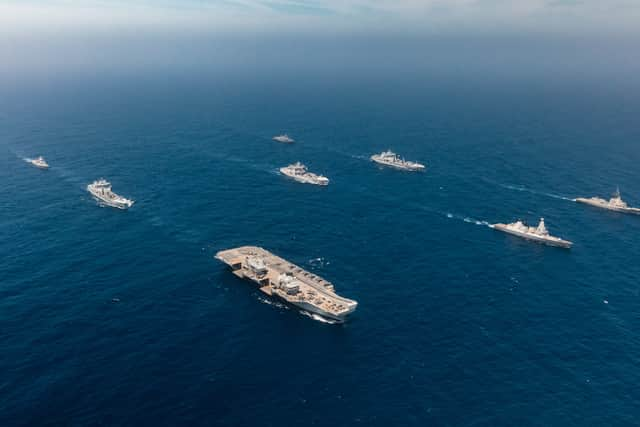
Autonomous surface and underwater vessels will be an accompaniment. The review said the UK must still pursue its “significant interests”, the Indo-Pacific being one of them. HMS Prince of Wales is currently leading the UK Carrier Strike Group on Operation Highmast, where various military exercises and diplomatic visits will be carried out in Japan, Australia and elsewhere.

It has been mentioned that deployments like this counteract the sphere of influence of China, with prime minister Sir Keir Starmer previously calling for more patrols in the region. HMS Tamar and Spey - both River-class offshore patrol vessels - have been permanently station there over the past few years, acting in an ambassadorial role for UK allies.
Mr Twigg asked if the Royal Navy will be doing less in the Indo-Pacific. General Barrons said: “We have very clearly said the job of the British armed forces is to play a prominent role in Nato deterrence, which is an everyday activity.

“If you commit to that, and say deterrence is a 24/7 activity, you are not going to regularly station force elements - ships, tanks, aircraft - in the Indo-Pacific. However, the UK has important global interests. In conversation with the officer who runs Indo-Pacific command for the US, he said it doesn’t really help to have UK forces permanently stationed in the Indo-Pacific region, because he has a lot of stuff.
“It’s really helpful, if as we’re seeing now, the carrier group makes a sortie there every four years. It sends a really important signal to opponents and friends. He welcomes that as part of his strategic communications campaign. We’re going to serve our global interest with far fewer permanent positioning of force elements, and a much greater reliance on diplomacy, technology and training.”
Mr Twigg said: “What you’re saying is our focus should be on Europe and not trying to do lots of things in different parts of the world?” General Barrons replied: “In terms of what we do with our forces, absolutely.”