
"Vulnerable" Royal Navy deployments "crippled" as Portsmouth dockyard workers face "significant redundancies"

“Significant redundancies” are set to cripple the Royal Navy’s ability to deploy warships from Portsmouth, it has been claimed.
The Prospect Union said the force will be left “vulnerable” as dockyard workers at multiple ports face losing their jobs. But Government officials believe effective operations can still take place after a new £850m contract package was agreed with Serco Maritime, with the new agreement kicking in on October 1.
Nathan Morrison, Prospect’s negotiations officer, said the deal is not a win for staff who carry out vital tasks so the force can function. He told The News: “This contract will lead to significant redundancies and it will directly impact upon the Royal Navy’s ability to carry out essential work.


“The MoD just hasn’t listened. They have set an arbitrary price for what they’re willing to pay, and the whole contract has come from the price rather than the needs of the Navy.”
Three contracts have been signed which are worth over £1bn combined. The largest is an £850m ten-year-deal for “in-port services” at HMNB Portsmouth, HMNB Devonport in Plymouth, and HMNB Faslane in Scotland. Essential activities cover the towing of warships out of the harbour, bunkering and watering, tank cleaning, passenger services, trials work, munitions and nuclear safety drills.
Twenty four new vessels over the next decade will be procured to replace older ships. Negotiations have rumbled on for months, with dockyard workers voting to strike after being frozen out of the discussions. Workers gathered outside Trafalgar Gate on February 3 to voice their frustrations, with planned shipping movements disrupted as a result.
As previously reported in The News, the government were seeking a reduction of £250m for a contract valued at £1.2bn. Two other deals have been signed; the first being a £70m five-year agreement for inshore support for military training at an underwater testing facility in Scotland; the second a £110m ten-year contract covering offshore support to military training and exercises by providing two specialist ocean-going ships. The maritime services deal has been split into four. Serco decided not to bid for work at other Scottish facilities other than Faslane.

Mr Morrison said the maritime services deals at each port was broken up to “break the power of the trade unions”. The News understands that some redundancies consultations took place earlier this year.
The negotiations officer said the contract means towing services will only take place between 7am and 7pm from Monday to Friday from October 1, with no work possible outside those hours and on weekends.
“They will only be able to do one move at Portsmouth Harbour at a time,” Mr Morrison said. “If one ship is in dock, and another needs to come in and be refuelled, they would tug both vessels out and create space. Now they wouldn’t be able to do that. They need to leave a ship loose.”
The trade unionist added that this will disrupt major deployments. A recent example, where HMS Dauntless was towed out of Portsmouth a few hours after HMS Prince of Wales left for Operation Highmast would not be possible under the new deal, he said. “They’d have to stagger it and wouldn’t be able to do anything on a Friday,” he said.

The Ministry of Defence disputes this claim and said services will remain operational 24 hours a day for 365 days a year from October 1 for the most operationally important tasks. This includes aircraft carrier deployments, the nuclear deterrent, and supporting services to make sure ships and submarines are at high readiness.
Mr Morrison said: “Our members are unhappy and disappointed, but they’re resigned. The fault here is with the MoD. They’ve restored some jobs, but the fundamental problems of the contract will mean that it is inoperable for the military needs that we have. We’re losing significant military capability. At Faslane, a 7am-7pm Monday to Friday nuclear deterrent isn’t very useful is it?”
Prime minister Sir Keir Starmer has already pledged to raise defence spending to 2.5 per cent of GDP by 2027, with chancellor Rachel Reeves aiming for the UK to become a “defence industrial superpower”. Plans are in place to upgrade Portsmouth Naval Base’s infrastructure, and implement a defence industrial strategy to support British businesses and grow the economy.
Mr Morrison said the decision was made as a “bean counting” exercise because “it’s all about saving money”, and the Royal Navy’s “ability to deploy out of port” is “crippled”. “They’re under self-imposed financial pressure and they’re cutting their hands off,” he added. “It’s completely inconsistent with what the government's stated aims are.
“If they keep the existing crew numbers and assets, they’ll be fine. They’ll need to expand the service if they want to expand the Navy. The resourcing they have given is the resourcing of downsizing the Navy rather than extending it, or maintaining what we’ve got.”

The negotiations officer said following a union meeting with Serco yesterday (May 19), it’s expected that roughly 45 frontline workers across the ports will lose their jobs.
“The MoD will realise they will not be able to run a service, and it will probably reemploy people within months of these redundancies in October,” Mr Morrison added. “They’ll spend a lot of money on redundancies, then have to employ people again to do the job. It leaves the Royal Navy vulnerable if they want to continue their existing size. They cannot expand. It leaves their current provision vulnerable at a knife-edge.”
In a Serco press release statement, chief executive Anthony Kirby said: “We are proud to have been awarded these three contracts and to have the privilege of continuing to provide critical operational services to the Royal Navy. These awards further strengthen our position in the defence market, where we provide deep expertise around the world.
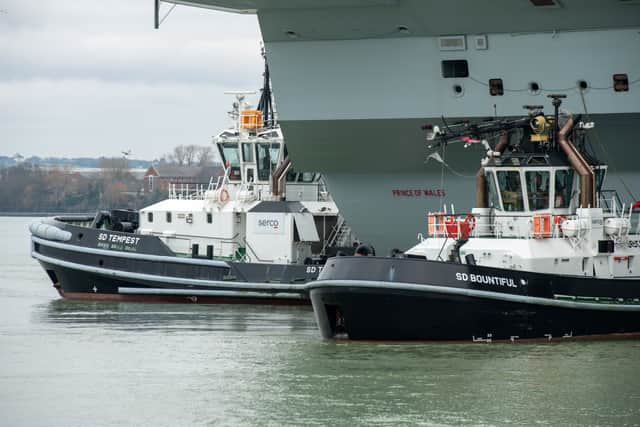
"We have been performing these duties to an extremely high standard for the last 28 years and we now have the opportunity to modernise the fleet of support vessels to ensure that the Navy has the support it requires, day in, day out, to enable it to keep our waters safe."
The firm declined to expand on the statement. A reduction in the size of the company’s workforce is expected, with discussions organised with the trade unions to agree on the size of the workforce and how they will operate. The number of redundancies has not been confirmed. Changes in roster patterns are expected all operational requirements will be met, they said.
The MoD said the contractor determines the number of personnel required to deliver the services set out in the contract. A spokesperson said: “The contracts awarded ensure our naval bases at Devonport, Portsmouth and Faslane have the modern maritime support services they need to maintain the Royal Navy’s effectiveness, while delivering value for taxpayers.”