
Royal Navy to protect 'where our prosperity flows' as warships can patrol Irish seas to deter Russia

The Royal Navy will be turning its attention closer to home in a bid to protect undersea cables from Russia.
Warship patrols could be taking place in Irish waters with an increasing trend of unwater infrastructure coming under threat. Political leaders and senior representatives from the Royal Navy and Irish Naval Service discussed the issue at the UK and Ireland Maritime Security Conference.
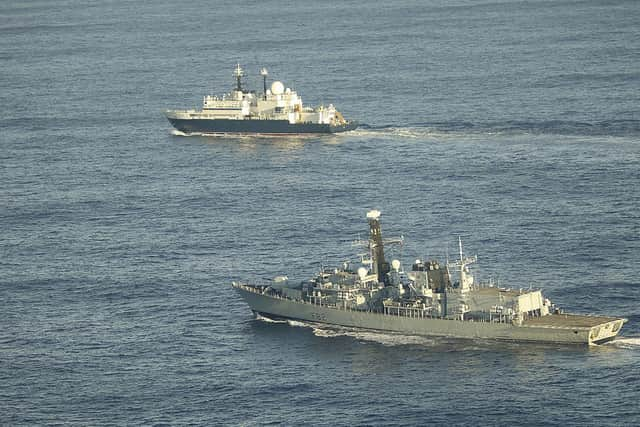

Ireland will be allowing the Royal Navy to patrol its waters in a bid to deepen naval co-operation with Britain and France. Rear Admiral Anthony Rimington, the Royal Navy’s Director Force Generation, said the maritime security environment is ”more congested and contested than at any time in my 35-year career”.
Speaking about the strategic value of undersea infrastructure, he added: “The waters that surround and connect these islands are not merely borders. They are arteries. They are connective tissue. They are the medium through which our prosperity flows.”
Rear Adm Rimington addressed threats in the North Atlantic, pointing to Russian activities mapping underwater cable networks. Warships and helicopters have previously been deployed to near hostile vessels such as the Moscow spy ship Yantar to safeguard British waters.
Deputy First Minister of Northern Ireland, Emma Little-Pengelly MLA, said: “The prosperity and security of Northern Ireland are interwoven with our closest neighbour." Dr Steve Aiken MLA warned that critical infrastructure such as gas pipelines and data centres is essential to daily life across the British Isles and Western Europe.
Activity has been spotted around Ireland in recent months. During the visit of Ukrainian president Volodymyr Zelensky in December, up to five military drones breached the Irish no-fly zone and flew towards his aircraft. This was suspected to be an act of Russian hybrid warfare. They later stalked an Irish naval vessel that was secretly stationed in the Irish Sea.
Turning Royal Navy to Ireland has not been universally well-receive. Retired Commander Tom Sharpe, who served in the Royal Navy for more than 25 years, said the Daily Telegraph that the Irish were “freeloaders”, as the country’s navy only contains eight lightly armed patrol boats that are “not really suitable for anything other than fisheries protection”.
He added that Britain does not have enough ships to look after itself properly. “It is a shared existential threat,” he said. “We in the United Kingdom do not have spare warships or aircraft to babysit a neighbour that refuses to arm itself. Russian submarines do not respect neutrality. If the cables and pipelines are severed, if tankers cannot deliver oil and gas, the Irish data centres and the rest of the country will go dark and cold.
“It is time Dublin stopped hiding behind outdated niceties and started defending its own waters – with sensors, ships, political will and cash. We are both islands dependent on the sea for our survival. Securing it should be core government business. The Russian threat demands it.”