
'Proud' Royal Navy destroyer HMS Duncan battles 'onslaught' of drones as guns open fire on targets

Ferocious weaponry aboard a Royal Navy destroyer was tested to its limits as sailors shot at targets off the coast of Wales.
Portsmouth-based warship HMS Duncan acted as the defender of critical national infrastructure as it staved off a wave of targets. The Royal Navy said she ‘battled an onslaught of drones, aircraft and missiles’, in an exercise dubbed as Sharpshooter. She tracked and neutralised five aerial targets, while sinking two Hammerhead surface vessels.
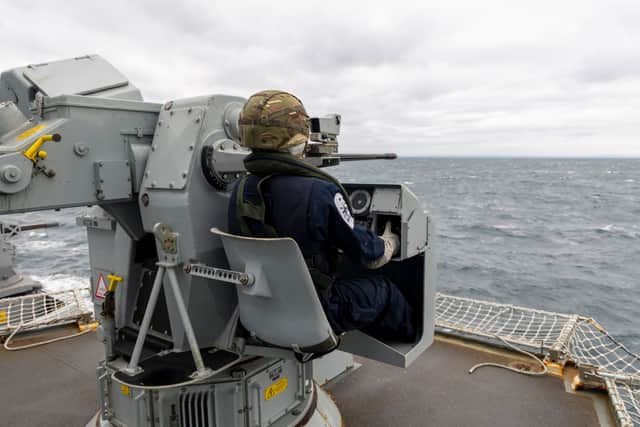

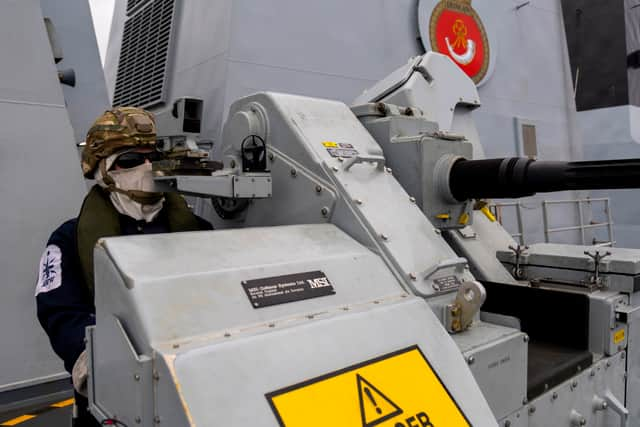
Commanding Officer Commander Dan Lee said: “Sharpshooter was an invaluable opportunity to test our systems and our people in a demanding environment. The ship’s company rose to every challenge, delivering successful layered‑defence engagements while simultaneously dealing with realistic damage‑control scenarios. I am immensely proud of how the team performed; their dedication ensures that HMS Duncan remains ready to fight and ready to protect.”
The Type 45 warship headed to the Aberporth Range in Cardigan Bay for 72 hours of intense drills, facing attacks from swarms of surface and aerial drones which could move up to 200mph. Ship’s company also dealt with virtual missiles, in preparation of defending against whatever is thrown at her. The training was designed to replicate the intense stresses and strains of real-life operations.
They were partially modelled on the conditions which HMS Diamond faced when she had to protect merchant shipping in the Red Sea, with civilians targeted by Iranian-backed Houthi rebels in Yemen. HMS Duncan and her attack helicopter from 815 Naval Air Squadron used their advanced weapons, radars and sensors to identify, track and neutralise the attacks. Personnel made full use of the Martlet air-to-air missiles, heavy machine guns, Phalanx Automated Gun, 30mm gun and the 4.5in naval gun.
HMS Duncan operated in defence watches, where she was maintained at high-readiness while responding to internal incidents which included firefighting and damage control. Sailors were tasked with fighting off the continued threats while dealing with other incidents around the clock, day and night.

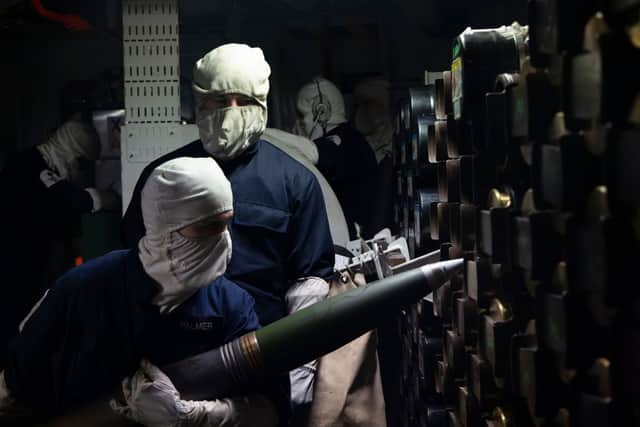
Able Rating Jaya Furnell (Above Water Tactical) said: “I don’t normally get to fire at live moving targets, so it was a brilliant experience. I focused, took the shot on my Heavy Machine Gun, and the un-crewed Aerial Vehicle went down in six rounds. It was exciting to claim the first kill of the exercise.”
The destroyer faced Hammerhead un-crewed Surface Vessels - that can travel up to 50mph on water - and QinetiQ’s Banshee Whirlwind aerial drone, capable of flying at over 200mph. Sailors also shot at simulated maritime vessels, aircraft and mock cruise and ballistic missiles, with the ship’s Sea Viper system being virtually fired.
Petty Officer James Ings, a maintainer of Duncan’s 4.5in gun, said: “It was a good week for the gun. We put more than 200 rounds down it and did some proper naval gunfire support as well. The 30mm medium calibre gun threw up a few faults, but that’s engineering – you figure it out and you get it working again. Each time we fixed it, it was back up for the next shoot. That’s the job, and it was good to see it doing what it’s meant to do.”
Will Blamey Chief Executive, UK Defence, QinetiQ, added: “We are proud to deliver dynamic, real-life scenarios that best-prepare our armed forces for the complex warfare challenges of today and tomorrow. Our combination of live and synthetic threats mean we can evolve training scenarios to ensure we are providing the very latest in threat representation, helping our warfighters to achieve mission-readiness at pace.”