
'Angry' RFA sailor told to put children 'into care' as 'outrageous' maternity policies force her to quit

“Shocking” suggestions made to a Royal Fleet Auxiliary sailor to put her children “into care” so she could go back to sea forced her to quit.
The experienced female seafarer, who asked to remain anonymous, became disillusioned with the force she loved after starting a family. Restrictive maternity policies, described as “horrific” by naval support service women who spoke to The News, are causing many to choose between their loved ones and career.
The sailor, whose partner works in the Royal Navy and often on deployment, said she was given limited options when her shore post came to an end. She added that one “bizarre” suggestion was to seek alternative childcare, which involved “hiring a live-in nanny” or asking if family members could look after them.
“I didn’t have children for someone else to raise them,” she told The News. “Then I was told that I could put them into care, which was absolutely shocking. That was the final nail in the coffin. I don’t want to work for an organisation which considers that a viable option.
“It was absolutely outrageous. It should never have been suggested. The only viable option was to quit.”


High-fiving on the gangway
The Royal Fleet Auxiliary’s (RFA) maternity policies have been a stumbling block for many women wishing to have a family. Female personnel who previously spoke to The News said finding alternative childcare and going back to sea is one of the three most common options given to them if an appropriate shore post cannot be found, or if someone is coming to the end of a land-based assignment.
Other options are to take special unpaid leave and forfeit their salary until such a time they can go back to sea - being separated from their partner - or to quit entirely. “We’d essentially be high-fiving when he returned and we wouldn’t see each other,” the sailor said.
“Taking unpaid leave wasn’t sustainable. You start to experience skill fade, and couldn’t train in that time. It would be a stop-start career which would put strain on my relationship. We would never see each other. The other option was to quit, which I found odd as it was presented as an option.”
A Royal Navy spokesperson said the RFA offers a wide range of maternity support.
“I’m not ill, I’m just pregnant”
The sailor said she enjoyed being part of the force in her 20s despite experiencing some male harassment, as it was exciting and she got to travel the world. Problems arose as her focus switched towards having children.
She said part of her knew she wouldn’t be able to go back to sea for childcare reasons, though this might not be the case for everyone. Her hope was to explore shoreside civil service opportunities and thought the RFA could navigate her through that. She told management she wanted to go back to work following maternity leave.
After being unassigned from her ship, she said she was met with “radio silence”. “I was ignored and left for nine months,” she added. “I called them as it seemed crazy to me. I’m not ill or have been medically downgraded, I’m just pregnant. I can still work and be useful.”
The sailor said she secured an office role in navy command for a few months, but “had to fight” for it. “Normally people just stay on continuous pay at home and have their child,” she added. “I felt ignored, undervalued, neglected, and in the dark about what happens next.

“No one contacts you. Your appointer always changes and usually, you wouldn’t hear from anyone. One person I knew just left because she thought there was no place for her in the RFA after having a baby. She felt so abandoned she didn’t want to come back.”
The sailor told management she didn’t want to go back to sea immediately and be away from her child, but was open to it in the future She said a female career manager immediately told her “don’t worry, if you don’t want to come back, it’s fine”. “I felt like they didn’t want me”, she added, “I had every intention of coming back.”
After a while, she was assigned to an enterprise engagement role under a Royal Navy captain in Portsmouth. She asked to renew her MoD ID card to access bases and other facilities, but despite sending off the paperwork four months ahead of time, nothing was done.
The seafarer added that she was told the documents were left on the desk and not dealt with, because “it was assumed I wouldn’t come back”. She was also unpaid for the first month due to an admin error, later receiving her wages as backpay.
“I was flagged up as being on unpaid maternity leave,” she added. “It was hugely stressful, navigating that with a baby in nursery and in a new work role. It was difficult.”
The sailor fell pregnant with a second child and stayed in the Portsmouth role until maternity leave. At the time, the RFA had a policy where the primary care giver would be allocated shore assignments for up to two years, or until the child was three years old. This was later rescinded.
The seafarer moved to work in a Royal Navy strategic studies unit at Portsmouth Historic Dockyard. She knew the end of her two-year shore post was approaching, so asked her superiors about her options. Going back to sea was off the table at the time, as her husband was on deployment and childcare provisions couldn’t be organised.
Dual-serving parents in the Royal Navy have protections to make sure one of them can stay at home and look after their children. These measures aren’t in place if one partner works in the RFA.
“This was a challenge we were facing as a family,” she added. “We were deciding whether it was me or him to step down. With him being from a naval background and having a passion for it, it was me.”
The current state of the RFA
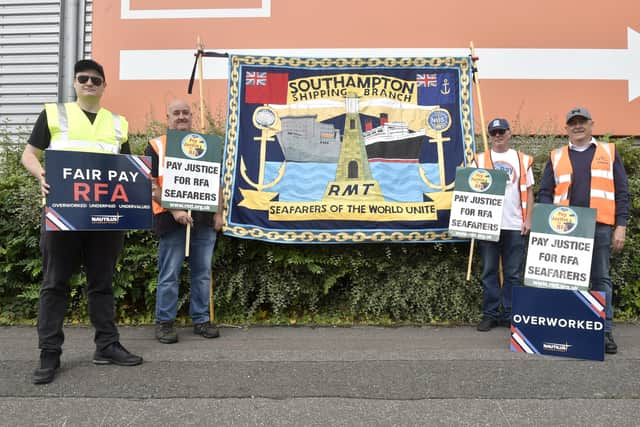
Retention is proving to be a major issue within the RFA. According to Ministry of Defence data, staff levels have fallen from 1,921 in January 2018 to 1,664 in October 2025, though voluntary outflow has halved since 2023. Maternity policies are one of the causes for this decline. RMT and Nautilus International union members voted to strike this week for better pay and conditions, with claims that salaries don’t meet the minimum wage threshold.
One commercial sailor with ten years’ maritime experience, told The News she thought about joining the RFA but found out she was pregnant. The prospective employee asked about maternity policies and was told by a recruiter there was no longer an option to go into a shore post after returning from maternity leave.
“I was told ‘we're a seagoing organisation, so you’re expected to go straight back to sea’,” she said. “It didn't sit well with me. You're leaving a baby who potentially still needs to be breastfed for a four-month trip.
“I decided not to join which is such a shame. Other companies have much better terms and conditions, it's not even comparable. The RFA seems to be in this place where you’re not a civil servant and not serving, but you get none of the benefits of either organisation.”
First Sea Lord General Sir Gwyn Jenkins said the matter of maternity policies has his ”full attention”, adding that he’s committed to a naval service that balances professional and family life. This comes after claims from sailors and the Nautilus International union were made about some seafarers “have abortions” to retaining their seafaring career.
This was never presented as an option by management staff, with some women taking the decision on their own. Nautilus’s director of organising Martyn Gray said he has heard ”first-hand and second-hand accounts” of such instances. This has believed to have impacted at least two women.
A Royal Navy spokesperson previously said: “The historic maternity policy stated in the article was replaced by the current policy which is in line with legislation so we can ensure every seafarer feels they can build a fulfilling career with the RFA while being fully supported. The Royal Fleet Auxiliary offers a comprehensive range of support for parental, maternity, paternity, adoption, carers, and shared parental responsibilities. These provisions include enhanced leave entitlements and assistance tailored to their circumstances.”
The former RFA sailor is now in a new career three grades above her previous pay level. She said the force tried to claim her career transition as a success, despite them encouraging her to leave, which made her “angry”. The mum-of-two dismissed claims that comprehensive support is offered to women.
She said: “Show me these support measures that are in place. They can say that as much as they want, but it’s absolute utter nonsense. I would like to see what they’re referring to, and examples of where it has been used. As far as I’m concerned, it never existed when I was there.
“It was a horrible end to what was otherwise a mostly enjoyable career. The RFA is in decline and in a perilous state. At 21, I wasn’t thinking about having a family. I wanted to have my career, go to sea and see the world. It’s only when you consider it that you realise how little flexibility and support there is. Then it’s too late. I don’t want people to fall into the same trap.”
If you have experienced similar problems within the RFA and wish to share your story, you can contact us by calling Freddie Webb on 07801 195443, or by emailing [email protected]