
'Deepening crisis' within Royal Fleet Auxiliary forces sailors to strike after years of pay 'falling behind'

Disgruntled Royal Fleet Auxiliary sailors are going on strike with the force suffering a ‘deepening crisis’.
Civilian seafarers that play a vital role in supporting the Royal Navy on deployments are walking out for better pay and conditions. Members of the National Union of Rail, Maritime and Transport Workers (RMT) union voted overwhelmingly to take industrial action.
The organisation said management ”could not even demonstrate that it was complying with minimum wage legislation”. RMT general secretary Eddie Dempsey said it was a scandal that RFA could not even work out its own pay rates.
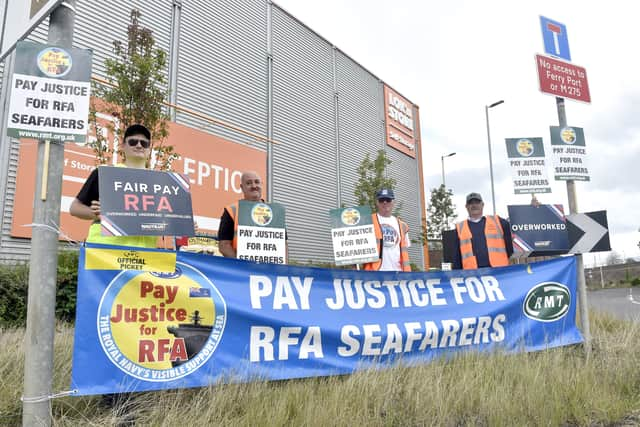

“Years of real terms falling behind in pay have left RFA seafarers worse off, and management still cannot show if all of our members are even being paid at least the minimum wage for the hours they are required to work,” he added.
“The absence of a transparent system for calculating pay, combined with excessive working hours, has created an unsustainable situation. RFA members are proud seafarers and this latest slap in the face will only add to a deepening crisis, it is time for the RFA and the Ministry of Defence to get around the table with this union.”
Out of a turnout of 61.43 per cent within the RMT, 96.5 per cent voted to strike, with 95.3 per cent voting for action short of a strike.
Why are the RFA sailors going on strike? It’s not just pay
Royal Fleet Auxiliary (RFA) sailors deploy on some of the Royal Navy’s largest deployments. During Operation Highmast in the Indo-Pacific, HMS Prince of Wales was joined by RFA Tideforce and Tidespring as part of her Carrier Strike Group. They replenish warships with vital supplies including fuel, food, water, mechanical components, engineering expertise and other supplies.
A 4.5 per cent pay increase offered by the Ministry of Defence (MoD) in January - evaluated by RMT and Nautilus International union members - was rejected after being described as “wholly inadequate and failing to address years of below-inflation offers, minimum wage concerns and a growing retention crisis across the service”. RMT members voted nine to one against the latest pay offer.
Personnel of varying ranks took to the streets in Portsmouth multiple times in 2024. In addition to the pay concerns, sailors spoke of rampant staff shortages, outdated equipment, broken ships, and employees being “harassed” into returning to work early to fill in gaps on operations.
An improved pay offer was accepted in January of 2025. Current minister of defence readiness and industry, Luke Pollard, said the agreement would spark vital reforms across the force and restore staff faith. Sailors who have spoken to The News said these promises of better pay and fairer conditions have failed to materialise.

Various controversies have clouded the force in recent months. The state of its ships has been called into question, with RFA Argus sitting alongside HMNB Portsmouth for several months after being declared unfit to sail.
Female seafarers reported issues with the force’s maternity policies, where they’re given three career options after having children: take special unpaid leave and forfeit their salary, go back to maritime assignments and be separated from their loved ones, or quit entirely.
Anonymous personnel told The News that some women decided to “have abortions” in order to keep their careers - claims backed by Nautilus International. First Sea Lord General Sir Gwyn Jenkins said the matter has his upmost attention and it will be looked into. A Royal Navy spokesperson added that a “comprehensive range of support” is offered.
Nautilus International confirmed its members are going on strike. After the ballot achieved a 56 per cent turnout, 88 per cent voted for strike action, and 95 per cent to take action short of a strike.
Director of organising Martyn Gray, said: “This was a huge ballot and a big success for RFA members. We balloted significantly more officers than ever before, and more people returned their ballot papers than in the last dispute. That level of engagement speaks volumes about the strength of feeling over pay and conditions across the RFA.
“When nearly nine in 10 members voting are prepared to take strike action, and 95 per cent are willing to take action short of strike, it sends an unmistakable message. RFA officers have been patient and constructive, but they are also clear that the current pay arrangements are no longer sustainable.”
The MoD has been approached for comment regarding industrial action.