
'Extremely important' DragonFire laser weapon to revolutionise Royal Navy Type 45 destroyers as tests continue

With the rise in drones warfare and using mass autonomous equipment, it’s hoped that DragonFire will make these warships more lethal
A lethal laser weapon that can zap targets from a mile away will soon be fitted to Royal Navy destroyers.
DragonFire is one of the latest pieces of technology due to be fitted to the Portsmouth-based Type 45 warships. Capable of hitting a £1 coin from a mile away, the weapon can target drones and other autonomous aircraft from a range of up to three miles.


Much of the testing has been undertaken at Portsdown Technology Park in North Hill, Portsmouth. James Anderson, senior campaign manager at QinetiQ, told The News: “If you look at the ability to take out swarms of drones, we’ve got to do something about the cost balance of war.
“I think lasers are a real opportunity. It’ll take time to build confidence in a system like that. We’ve been using missiles and guns for years.”
The recently published Defence Investment Plan allocated £490m towards Directed Energy Weapons, which includes fitting DragonFire to Type 45 warships from 2027. Theyr’e also expected to be used on the new Type 26 and 31 frigates. Assembled and tested by MBDA, Leonardo, and QinetiQ, the weapon will take a feed from the Sampson radar, which will be used to establish a target and open fire.
It uses a beam director and various field of view cameras to track targets and fire the beam. Extensive tests have already been undertaken during its development, which included shooting down drones and other small targets on the Ministry of Defence’s ranges in the Hebrides.
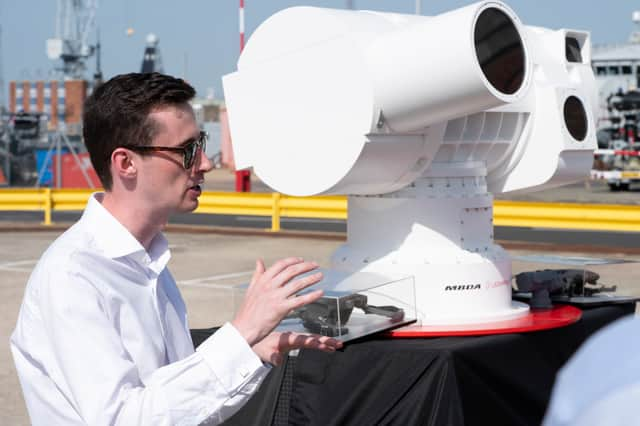
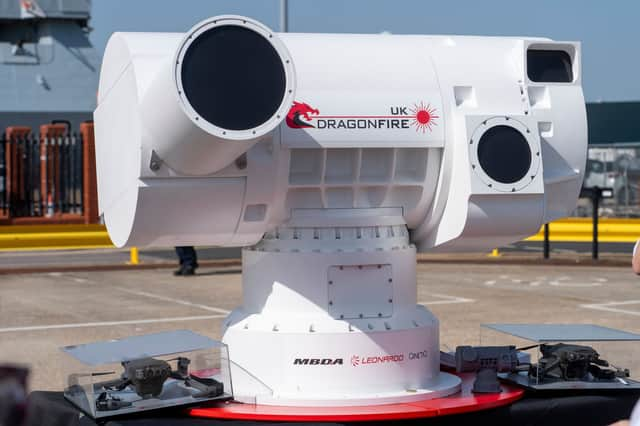
The programme was brought forward after HMS Diamond’s exploits in the Red Sea, where she had to fire Sea Viper missiles at drones and other small targets at exorbitant cost. Oliver Mead, MBDA’s UK Business Manager for Laser Directed Energy Weapons, said DragonFire won’t entirely replace other weapons on the Type 45s. He believes it will allow personnel to have more options when it comes to shooting down drones and other threats.
Speaking at the Nato Plenary at HMNB Portsmouth last month, he said: “It’s extremely important to have a mix of systems. A laser weapon is only going to be so good. It’s really designed to intercept certain targets, and you’re still going to need cruise and ballistic missiles.
“The other limitation is always going to be line of sight. There are certain threats you just want to take out that are further away. They’re going to move at such a pace to go and hit the ship. It’s important to have the logic in the effects management system, which can identify the target and determine which weapon to use.”
Mr Mead said he’s happy with the development of the system, which has already been fired more then 1,000 times with very little maintenance requirements. “We tuned the software progressively to maximise the level of efficiency and the power coming out of the system,” he added.
“There are still a lot of challenges to overcome. The ever prevalent and growing threat in Ukraine and Strait of Hormuz shows drones being used more and more.”

Mr Anderson said new weapons need to be developed to deal with hypersonic and supersonic threats. “The enemy is developing that threat,” he added. “With the ranges many of those things fly, the best way of engaging with that is with the Navy.”
Mr Anderson added that DragonFire still needs to go through further tests and evaluations, working on the overall size of the system and how the beam is formed. “You have to cohere a number of laser beams together, not just one,” he added.
“The kinetic technology allows you to aim them at the target. We’ve thrown science behind how to make the laser focus on the target, and lift the effect up. No one has actually demonstrated they can effectively field this in the battlespace yet. Once we start to, we could see more interest.
“I think we’ll see them retrofitted to existing platforms. I don’t think it’ll extend the life of that platform. That’s genuinely defined by the length of life in mechanics. We’re continuously upgrading weapon systems on platforms and we’ll carry on doing it.”