
Cost of retiring Royal Navy ships HMS Richmond and Chiddingfold laid bare as millions in taxpayer cash lost

Both ships were officially retired after spending hundreds of days on the side-lines
Millions of pounds has been lost in retiring two aging Royal Navy ships - with one of them receiving various upgrades before being decommissioned.
The Ministry of Defence’s Annual Report and Accounts 2025-26 reveals that more than £55m has been lost after HMS Richmond and HMS Chiddingfold were decommissioned. Both vessels, alongside the Type 23 frigate HMS Iron Duke, were officially retired last week after spending lengthy periods not at sea.
In the “constructive losses” section of the accounts - which lists every item with a value of more than £300,000 - HMS Richmond’s “removal from service” cost £45.847m. HMS Chiddingfold’s “impairment pending removal from service” cost £10.896m.


HMS Richmond played a vital role alongside HMS Prince of Wales on Operation Highmast last year. Part of the UK Carrier Strike Group (UKCSG), the Type 23 frigate was involved in an eight-month deployment to the Indo-Pacific. She conducted military drills and diplomatic engagements while visiting Australia, South Korea, India, and elsewhere.
This was her last deployment before a ceremony in the Yorkshire village of Richmond which practically marked an end to her service. She was originally launched on April 6, 1993 - subsequently being deployed extensively around the world.
The frigate received various upgrades packages in the 2020s. This included being fitted with the Sea Ceptor air-defence system, and undergoing a life-extension programme which modernised accommodation and communal spaces, replaced pipework and cabling, and other engineering enhancements.
Under the Power Generation and Machinery Controls Update (PGMU), HMS Richmond was the first Type 23 frigate to have her diesel generators replaced with modern MTU M53B units and new power-conversion equipment. Her machinery control and surveillance systems were modernised, and was the first of her class to be fitted with the modernised Link 16 cryptographic system in 2025.
Responding to a parliamentary written question, minister for defence readiness and industry Luke Pollard said the cost of HMS Richmond’s deep maintenance period of 126 weeks - between October 2017 and June 2020 - cost £72m. He added: “These periods of planned deep maintenance were undertaken to sustain the ships’ operational capability and recertify the ships’ safety to operate in accordance with the Programme of Record (the ships’ sustainment) under the last government.”
Even though the Duke-class ship received numerous enhancements, the structure of her hull was only designed to last for around 18 years. She would end up serving for more than three decades.
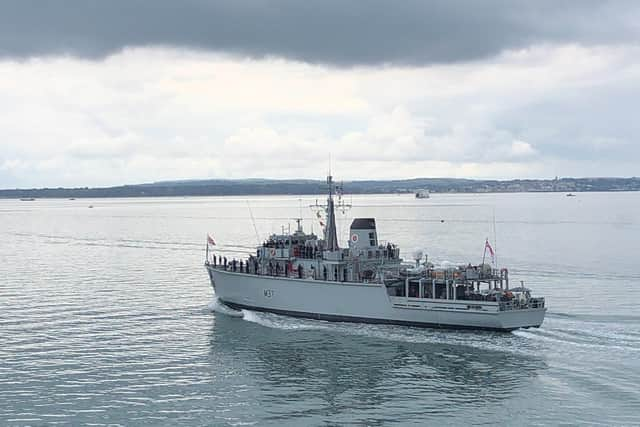
HMS Chiddingfold, a Hunt-class minehunter, was primarily deployed away from her Portsmouth home and in the Middle East. As part of Operation Kipion, she was extensively involved in clearing underwater explosives, conducting freedom of navigation patrols, and anti-piracy operations. She was damaged following a crash with fellow minehunter HMS Bangor.
The Royal Navy is currently pushing to create a hybrid force of conventional warships alongside autonomous vessels, with older ships being retired for new capabilities. The fleet now has five frigates, with the first of modern Type 26 and 31 replacements not due to be commissioned into the fleet until 2028 at the earliest. Most will come online in the early 2030s.
Speaking about the recent retirements, Fleet Commander Vice Admiral Steve Moorhouse previously said: “HMS Richmond, HMS Iron Duke and HMS Chiddingfold have each played a key role in safeguarding the UK’s security and interests worldwide.
“As they are retired from service, their legacy continues through the next generation of warships and advanced autonomous systems. This marks a significant step in the Royal Navy’s evolution towards a Hybrid Navy, combining cutting-edge technology with proven capability to meet future maritime challenges. We honour their service and look forward to the advantage the future fleet will provide.”