
Green comet: When and how to see C/2022 E3 (ZTP) comet last seen 50,000 years ago in Portsmouth

A ONCE-IN-A-LIFETIME comet that was last seen in the Stone Age is flying across the sky.
Astronomy enthusiasts will be glued to their telescopes as a green comet will be visible for the first time in 50,000 years. The Comet C/2022 E3 (ZTF) made its last closest approach to the Sun on January 12, and is set to make another approach soon.
The comet will be in the Camelopardalis constellation when it reaches its peak. Comets have been spotted in the Portsmouth area before, including Comet Neowise over Titchfield haven.
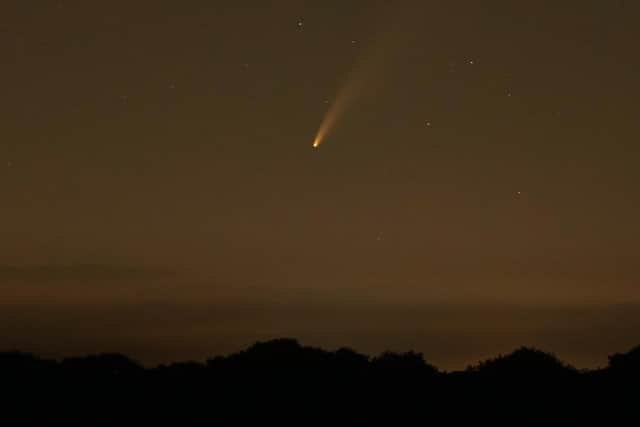

Here is all you need to know about C/2022 E3 (ZTF).
When is the best time to see the green comet?
The celestial object will be at its most visible between February 1 and 2. It will make its closest approach at a distance of 27 million miles.
Why is it called a green comet?
Comets orbit the Sun on extremely elliptical orbits, warming up as they get closer. Once they get close enough to the heat mass, their surface ice turns into gas. This disperses and displaces dust in the process.
The process gives comets dusty ‘tails’, known to stretch out behind them for millions of miles as they fly through the Solar Systems. A range of images of comet C/2022 E3 have been pictured over the years.
Astronomers have captured the faint green glow surrounding the comet.
This is thought to be caused by the presence of diatomic carbon, bonded pairs of carbon atoms which emit green light when stimulated by the Sun’s energy.
The green comet originate from the Oort cloud. This is made up of a spherical layer of icy objects, thought to be located between 2,000 and 100,000 astronomical units (AU) from our Sun.
SEE ALSO: James Bond actress Eva Green says her 'soul will die' if she made a film in Hampshire, court told
How to see the green comet from Portsmouth?
The best time to catch the comet – at its peak visibility – is in the early morning of February 1 and 2. It will be difficult to see with the naked eye, especially if it’s cloudy. While you may be able to see the comet from a high-viewing point in the city, it is best to use a pair of binoculars to capture comet C/2022 E3 (ZTF).
Astronomers have advised people to choose a dim location free of ambient light. Enthusiasts are encouraged to get there before the comet is in the sky, so their eyes can adjust to the conditions. People who want to pinpoint the comet’s location can use smartphone apps such as Star Chart and Skyview.