
Fibonacci Day 2025: Why this Italian mathematician and his Golden Sequence are celebrated today?

Celebrate the simple mathematical sequence that is hidden in everything from sunflower spirals to Da Vinci's paintings
- Discover why the sequence is considered nature's secret code, governing everything from the spirals on a sunflower to the chambers of a nautilus shell.
- Learn how the resulting Golden Ratio has been used for millennia by artists and architects, including Leonardo da Vinci, to create aesthetic perfection.
- Find out which progressive metal band famously used the sequence to structure their music and which blockbuster novel turned the numbers into a cryptic mystery.
November 23 might not sound like a national holiday, but for mathematicians, artists, and fans of patterns, today is Fibonacci Day.
The date is celebrated because when written in the US format (11/23), the digits form the first four numbers of the famous mathematical pattern: 1, 1, 2, 3. This sequence is not just a quirky numerical party trick—it's a fundamental code that governs the world around us.
This series, in which each number is the sum of the two preceding ones, is ranked by many scientists alongside Pi as a recurring value in both mathematics and the natural world.
In nature, you see it everywhere: if you count the number of petals on many flowers (like the three petals of a lily or the five on a buttercup), you'll often land on a Fibonacci number. More strikingly, the spirals in the seed head of a sunflower, the arrangement of scales on a pineapple, and the chambers of a nautilus shell all strictly adhere to this sequence to maximise efficiency.
This unexpected universality is why we celebrate the man who brought the formula to the Western world.
So, as mathematicians, logicians and some of us Tool fans celebrate today, let's take a look at who Fibonacci was and what 'The Golden Ratio' entails
Who Was Leonardo Fibonacci?
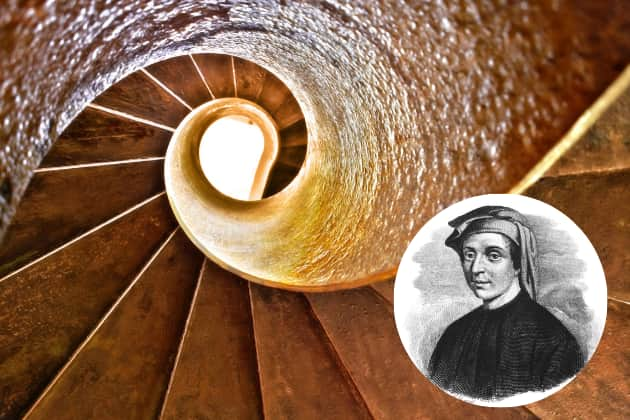

The celebration honours the Italian mathematician Leonardo Pisano Bigollo (also known as Leonardo of Pisa), who lived from approximately 1170 to 1250.
Heralded by historians as 'the most talented Western mathematician of the Middle Ages,' his most significant and world-changing legacy was not the number sequence itself, but his role in popularising a massive cultural and economic shift: the widespread adoption of the Indo–Arabic numeral system across Western civilisation.
Fibonacci's father was a customs official who frequently travelled around the Mediterranean, and Leonardo travelled extensively with him, learning the numbering systems used by traders in places like North Africa and the Middle East.
It was here that he encountered the revolutionary system, which included the decimal point and, most importantly, the concept of zero.
Before Fibonacci’s work, Europe still clung to cumbersome Roman numerals (I, V, X, L, C, etc.). Imagine trying to perform long division or track complex interest rates using only Roman numerals—it was a bureaucratic nightmare.
By championing the Indo-Arabic system in his books, Fibonacci gave merchants, bankers, and academics a tool for efficiency. By introducing the ease of the decimal system and the concept of zero—which allows for the crucial concept of place value—his work laid the indispensable groundwork for modern commerce, complex science, and advanced calculation that defined the Renaissance and beyond.
His influence essentially streamlined the entire European economy.
What is the Fibonacci Sequence? (And the Rabbit Problem in Liber Abaci)
Fibonacci introduced the sequence in his 1202 book, Liber Abaci (The Book of Calculations), but it was not done as an abstract thought experiment, but as a practical way to solve a hypothetical problem concerning the then ever-growing rabbit population.
His simple hypothesis was: If you start with a single pair of newborn rabbits, how many pairs will there be after a year, assuming:
- A newborn pair requires one month to mature.
- Every mature pair produces exactly one new pair each month.
The solution created the famous sequence: 1, 1, 2, 3, 5, 8, 13, 21, 34, 55...
The sequence is built on a deceptively simple mathematical rule: each new number is the sum of the two preceding numbers.
- Month 1: Start with 1 pair. (1)
- Month 2: The original pair matures, but still only 1 pair exists. (1)
- Month 3: The original pair produces a new pair. X³ = X² + X¹ = 1 + 1 = 2. (2)
- Month 4: The original pair produces another pair. The second pair matures. X⁴ = X³ + X² = 2 + 1 = 3. (3)
- Month 5: The original pair produces a pair, and the pair born in Month 3 produces its first pair. X⁵ = X⁴ + X³ = 3 + 2 = 5. (5)
The elegant formula that defines the sequence is often written as: Xⁿ = Xⁿ⁻¹ + Xⁿ⁻²
While the rabbit problem itself is unrealistic, the numbers generated have proven to be an astonishingly accurate description of growth and patterns observed in the natural world.
What is “The Golden Ratio”?
The sequence’s enduring fame comes from its profound, almost mythic connection to a mathematical concept known as the Golden Ratio. This ratio is represented by the Greek letter Phi, and its value is approximated at 1.618.
The magic happens when you perform a simple division: take any number in the Fibonacci sequence and divide it by its immediate predecessor.
- 8 divided by 5 = 1.6
- 13 divided by 8 = 1.625
- 21 divided by 13 is approximately 1.615
As the numbers in the sequence grow larger, the resulting ratio gets closer and closer to 1.618.
This proportion is often called the 'Divine Proportion' because it has long been claimed to represent the most visually pleasing relationship between two parts, forming the basis of Western art and design.
This spiral is why the sequence has endured beyond mathematics. The ratio has allegedly been found in:
- Classical Architecture: The proportions of the Parthenon in Athens.
- Renaissance Art: The placement of figures and features in paintings by Leonardo da Vinci.
- Human Biology: The proportions of the human face and body (the ratio of the forearm to the hand, or the length of fingers).
The mathematical reality is that the Fibonacci sequence is the closest known whole-number approximation of the universal aesthetic appeal of the Golden Ratio.
From Pineapples to Pop Culture: Finding Fibonacci in the World
The Fibonacci numbers have taken on a mythic quality because of their uncanny and unexpected appearances across the natural and human-made worlds.
In Nature
The sequence is considered the 'secret code of nature' because it describes the most efficient way to pack seeds, leaves, and petals to ensure maximum sunlight exposure and tight packing with minimum wasted space. The numbers are often found in the arrangement of plant parts:
- Petals: Many common flowers have a Fibonacci number of petals (3 for lilies, 5 for buttercups, 8 for delphiniums, 13 for marigolds).
- Spirals: The stunning spirals found in the seed head of a sunflower, the scales on a pineapple, and the cone of a pine tree all adhere to a Fibonacci progression. For example, a sunflower head often has two sets of intertwining spirals—one numbering 34 and the other 55.
- Botany: The branching patterns in trees and the arrangement of leaves on a stem (known as phyllotaxis) often follow a Fibonacci-based ratio to prevent lower leaves from shading those above.
In Culture
The sequence’s universal appeal has made it a persistent trope in literature, film, and other non-mathematical fields:
- Literature: In Dan Brown’s hit novel The Da Vinci Code (2006), the numbers were famously used as a cypher to unlock a safe, giving the sequence a renewed burst of fame and a cult appeal akin to the predictions of Nostradamus.
- Music: Progressive metal band Tool used the sequence in both the syllable count of the verses and the time signature changes (from 9/8 to 8/8 to 7/8) in their 2002 single, Lateralus.
- Architecture: Fibonacci numbers and the Golden Ratio appear in the design and proportions of many buildings, including the Mole Antonelliana in Turin and the Zürich Hauptbahnhof, where designers sought to achieve visual harmony and balance.
- Finance: The ratios derived from the Fibonacci sequence (often translated into percentages like 38.2% and 61.8%) are now a consistent feature of technical analysis used by stock traders to predict potential support and resistance levels in financial markets.
Whether you're a seasoned mathematician, an architect, or just someone who appreciates the hidden structures of the world, Fibonacci Day is a moment to marvel at how this simple sequence—discovered by counting rabbits—truly is the golden key to understanding the harmony of the universe.

Beats by Dre have a reputation for being some of the best headphones on the market, both noise-cancelling and clarity of sound.
There’s a whopping 46% off these Beats now:
- High-performance wireless noise cancelling headphones
- Compatible with iOS and Android devices.
- Pure adaptive noise canceling (pure ANC) actively blocks external noise
- Real-time Audio calibration preserves a Premium listening experience
- Up to 22 hours of battery life enables full-featured all-day wireless playback
One reviewer noted “These headphones are so comfy and cup around the ears perfectly for noise cancelling.I know they are wireless but when you use them with the 3.5mm headphone cable it’s just so so so much louder. It’s mad that songs I’ve listening to a thousands times I can now hear different instruments or parts that are so clear it’s crazy how I didn’t pick up on these before.”