
Portsmouth’s enduring legacy for English football on landmark occasion
An iconic part of England’s football heritage celebrates its centenary today at Fratton Park.
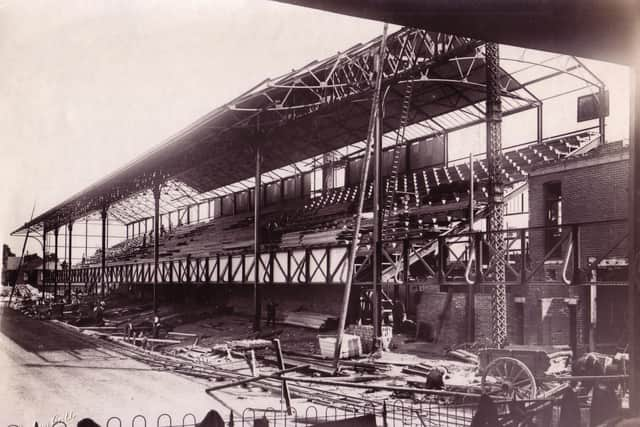
Designed by the leading football ground architect of the period, Archibald Leitch, Fratton Park’s double-decker South Stand — complete with trademark latticework frontage — is 100 years old.
The club are marking the anniversary by unveiling a permanent exhibition telling the story of the stand at 12.30pm tomorrow, before the Championship clash with Preston North End. The display has been pulled together by the Pompey History Society charity, which works with the club to preserve and share its archive.
To officially open the exhibition, two of Leitch’s great grandsons Graham and David Easton will be guests of the club at the game, along with renowned football ground historian Simon Inglis.

Inglis wrote The Football Grounds of Great Britain (1986) and Engineering Archie (2005), which told the story of Leitch’s extraordinary impact on football ground design. The book is currently being revised and updated for publication in October 2026.
Also in attendance will be relatives of Pompey legend Bob Blyth, including great grandsons Andrew Hind, who is also a trustee of the Pompey History Society, and Rob Blyth.
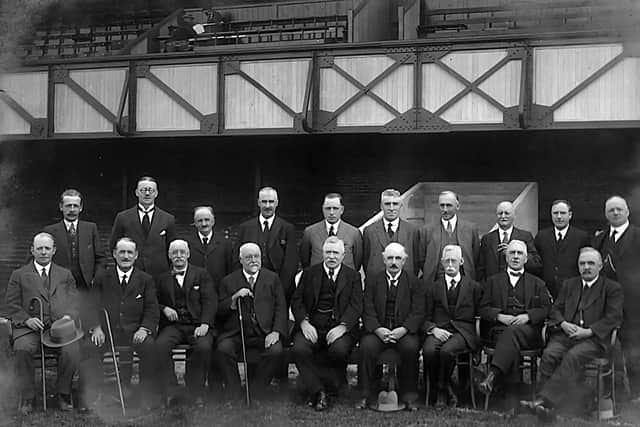
A former player and manager of the club Blyth, by 1925 club chairman, was a key driver behind the project and persuaded his fellow directors to underwrite the £21,500 it cost to build it.
Having taken just ten weeks to complete, the stand opened on August 29, 1925 at the second division home game with Middlesbrough. Seating 3,961 with 6,685 standing capacity in an enclosure below, at the time it was one of the foremost stands of its type in England.
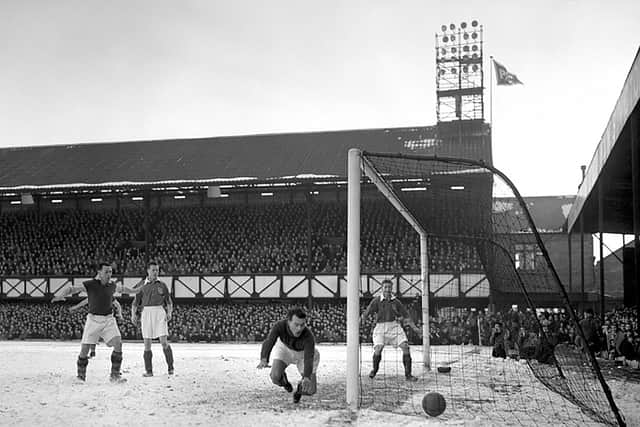
With its distinctive criss-cross steel frontage, the South Stand is now the oldest surviving example in the country and the only one of its type still in use in the men’s game, after Everton’s men’s team stopped playing at Goodison Park at the end of last season, leaving the Bullen Stand behind.
There had also been an example at Sunderland’s Roker Park, built in 1913 and demolished in 1997, and one other remains, although highly modified, at Ibrox, home of Rangers in Glasgow, built in 1926.
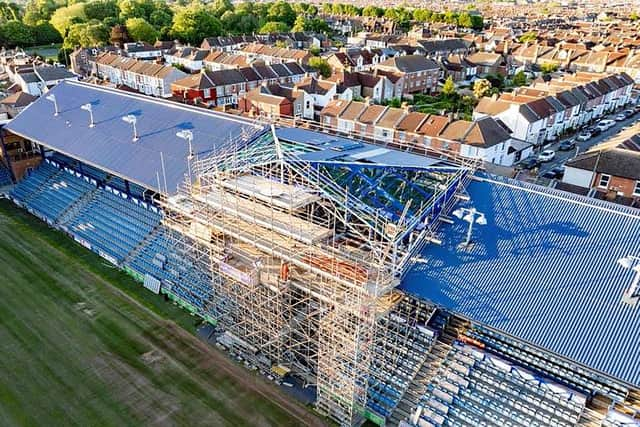
In the past two years the Pompey stand has been sympathetically restored at a cost of £4m by present owner Michael Eisner, to incorporate new seating in the former terraced enclosure and also a state-of-the-art TV gantry, with an in-keeping gable roof and period clock.
As part of the South Stand commemorations, family members of Blyth are also held a private ceremony today to put a headstone on Blyth’s grave in Milton Cemetery, where he is buried with his wife Isabella.
He died in February 1941 — he was laid out in his coffin on the boardroom table at Fratton Park the night before his burial — but the constraints of World War Two, meant the family were unable to arrange a headstone at the time.
Eisner said: ‘When my family and I took on the custodianship of this great football club in 2017, it was the unique atmosphere created by the fans in an iconic and traditional stadium which was a key reason why we chose to invest in Pompey. The South Stand is the jewel in that crown. Ensuring we maintained the essence of its classic lines and features was foremost in our planning for its renovation over the past couple of years and I am thrilled we are marking its centenary with this new exhibition.’
Mick Comben, chair of the Pompey History Society, said: ‘A new stand on the south side of the ground had been desperately needed since the end of the first world war when fans flooded back to football. Chairman Bob Blyth obtained the finance and Archibald Leitch got it built. I am really looking forward to bringing together at Fratton Park the descendants of the men who made this stand happen a hundred years on.’
Simon Inglis, author, writer and biographer of Leitch, said: ‘After the earlier dominance of clubs from the north and Midlands, Pompey’s ascent in the 1920s Football League sent out a message that the south had finally arrived on the national scene. Fratton Park’s South Stand, whose centenary we celebrate, embodied this ambition. An instant Archibald Leitch classic with its distinctive criss-cross balcony truss, it is now one of only three Leitch of that type still standing. Along with Fratton's quirky entrance on Frogmore Road, I am so glad that this unique corner of our national sporting heritage has survived and is still cherished. Well played Pompey!’
Graham Easton, great grandson of Archibald Leitch, said: ‘Along with David, as Archie's great-grandsons we are incredibly proud to see the South Stand — one of only three remaining examples of his trademark double decker stand — celebrated 100 years on. It is a real honour for our family to be part of these centenary events and to see the stand so beautifully restored and loved by Pompey fans.’
Andrew Hind, great grandson of Blyth, said: ‘As a lifelong Pompey fan, I am immensely proud of the contribution my great grandfather made to the club — a true leader on the pitch and in the boardroom. As chairman he was the prime mover behind getting the South Stand built. It is wonderful that the family can now join with the club in celebrating its centenary. The South Stand remains a living legacy to Bob Blyth and the other Pompey trailblazers to whom all fans owe so much.’
Words by Colin Farmery