

The city prepared key aircraft carriers that formed the Task Force sent to retake the islands.
Amphibious assault ships carrying Royal Marines and landing craft also departed Portsmouth. Destroyers and frigates deployed from the city provided escort, air defence and naval gunfire support.
Several Portsmouth-based ships were lost during the campaign. Memorials to their crews remain in the city.
Portsmouth’s dockyard played a wider role fitting out vessels, loading stores and converting civilian ships for military use.
The city’s contribution to Operation Corporate, at sea and ashore, was central to the UK’s ability to mount and sustain the campaign in the South Atlantic.
Here are a selection of ships that served our country proud during the conflict with the Argentinian junta, from a range of different classes and capabilities.
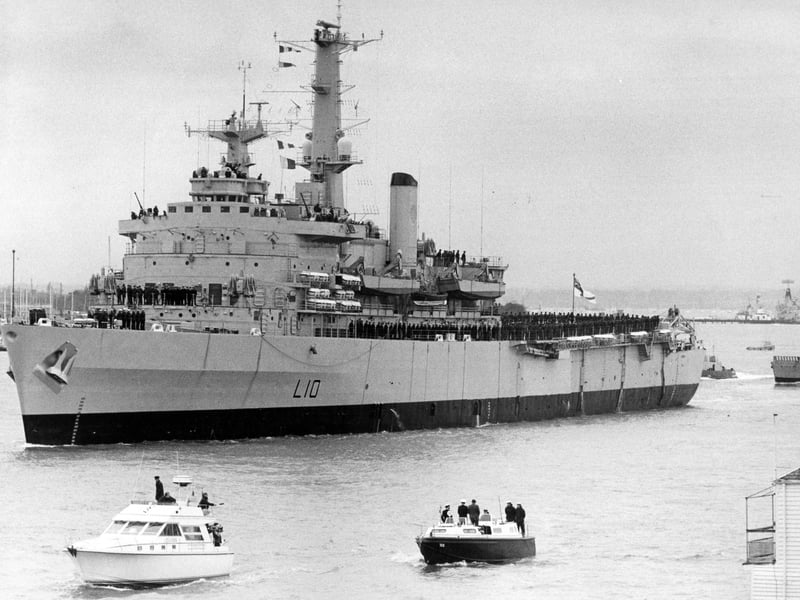
1. HMS Fearless
HMS Fearless served as one of two principal amphibious assault ships, deploying her four Landing Craft Vehicle Personnel and Helicopter deck to land Royal Marine Commandos at San Carlos Water. As the amphibious command centre, she housed Commodore Clapp’s headquarters and coordinated beach landings, logistic convoys, and special forces insertions. Despite constant Argentine air attacks, her Seacat missile system successfully defended the fleet. The ship's critical troop deployment and command functions significantly enabled the British land campaign. | The News Portsmouth
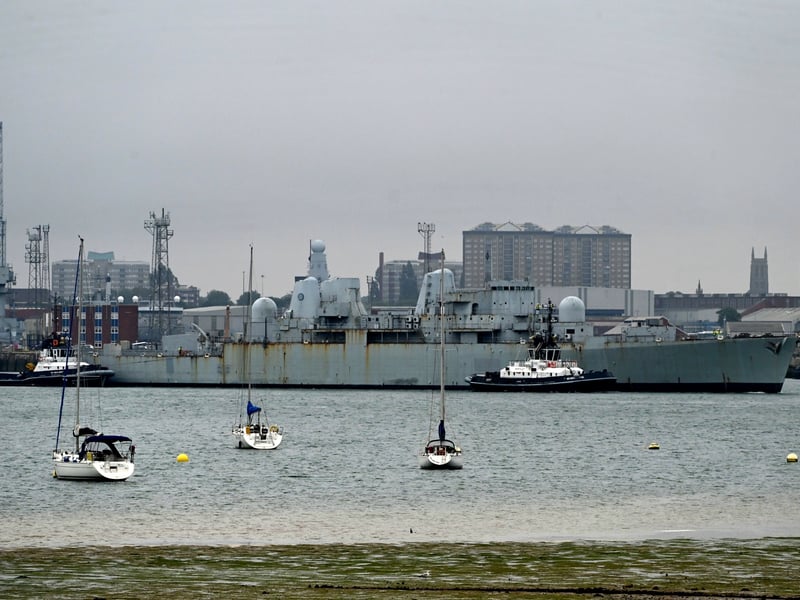
2. HMS Bristol
HMS Bristol, the solitary Type 82 destroyer, was recommissioned from Portsmouth and sailed late in April 1982. Equipped with Sea Dart, Ikara, and advanced communications, she served as flagship of the rearguard Task Group. Though not in frontline combat, Bristol coordinated resupply, logistics, and fleet movements. Following the sinking of HMS Coventry, she assumed flagship duties, maintaining cohesion across support vessels. Bristol’s command-and-control capability was indispensable for sustaining naval operations through the campaign’s conclusion. | Alison Treacher
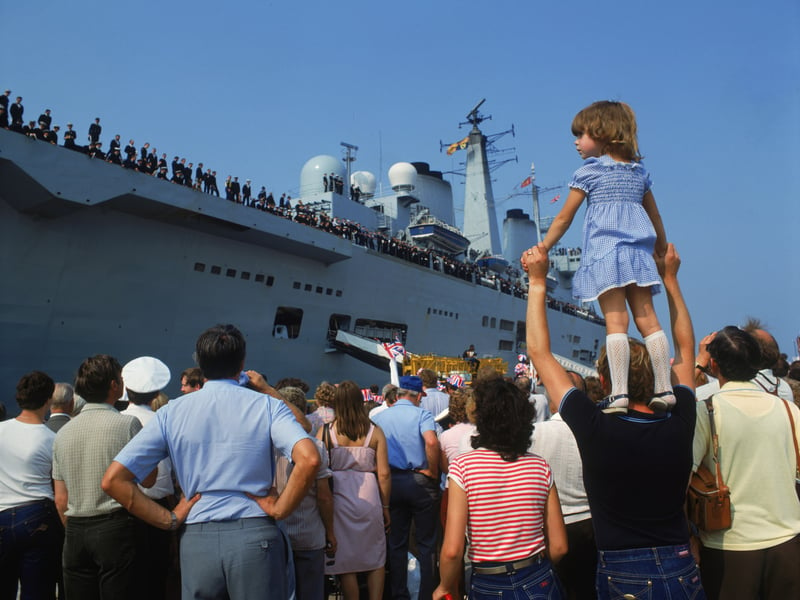
3. HMS Invincible
HMS Invincible, a light aircraft carrier, played a key role in the Falklands War as part of the Royal Navy's carrier strike group. Embarked with Sea Harriers from 800 and 801 Naval Air Squadrons, she provided continuous air defence, strike missions, and reconnaissance. Operating alongside HMS Hermes, Invincible helped maintain air superiority over the islands. Her Sea Harriers downed several Argentine aircraft. Though under threat from submarines and missiles, she remained undamaged and vital to British control of the air throughout the conflict. Pictured: HMS Invincible returns to Portsmouth, carrying British troops home from the Falklands War, | Hulton Archive/Getty Images
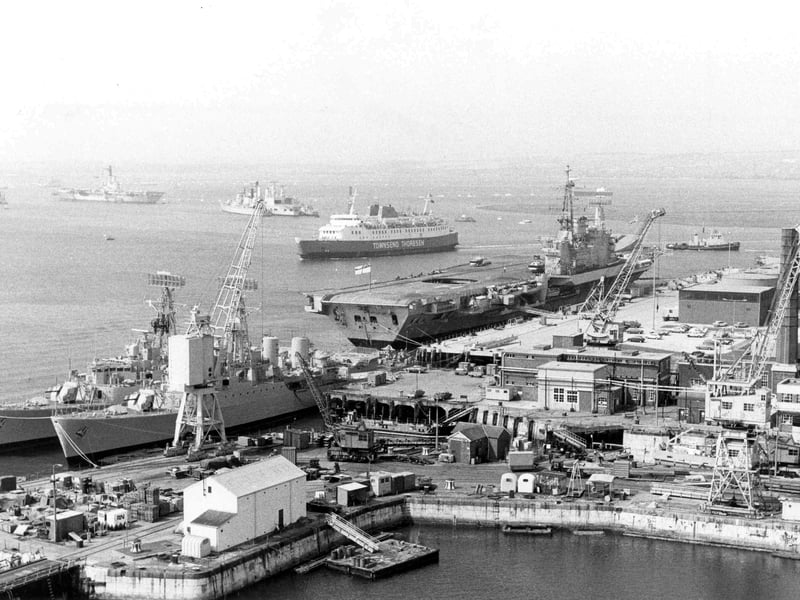
4. HMS Hermes
HMS Hermes, recommissioned from Portsmouth dockyard, became the Task Force flagship within three days of the invasion. Hosting Sea Harrier and Sea King squadrons, she launched air strikes, air defence patrols, and reconnaissance missions deep into Argentine territory. Positioned outside threat range, her Harriers maintained sustained air superiority. As the main carrier, Hermes enabled fleet protection, ground support, and maritime strikes — central to overall success in recapturing the islands. | The News Portsmouth archive