
Saharan dust: Why Portsmouth sunsets are looking beautiful - and why your car may get dirty tonight

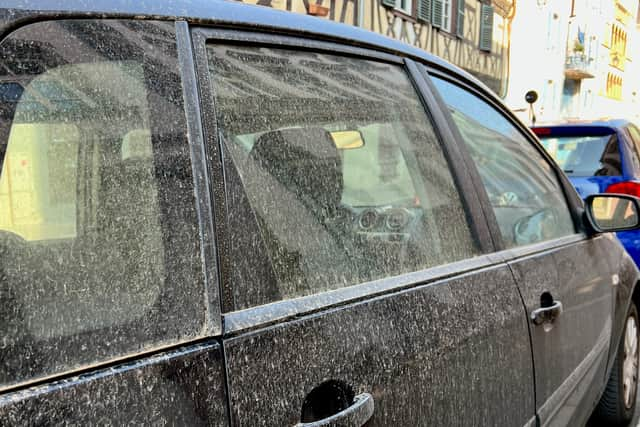
You may find your car is looking a bit dusty on Friday - despite the fact it has been deluged with rain for most of this year.
The reason for the griminess is the same as to why sunrises and sunsets are looking particularly photogenic at the moment - Saharan dust.
Last night’s moon took on a reddish tinge, and anyone heading eastbound on the M27 this morning between about 6.40am and 7am was looking into a very orange-appearing sun as it rose.
Fine sandy dust is travelling across Europe, and the weather systems are heading this way. With Portsmouth being on the south coast, it regularly sees dust arrive - and with some wet weather possibly due tonight, but more likely on Friday morning, the dust will be washed out of the sky in so-called “blood rain”.

The Met Office said: “The term ‘blood rain’ often captures attention, but it can be misleading. It is not a scientific phrase, nor does it describe a frequent or clearly defined meteorological event. Instead, it simply refers to rain that takes on a reddish tint once it reaches the ground. The colour can vary from a faint rusty hue to deeper reds, depending on how much dust is present in the atmosphere at the time of rainfall.
“For rain to appear red, relatively high concentrations of red‑coloured particles must mix with the water droplets in the cloud. Typically, these particles are sand or dust rich in iron oxides, giving them their characteristic colour. When rainfall occurs while these particles are suspended in the atmosphere, the droplets can take on that tint.”
The Met Office says that in reality, the concentration of dust particles in rain is rarely high enough in this country to make it appear red. Normally, the dust is only spotted when rain dries, leaving a film of dust on outdoor surfaces, and most obviously on cars.
The dust gets into the air if it is whipped up by desert winds. It can be carried up to high altitudes and can end up being transported thousands of miles.
Claire Ryder, a professor at the University of Reading who specialises in dust transport, explained the dust is brought over to the UK by strong, warm winds coming from the south.
“The dust particles are smaller than a grain of hair and can stay in the air for a long time,” she said. “They will slowly be settling but they can also be taken out of the atmosphere by rainfall and clouds.”
Dr Ryder believes the best sunsets will be across the east of England on Thursday evening.
She added: “The peak dust concentration is through tonight and it is going to get much more severe through the night and into tomorrow. Tomorrow, skies will be less visible as it is more cloudy so the best chance to see a great sunset is this evening.”
The Met Office added: “Saharan dust is relatively common in the UK often happening several times a year when big dust storms in the Sahara coincide with southerly wind patterns. In certain weather situations, Saharan dust can also affect air pollution and pollution levels.”