
The News defence correspondent '˜lands' jet on HMS Queen Elizabeth
SITTING in the cockpit of an F-35b is like being cocooned inside some sort of futuristic spacecraft.
I’m surrounded by a range of complicated-looking controls; a joystick to my right controls the direction my jet flies in — its pitch and yaw. While to my left there is another bulky lever to boost my speed.
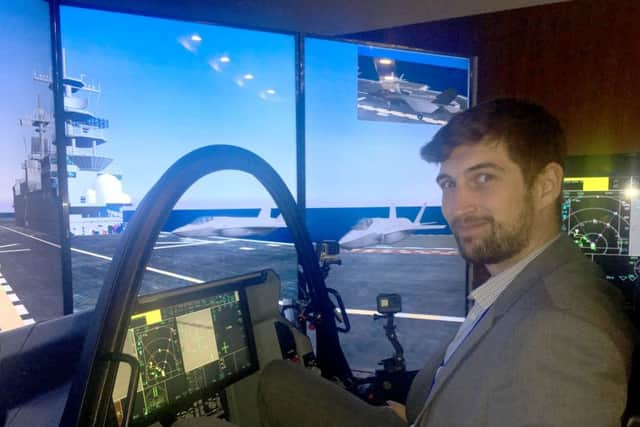

In front there are a number of buttons, too — although nowhere near as many as I thought there’d be.
‘The F-35 is intuitive, it’s seriously easy to fly,’ my instructor Squadron Leader Andy Edgell says confidently.
‘There’s not a plethora of dials, knobs and switches any more.’
‘We can have untrained civilians flying a simulator like this in minutes,’ he adds, with a smirk.
My simulator is a metal skeleton of the real thing, with no canopy and a large computer screen. My mission was to make a safe landing on the deck of HMS Queen Elizabeth.
My screen shows me everything, from altitude and speed to what vector of approach to take.
It feels like a computer game — although both my joysticks are bulky and took awhile to get the hang of.
But once I had, landing on the virtual flight deck of the 280m warship became a doddle.
I was able to hover in place before slowing lowering myself down.
The only tricky bit was controlling my speed and adjusting the sensitive steering when I’m hovering.
Surprised, I ask Sqd Ldr Edgell if it’s that easy in the real thing.
‘It’s easier — the plane doesn’t jerk around nearly as much in real life,’ he says.
Perhaps he was being nice. Perhaps not. Either way, if the F-35 is anything like the simulator, the pilots will be in for a treat.