
Clean Air Zone here to stay for now, despite air quality improving city-wide
Councillors have confirmed the extension of the clean air zone (CAZ), despite air quality improving across the city.
Portsmouth City Council’s cabinet has welcomed a report showing continued improvement in the city’s air quality, although it suggests current measures could remain in place until 2027.

The council is required by the government to cut NO2 levels in areas exceeding legal limits. Nitrogen dioxide (NO2) is a highly reactive gas that can inflame airways, reduce lung function and worsen conditions such as asthma.
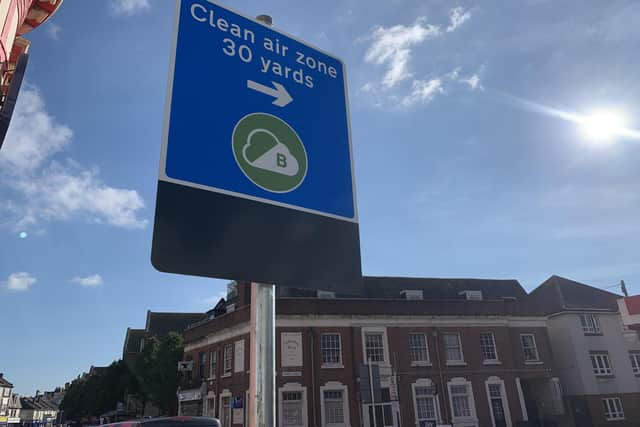
The Joint Air Quality Unit (JAQU) first assessed the city in 2023, identifying three areas above legal NO2 limits and nine more at risk. To bring levels down quickly, the council introduced a clean air zone covering the south-west of the city, from Landport to Somerstown and west to Portsmouth Harbour.
The CAZ charges non-compliant buses, coaches, taxis and private hire vehicles that fail to meet Euro 6 (diesel) or Euro 4 (petrol) standards.
A further JAQU assessment in January confirmed Portsmouth passed its second test with no exceedances, though three sites on Alfred Road and Hope Street remain at risk.
The council will carry out modelling for a third assessment at the end of 2026. Passing both the third and fourth assessments would meet legal requirements and allow the CAZ to be removed, potentially in 2027.
Cllr Kimberley Barrett, cabinet member for climate change and greening the city, underscored the importance of clean air.
“We really do want everyone in Portsmouth to breathe air that doesn’t damage their health.”
She said that “we often hear negative news at the council” but the city has “made positive steps forward” as air quality continues to improve.
She added that diffusion tubes, which measure the concentration of NO2, have increased from 27 in 2017 to 228 across the city today.
“There is no safe level of air pollution so we will continue to do everything we can.”
Cllr Peter Candlish, cabinet member for transport, said that while transport is vital to the city, it is a large contributor to air pollution.
He said he’s “really proud” that we are putting forward alternatives to petrol and diesel vehicles.
These include improved bus routes and electric buses, which have seen fare-paying passenger numbers rise by 26 per cent compared with before Covid.
He also highlighted the use of car clubs across the city and more than 300 electric vehicle chargepoints installed over the past year.