
Aquind fears return as city leaders warn of significant disruption
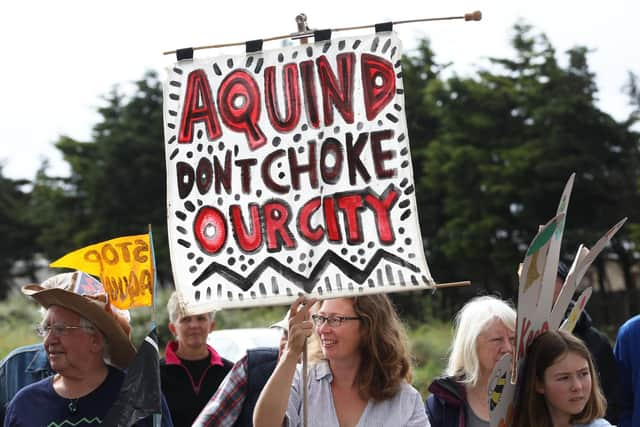
Portsmouth City Council is again highlighting the Aquind scheme, warning residents the project still poses a significant threat to the area.
During a full council meeting, a motion to raise awareness of the Aquind interconnector project was passed.
If approved, the Aquind Ltd would install an electricity and data cable stretching from Normandy to Eastney, passing through the eastern side of Portsea Island, Drayton, Purbrook and Waterlooville, before terminating at a substation in Lovedean.
The decision on the project rests with Ed Miliband, the Secretary of State for Energy Security and Net Zero.
Viola Langley, of the Let’s Stop Aquind (LSA) campaign, described the project as “unnecessary” and “unworkable”.
She highlighted a recent cross-Channel, cross-party meeting with members of the council and French campaigners and politicians who also oppose the scheme, which “clearly demonstrated how all interested parties are resisting the Aquind interconnector”.
“We thank PCC for your never-ending support.”
Cllr Kimberley Barrett thanked Viola and the rest of the LSA for sustaining the campaign, as well as various local MPs, past and present, for their opposition, including Stephen Morgan, Amanda Martin, Suella Braverman, Flick Drummond and Dame Penny Mordaunt.
Council leader Steve Pitt said the campaign “needs to be brought back to people’s attention again and I’m genuinely concerned”.
He warned that the campaign was at risk of “fatigue” despite there being a “very real threat” that it could be approved.
“We cannot be caught asleep on this issue, this would cause huge consequences for our city.
“Understandably everyone gets stressed out and up in arms if a road has to be closed for four or five weeks for infrastructure replacements, this is 18 months.”
Labour councillor Judith Smyth said the project would cause “enormous damage” to the local environment, lead to “gridlock”, and have a “devastating” impact on Locksway Road allotments.

Cllr Matthew Winnington argued that “no one in Portsmouth wants it”, claiming the route was chosen because it was “the cheapest” option and criticising the lack of a national plan for interconnector infrastructure.
He compared the situation to “railway mania” in the 19th century, saying the government had allowed development to proceed “without any plan”.
“If you were coming up with an infrastructure plan, what would you do, would you put an interconnector cable through a very densely populated urban environment, no of course you wouldn’t.”
Conservative councillor Simon Bosher warned that the impact on Drayton and Farlington would be “immense”. He recalled past encounters with Aquind representatives, saying he had been “grilled” after asking “awkward questions” at a public event and described their behaviour towards him as “a little on the intimidating side”.
Cllr Russell Simpson echoed concerns raised by the Ministry of Defence that the project would impede and compromise operations in and around Portsmouth Naval Base.
Cllr Barrett recalled walking down Locksway Road and seeing a resident crying, after recieving a letter from Aquind stating they would put a compulsory purchase order on their house.
“The fact that this company wants to scare people into thinking that because their house was on the route that they could have their home taken away from them.”
The motion was passed unanimously.

An Aquind spokesperson said: “We acknowledge the resolution of Portsmouth City Council, but AQUIND’s focus remains on the essential purpose of delivering the AQUIND Interconnector and its benefits to the UK.
“The UK urgently needs new, modern energy infrastructure. AQUIND will strengthen the nation’s energy resilience, reduce wholesale electricity costs, and support the transition to a more secure and sustainable energy system.
“These benefits extend not only to the UK as a whole but also to Portsmouth itself, which stands to gain from significant investment, in the form of employment opportunities during construction, and reduction of energy poverty due to lower energy prices.
“We have worked constructively with national and local stakeholders for many years and will continue to do so as the project progresses. We look forward to bringing this important infrastructure to completion for the benefit of consumers, communities, and the entire country.”