
Neowise comet visible over Hampshire's skies gives a glimpse into Big Bang origin of universe
A COMET measuring five kilometres across and travelling more than 100 million kilometres above the earth’s atmosphere is currently lighting up the night skies above Hampshire.
The comet was first discovered on March 27 and will be closest to earth (103 million km) on July 23 when it will be at its most visible. It was christened Neowise in recognition of the satellite telescope which first discovered the comet.
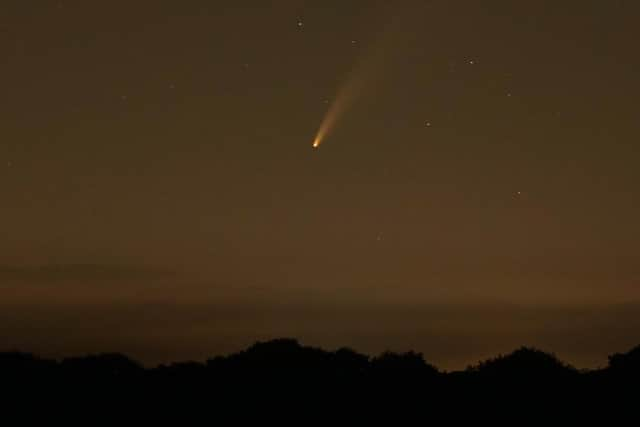

Graham Bryant, fellow of the Royal Astronomical Society and president of the Hampshire Astronomical Group, said: ‘A comet is always named after the person or satellite who discovers it. Neowise is around four-and-a-half billion years old and has travelled from beyond Pluto. The comet can be seen by looking towards the northern skies with the best time being around 11.30pm. It’s one of the brightest comets to be seen in our skies for many years.’
‘Neowise is currently quite low in the sky and so looking from Portsmouth it could be obscured by Portsdown Hill. The best place to see Neowise is in rural areas where there is less light pollution.’

Graham explained there are ‘millions of comets in the solar system’ which were created during the Big Bang – the process which scientists believe was behind the formation of the universe.
The astronomer added: ‘Comets are made from a mixture of ice, gas and rock. The trail you can see is the dust left behind which reflects yellow in the sunlight. It is difficult to say how fast Neowise is travelling but comets do speed up as they get closer to the sun.’
The best place to locate Neowise is by looking towards the constellation of the Plough where it will be visible as a bright white light.
Graham said: ‘While Neowise is moving this will not be visible to the naked eye and will only be seen by using a telescope. By July 23 Neowise will be higher and with darker skies this will be the best time to see the comet. The orbital period is believed to be in the order of 6,800 years so we shall not see Neowise again.’