
Ketamine addiction on rise for young people in Portsmouth as sufferers face “great challenges”
Ketamine has caused devastating health problems for addicts
Ketamine addiction is on the rise for young people - especially women - with sufferers facing some of the “greatest challenges” to recovery.
What starts as casual use of the Class B drug can quickly spiral into addiction and leave users facing devastating health consequences.


Party girl Paige Collins, of Havant, thought the drug would kill her despite its apparent harmlessness when she first started taking it aged 19.
She said: “I was 19 when I first tried ketamine. My friend asked me to sort some for a rave we were going to and it started from there. It started as a once-in-a-blue-moon thing then it was a weekend thing then it started picking up during Covid to week days and then every day.
“Initially I really enjoyed it. It took me three years to realise I was addicted. I would start off getting one or two grams a night and then at the start of 2024 I was doing between five and 10 grams a day. It was costing me anywhere between £150 to £250 a week.”
The daily habit that saw her snort between 5g and 10g a day and fork out £1,000 a month. Drug harm reduction websites warn that just 150mg is a heavy dose.
Over the course of three years Paige, now 26, started needing the loo more often and was horrified when she started experiencing excruciating pain and peeing a jelly-like substance.
At the height of her addiction Paige was bed-bound, struggling to eat, drink or sleep and needing to urinate around 50 times a day.
In January 2023 Paige had her first ultrasound and a cystoscopy where doctors discovered her bladder had drastically shrunk. The NHS states that a healthy bladder should hold around 400-600mls of urine, while Paige's can only hold 30ml - just 5 per cent.

Paige said: “It was awful, I was in pain. I was stuck in a cycle of waking up, doing it, crying, saying I'm never going to touch it again then picking it up again. I was nipping to the loo 50 plus times a day. It was ruining my life. I couldn't go out for four or five months of 2023, I didn't leave the house.”
Paige is far from alone. Portsmouth woman Kate Douglas, 27, recently revealed how ketamine took over her life - leaving her with angina, pneumonia, a hernia and weighing just 6st.
The HR graduate told how she fell into a seven-year ketamine addiction after getting hooked to the "cheap" drug she could buy for just £8.50 a go. "Looking back, I missed so much of my life - I ruined my 20s,” she said.
"It started out for fun but it became an escape after trauma in childhood. Soon, I was chasing the scene, chasing the drugs - I didn't sleep, didn't eat, and I got a cheap price because I knew all the dealers. Even when I tried to get help, I just couldn't stop using.
"In late 2025, I'd lost all hope - before it clicked that if I didn't stop, I was going to die. I'm clean now and this time, I want to make a purpose of my life and show people the reality. Ketamine will rob you of everything - I'm lucky to be alive."

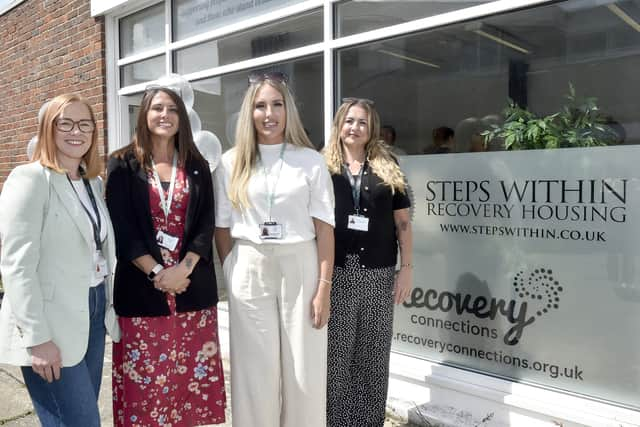
Sinead Smith, of Gosport drug and alcohol recovery service Steps Within, said ketamine addicts face a significant battle.
She said: “At Steps Within, we have supported a number of young women whose primary drug of choice has been ketamine, and sadly this is something we are seeing more and more frequently. In our experience, those struggling with ketamine addiction often appear to face some of the greatest challenges in achieving long-term sobriety.
“What is particularly concerning is how quickly ketamine use can escalate and the severe physical impact it can have on the body, especially the bladder and urinary system. Many users experience chronic pain, incontinence, bleeding, and ongoing health complications at a very young age.
“One of the most heartbreaking parts is that some individuals continue using ketamine not to get high, but to temporarily escape the intense physical pain the drug itself has caused. It can become a devastating cycle that is incredibly difficult to break.
“Behind every addiction is a person struggling, often silently, and many of the young people affected are vulnerable, isolated, and dealing with trauma or mental health difficulties alongside substance misuse.
“We hope that by speaking openly about the realities of ketamine addiction, more awareness, understanding, and early support can be offered before the long-term damage becomes irreversible.”
Portsmouth City Council has also revealed the city is seeing a rise in the number of people accessing support for ketamine use, reflecting both an increase in ketamine use locally and greater awareness of the help available.
Figures show that at the end of March 2026, 42 adults were in treatment for ketamine use in Portsmouth, compared to 13 at the same point in 2025, 11 in 2024 and six in 2023. Across the full year, 99 adults received treatment in 2025, up from 80 in 2024, 41 in 2023 and 27 in 2022.
Support is also being provided to young people, with the Council’s Drug and Alcohol Support Service (DASS) currently working with 12 under-18s affected by ketamine use.
Councillor Matthew Winnington, Cabinet Member for Community Wellbeing, Health & Care, said: "In Portsmouth and across the country, more young people and adults are coming forward for support with ketamine use. While this is concerning, it also shows that people are reaching out for help.
"By raising awareness of the severe and long-term damage ketamine can cause to health, we hope to prevent people from starting to use it, and to encourage those who are struggling to seek support as early as possible to avoid long-term harm. If you are struggling with ketamine use, or worried about a friend or family member, please do reach out for support."

Support available
In response, Portsmouth City Council and its partners have expanded local services to better meet this growing need. This includes a dedicated ketamine support group, the development of a ketamine workbook for people in treatment to guide their treatment plan and to help them stop using, and increased outreach work to help people access support earlier. This includes engagement within colleges and youth settings to highlight the risks and encourage early intervention.
Training for professionals has also been enhanced, alongside new guidance for GPs and healthcare practitioners to help identify ketamine use and refer to the right support.
Free treatment and recovery support for adults is primarily provided through Society of St James’ Portsmouth Recovery Service, with DASS supporting young people and young adults up to the age of 25. Support available includes:
- A dedicated support worker, providing one-to-one support
- Counselling
- Group support
- Access to detoxification and rehabilitation services
- Peer support
- Opportunities for volunteering and physical activity
Inclusion Recovery Hampshire provides a confidential, free and easy-to-access service to anyone living in Hampshire impacted by their own or someone else’s use of alcohol and drugs. The service is provided by Inclusion, part of Midlands Partnership University NHS Foundation Trust, and is commissioned by Hampshire County Council.
A spokesperson said: “Whilst the service has seen an increase in the number of people accessing support for ketamine use in recent years, the percentage of people seeking treatment for ketamine use compared to alcohol and other drugs remains low, accounting for five per cent of all people receiving support in 2024-25.
“Alongside one-to-one psychosocial support, the service provides health and wellbeing interventions and works closely with specialist secondary health teams to ensure people receive the right care at the right time. The service is committed to reducing harm, improving wellbeing, and supporting people and their families in a compassionate, non-judgemental way, delivered through a partnership approach.
“Younger people aged 24 and under make up the largest group accessing support for ketamine use. Specialist, age-appropriate support for this group is provided by our partner Catch22. In addition to this offer, our partner Parent Support Link (PSL) work with us across Hampshire to provide dedicated support for families and loved ones affected by substance use, including ketamine.
“The service also works closely with a range of partners, including primary and secondary care services, alongside voluntary and community sector organisations such as the Society of St James (within the Portsmouth Recovery Service), to provide a coordinated response that best supports those in need. This collaborative approach also helps to reduce the stigma associated with ketamine use, which can prevent people from seeking help.”
- People aged 25 and over seeking help with their own use can call the service on 0300 124 0103
- Those aged 24 and under seeking help with their own use can call 0845 459 9405
- The service accepts online self-referrals at Home - Inclusion Hants
Anyone concerned about their own or someone else’s ketamine use is encouraged to seek support, which is confidential and free to access.
Portsmouth Recovery Service: visit www.portsmouthrecovery.org or call 023 9229 4573
Drug and alcohol support service (DASS) for up to age 25: visit www.portsmouth.gov.uk/dass or call or text 07979 706037
Further support is also available locally from:
- Ketamine Anonymous, visit www.ketamineanonymous.org.uk
- PSL provide support to family and friends to people experiencing drug and alcohol addiction, including running the ARK (affected relatives of ketamine) group. Contact 023 8039 9764 or visit pslcharity.org.uk
For drug and alcohol support, Portsmouth City Council also commission Ambition Portsmouth, which provides peer support from people with lived experience of recovery. Group programmes include B.More who lead its Inclusive Recovery City initiative, and Project W which is a women-only service offering holistic support.