
Innovative treatment helps Marwell baby rhino Amali get back on her feet after life-threatening illness

Marwell team help rhino recover from a serious illness
A baby rhino at Marwell Wildlife has made a remarkable recovery after spending more than two months receiving intensive care for a potentially fatal illness.
Southern white rhino calf, Amali, was born at the Hampshire zoo on March 15, 2026, and initially appeared to be healthy. However, towards the end of May, keepers became concerned after noticing she had become unusually quiet and less active, while also suffering from an upset stomach.
Hoofstock keeper Darren Ives said: “When you work with animals every day, you notice the smallest changes. As Amali became more uncomfortable, we knew something wasn’t right.”
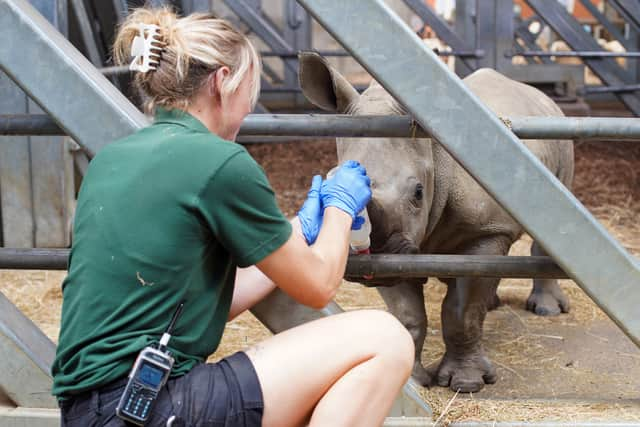

Finding the cause of her illness proved challenging, as veterinary samples had to be collected without causing unnecessary stress or disturbing the important bond between Amali and her mother, Zahra.
Marwell brought in additional expertise from Liphook Equine Hospital, whose specialists were able to provide valuable insight despite normally treating horses. Rhinos share a number of physiological similarities with horses, making the hospital’s experience particularly useful in developing Amali’s care.
Tests revealed the calf was suffering from salmonellosis, a bacterial infection which can be particularly dangerous in young animals.
Amali developed severe diarrhoea and inflammation, resulting in substantial losses of fluids and nutrients. The infection also entered her bloodstream, leaving her in need of intensive treatment, including hydration, pain relief and nutritional support.
Throughout her illness, the team made the decision to keep Amali with Zahra rather than separate the pair. When Zahra subsequently developed mastitis and was unable to provide as much milk, keepers introduced supplementary bottle feeds while allowing Amali to continue nursing from her mother.
The illness had also affected the healthy bacteria in Amali’s digestive system. With specialist rhino probiotics used in South Africa unavailable in the UK, Marwell’s Principal Vet, Dr Elysé Summerfield-Smith, researched alternative products and developed a bespoke combination using human and canine probiotics.
After weeks of round-the-clock care, Amali has now been discharged from intensive treatment. She still receives supplementary feeds and remains under close observation, but is becoming stronger every day.
She can now be seen exploring Marwell’s main field alongside Zahra.
Dr Summerfield-Smith added: “Amali is still receiving supplementary feeds and is still being closely monitored by our veterinary and hoofstock teams, so her recovery isn’t completely finished. But she’s making really encouraging progress.”
For the team who cared for her through countless difficult nights and early mornings, seeing Amali behaving like a healthy young rhino again has made the effort worthwhile.
Her recovery highlights the specialist knowledge, dedication and teamwork involved in caring for Marwell’s animals and supporting its wider conservation work.