
Historic reptile species related to dinosaurs discovered by Portsmouth scientists
AN HISTORIC discovery of a new reptile species has been made by researchers.
The University of Portsmouth has discovered a new small pterosaur – flying reptiles that went extinct around 66 million years ago.
A team of paleantologists from the univeristy were studying a fossilised piece of beak, with the help of experts from Bath University.
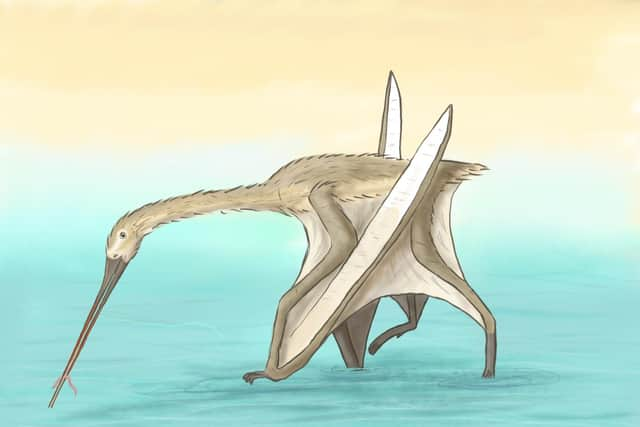

Careful searching of the late Cretaceous Kem Kem strata of Morocco, where this particular bone was found, revealed additional fossils of the animal, which led to the team concluding it was a new species with a long, skinny beak.
Their findings have been published in Cretaceous Research, an online journal, today.
Professor David Martill, who co-authored the study, said: ‘We’ve never seen anything like this little pterosaur before.
‘The bizarre shape of the beak was so unique, at first the fossils weren’t recognised as a pterosaur.’
There are more than 100 species of pterosaur that have been discovered, which range in sizes as large as a fighter jet to as small as a sparrow.
While not strictly dinosaurs, both are descendants of avemetatarsalia.
The new species, leptostomia begaaensis, used its beak to probe dirt and mud for hidden prey, hunting like present-day sandpipers or kiwis to find worms, crustaceans, and perhaps even small hard-shelled clams.
Dr Nick Longrich, from the Milner Centre for Evolution at the University of Bath, said: ‘Leptostomia may actually have been a fairly common pterosaur, but it’s so strange - people have probably been finding bits of this beast for years, but we didn’t know what they were until now.
‘Pterosaurs flying over water to hunt for fish tend to fall in and die, so they’re common as fossils.
‘Pterosaurs hunting along the margins of the water will preserve more rarely, and many from inland habitats may never preserve as fossils at all.’
The longer, slender beak found in this species is an evolution picked up by many modern species, allowing them to forage in the earth and in water, catching worms and fish for food.
With this beak being unearthed in a former ecosystem of estuaries implies this species focused on aquatic prey.