
Marwell Zoo celebrates birth of Freya the rare antelope calf which is extinct in the wild
MARWELL zookeepers are celebrating the birth of an extremely rare type of antelope which is believed to be extinct in the wild.
Freya the scimitar-horned oryx calf was born to parents Christina and Tenzi at the popular Hampshire zoo.
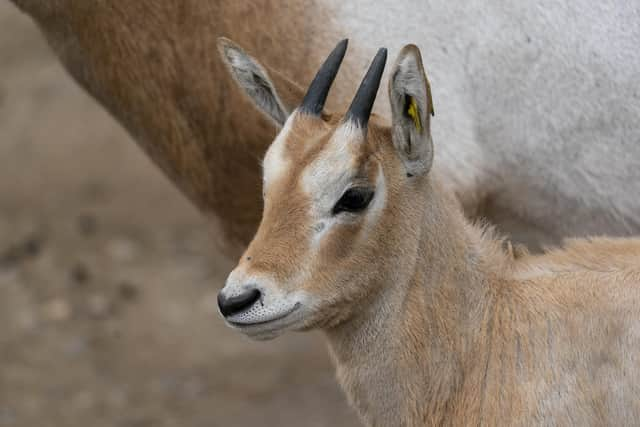

The youngster is said to be ‘thriving’ at its home in the zoo’s large paddock which she currently shares with white rhinos, zebra and ostriches.
Marwell’s hoof-stock team leader Tim Rowlands, who is monitoring Freya’s progress, said: ‘The calves will hide for the first few days, which is why their pelage is sand-coloured and replaced with a white coat as they grow.
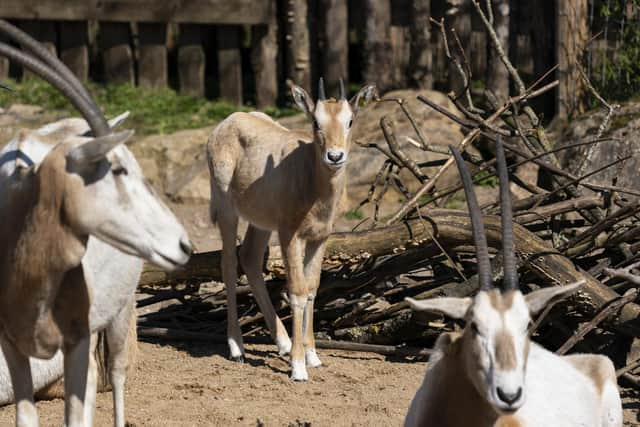
‘After the first week, the calf follows the dam (mother) as she calls her to explore new areas but she’s not at the age to venture too far on her own just yet. However calves are able to run as fast as the adults as early as 20 days old and she has been enjoying running around in the paddock.’
The once abundant scimitar-horned oryx was assessed as ‘extinct in the wild’ by the International Union for Conservation of Nature (IUCN) in 2000 and the species is reliant on captive breeding and reintroduction efforts for its continued survival.
Marwell Zoo has played a pivotal role in breeding the animal with the ultimate aim of reintroducing the species to its natural home in North Africa.
SEE ALSO: Marwell Zoo break-in: 'Significant damage' and animal abuse leaves staff 'deeply saddened'
Conservation biologist Dr Tania Gilbert, who supports the initiative at Marwell, said: ‘The scimitar-horned oryx was one of the first species we brought to Marwell Zoo in November 1971.
‘We’ve had 378 births here, making the species one of our biggest success stories in terms of breeding and conservation success.
‘We have reintroduced groups of oryx into protected areas in Tunisia to re-establish them in their natural habitat and we continue to research the re-established populations and work to enhance the biodiversity of the protected areas where they live.’
The Tunisian reintroductions began in 1985 with 10 scimitar-horned oryx from Marwell and Edinburgh Zoos, co-ordinated by the Zoological Society of London (ZSL).
There are now nearly 300 oryx living across five protected areas.