
Got bats? What to do if bats choose your house to hibernate in this autumn - and whether you need to worry

Bats have strong legal protections - even if they’ve snuck into your roof 🦇
- The UK’s native bats will be looking for safe, warm places to hibernate over the coming weeks
- Habitat loss means many of them now choose human buildings
- Bats and their roost have legal protections in the UK, so you shouldn’t disturb them
- Experts say it is possible to coexist peacefully, and they likely won’t cause any issues for homeowners
As the days get shorter and the weather continues to cool, some unusual houseguests may soon start paying lofts and eaves a visit.
The RSPCA says that this time of year is when the 18 species of bat which call the UK home will start looking for a warm place to sleep away the winter months. All bats – and their roosts – are protected by law, and experts say habitat loss has led to more of them using man-made buildings as their seasonal getaways.
Some homeowners might understandably have concerns about sharing their house with bats, while others might be wondering whether they’re allowed to encourage them to move somewhere else. We’ve checked what wildlife groups like the Woodland Trust and the Bat Conservation Trust have to say, to answer all of your questions about co-existing with these unique animals peacefully.
Here’s what you need to know:
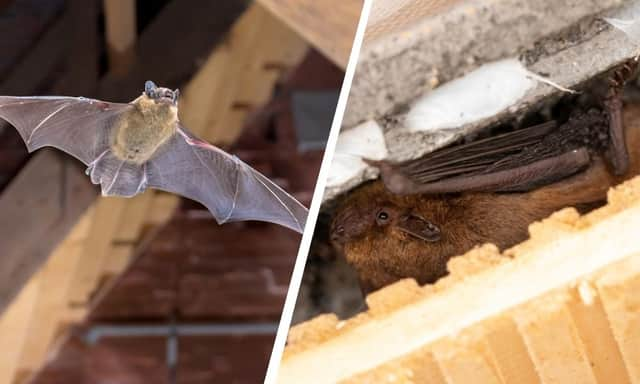

Why do bats come inside at this time of year – and how long will they stick around?
As temperatures start to drop in September and October, bats will be building up their fat reserves and looking for a safe, warm place to roost. This is because they hibernate over the winter months, usually starting from about November, the Woodland Trust says.
They will enter a state of deep sleep called torpor to conserve energy, so that they don’t have to go out hunting for insects to eat in the cold. They might not be fully active again until next May.
Bats aren’t really able to build their own nests, so they have to find a comfortable, pre-existing nook to sleep in. Many have adapted to roost in hollow trees, but the Bat Conservation Trust says that many of these natural habitats have been lost. Just like barn owls and swifts, bats have learned to take shelter in buildings.
While barns or abandoned buildings are preferred, they do sometimes end up in our roofs, ceiling spaces, eaves, porches, or even wedged into gaps between bricks. Common species that will nest indoors include pipistrelles and long-eared bats, both on the smaller side. They probably won’t live in your house year-round either, but will often return to roosts at the same time year-after-year.
Can you remove or rehome bats if you find them?
Bats and their roosts are protected by law in all four UK countries, the Bat Conservation Trust says. This means that it is illegal to disturb or remove them, even if they have snuck into your roof.
Any measures taken to try and deter bats from your property may also put you at risk of breaking the law, the Trust warns, including using ultrasonic devices near nesting areas. They are quite loyal to their roosts too, so unfortunately luring them away to an alternative like a bat box might not work.
In general, you should try to consider yourself lucky your place has been chosen – and learn to love them. “Bats are usually excellent houseguests and most people living in properties with bat roosts experience no issues with their tiny lodgers,” its guidance says. “In fact, many homeowners and tenants share their property with bats without being alerted to their presence at all.”
The only problems they generally cause are accidentally entering living areas. Or for roosts shared by a lot of bats, noise and droppings can sometimes be an issue. But the Trust says these are easily managed (they have online guidance on what to do in both situations available here), and are less likely to be an issue during the winter anyway, when bats are sleeping.
Are bats a health risk?
Sharing your home with bats is usually quite safe, experts from the Bat Conservation Trust say. Those that do live in our houses generally stay tucked away in their roosts and avoid any contact with humans – even when they are awake.
They’re relatively clean animals too, “which spend many hours grooming themselves”, and as they mostly just eat insects, their droppings are dry and crumbly. While it is possible to catch a disease called Histoplasmosis from a fungus in bat droppings in the US, Africa, or South America, this fungus is not present in the UK.
According to the Trust, the only real health risk from droppings is allergic reactions or dust inhalation if cleaning up very large quantities – which can be easily avoided by basic safety precautions like wearing a dust mask. The other concern is rabies, a rare but very dangerous virus that can be caught if an infected animal bites or scratches you. A small number of bats in the UK may carry rabies-like viruses called European Bat Lyssaviruses (EBLV).
“EBLV are transmitted by the bite of an infectious bat or by its saliva entering a wound or mucous membrane,” the Trust continued. “There is therefore no risk to you if you do not approach or handle a bat. This means that there is no need to be concerned if you have bats roosting in your property or flying in your garden.”
If you do make contact with a bat or get bitten, you should thoroughly wash any wounds with water and soap immediately. You should then get medical advice from your GP as soon as possible as a precaution – even if you’ve been vaccinated. If the bat is alive and you suspect it might have rabies, you should also report it to the Animal and Plant Health Agency (APHA) right away. You can find details on who to call in England, Wales, or Scotland online here, and in Northern Ireland online here.
How to give your local bats a helping hand
Bats are fascinating and important parts of the ecosystem, keeping insects like midges, flies and moths in check. But the UK’s bats have “declined dramatically” over the past century due to persecution and habitat loss, The Bat Conservation Trust says, and in this ever-changing world, your property can offer a safe place for them to live – if you can make your peace with them.
You can put your roost on the map while learning more about the bats which call it home by registering it, and joining the National Bat Monitoring Programme’s roost count. Your observations will help researchers and conservationists track how the country’s bat populations are doing.
Taking care of the local environment is also important for helping bats thrive in general. You can help support your bats even more by making your garden wildlife friendly, the Trust added. Even small steps like planting flowers which attract insects can make a big difference to conservation – and to bats, birds, and other critters alike.
Got bats? If you need advice about bats on your property, you can call the Bat Conservation Trust’s national bat helpline on 0345 1300 228 between 9.30am and 4.30pm, Monday to Friday.