
Why the Spitfire still has a hold on Portsmouth - the Second World War plane’s links to our area
Why the Spitfire still has a hold on Portsmouth - from the Schneider Trophy crowds at Southsea to the last flights from Daedalus
This weekend it was announced that spitfires.com is pulling out of Solent Airport at Lee-on-the-Solent, citing safety concerns to people on land in the event of engine failure. Here, writer Richard De Vere explains how the Spitfire plane is embedded in the consciousness of this area
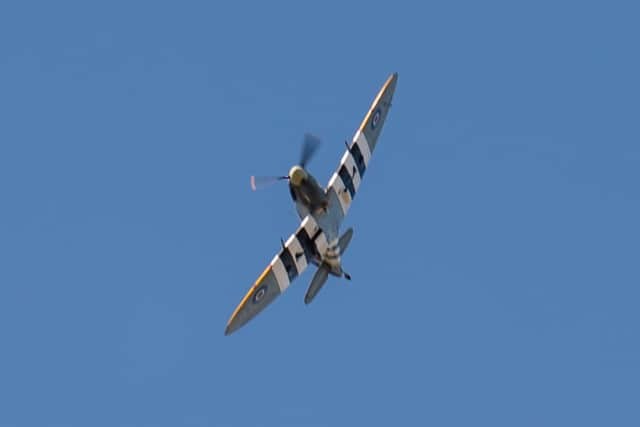
For eight years, the sound of a Merlin engine over Lee-on-the-Solent has been part of summer in south Hampshire.
Spitfire passenger flights from Daedalus have thrilled passengers and delighted those watching from the beaches. Now they are coming to an end. As The News reported on November 21, the operator, spitfires.com, has decided the airfield is no longer safe for its flights because of the risk to beachgoers if an engine failed after take-off.
Safety has to come first, but few places have a stronger claim on the Spitfire than this stretch of coast.

In a sense its story began over these waters. In September 1929, crowds packed Southsea seafront to watch the Schneider Trophy seaplane race, with one of the turning points off Southsea itself. More than 250,000 spectators were believed to have turned out.
Britain won with the Supermarine S.6, designed by R.J. Mitchell, and the Spitfire grew out of his work on those racing seaplanes. One of the S.6s that raced that day, N248, can still be seen at Solent Sky in Southampton.
On March 5, 1936, test pilot Joseph 'Mutt' Summers took the prototype Spitfire, K5054, up from Eastleigh, now Southampton Airport. The flight lasted around eight minutes. After landing, Summers is reported to have said: "Don't change a thing."
Mitchell died in 1937, before his fighter entered RAF service.
When the Luftwaffe bombed the Supermarine works at Woolston on September 24 and 26, 1940, production was scattered into requisitioned garages, laundries and bus depots.
South-east Hampshire played its part. Wadham Bros, the Waterlooville cycle and motor business, turned some of its workshops over to aircraft parts for Vickers Supermarine and for Airspeed in Portsmouth. A wartime list of Supermarine's sub-contractors shows the firm supplying oil tanks, sheet metal parts and bomb racks.
So why does the Spitfire still have such a hold on people? It is not about results alone. In the Battle of Britain the sturdier Hawker Hurricane shot down more German aircraft, 656 to the Spitfire's 529.
Part of the answer is those elliptical wings and that unmistakable engine note. But the deeper reason may be that so many ordinary people had a hand in it. It was built piece by piece in workshops up and down the country, including here.
The affection has not faded. Crowds still turn out on Southsea Common whenever Spitfires are due over the seafront, as they did for Armed Forces Day in June.
Many families in Portsmouth, Gosport and Havant will have their own Spitfire stories, handed down from relatives who made parts, watched the Schneider racers or simply looked up and cheered. Those memories are worth keeping.
If you have memories of or connections to the Spitfire, please do share them with us at [email protected]