
Royal Navy veteran who lost leg to bone cancer vows to 'rise like a phoenix' and be best disabled Strongman

The rare form of bone cancer was discovered after months of misdiagnosis
Losing a leg to ‘aggressive’ bone cancer will not stop a Royal Navy veteran from achieving his strongman dreams.
Shane Henry, of Gosport, knew something was badly wrong the morning he woke in agony and couldn't stand. The swelling above his knee - which doctors spent months failing to diagnose - turned out to be the rare form of cancer osteosarcoma.
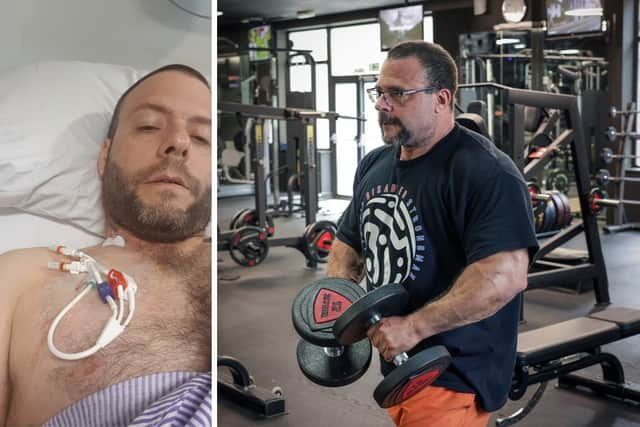

Within weeks, Mr Henry’s leg would be gone, and he would have to learn how to walk again at the age of 42. That didn’t stop the former Royal Navy engineer wanting to be on the Strongman podium.
He started with the gruelling training aged 40 in 2018 before the diagnosis, and said he was stuck in a rut. “I started thinking about the able-bodied Strongman circuit and began training,” he said.
Mr Henry began to progress and by early 2019, he had beaten his personal best in the leg press. That’s when he began to notice pain in his right knee. He shrugged it off and eased back on the training, but the pain was not going away. After a few weeks, he saw a GP who told him to stop.
His leg being began to swell and became uncomfortable to walk on. Months had passed and despite being prescribed painkillers, he couldn’t walk on the leg and the swelling was hot to touch. It was now twice the size of his left leg. He started researching sarcoma “I had been told what it wasn’t, but nobody had told me what it was,” Mr Henry said.
By June 2019, the pain got so bad Mr Henry had to take time off work. He woke up one morning in agony and his wife Emma called 111. Paramedics rushed to their third-floor flat in Gosport, but the two female staff realised they couldn’t carry him down the stairs to the ambulance. “I had to walk down and with each step it felt my leg was going to snap,” Mr Henry said.
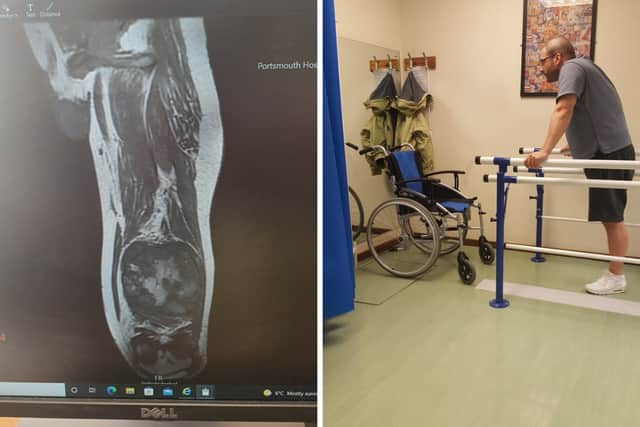
The veteran was taken to Queen Alexandra Hospital for blood tests and scans. He was diagnosed with osteosarcoma after being in the medical facility for a week. By then, the tumour was the size of a grapefruit.
Mr Henry said: “The doctor may as well have been speaking Latin. He then told me ‘you have a very rare and aggressive form of cancer above the knee’.” The engineer was transferred to Nuffield Hospital in Oxford, and after a biopsy, he was told the cancer was so far advanced that his leg would have to be amputated.
The six-hour operation in July 2019 saw Shane’s leg amputated quite high, and Mr Henry remembers the shock of coming round from surgery. He said: “Nothing can prepare you for that. Life would never be the same again.”
With Mr Henry’s house being on the third floor, he was classed as homeless until alternative accommodation could be found by the council. Eight days after the operation, he was transferred to Southampton General Hospital for chemotherapy treatment.
“I spent six months on a cancer ward,” Mr Henry said. “That is something that changes you. I would speak to someone in the next bed and the next day their bed would be cleared. I knew they hadn’t gone home.” The veteran spent ten days in the intensive care unit with sepsis, and was told there was a four hour window to save his life. At the end of November 2019, Mr Henry and his family were given the keys to a new flat in Gosport, adapted for his needs, alongside his son Callum, 17, and daughter Abbie, 11.
He had his first prosthetic leg within a few weeks. Mr Henry said it was a surreal experience, and learning how to walk again was a slow process. “The first couple of months were tough. It was a case of trusting myself to put my weight on it.”
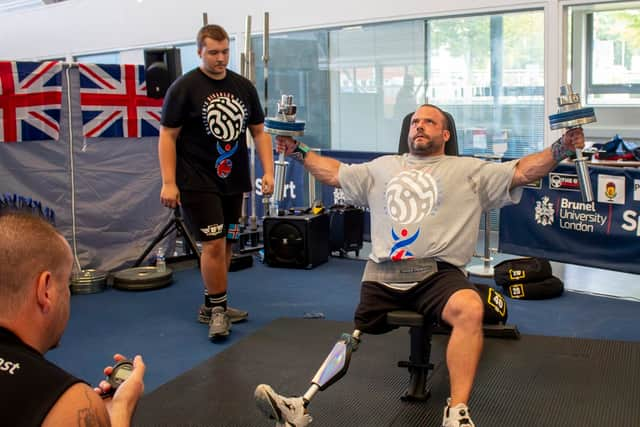
After taking his first steps unaided with crutches, and going out in public, he saw Strongman competitions for amputee entrants - reviving a long-lost dream that had previously disappeared. He took up training after the Covid-19 lockdowns finished. Mr Henry returned to the gym before signing up for his first tournament – the World Championships in Birmingham in November 2024.
It didn’t matter that he came last, because he now had the taste for the competition and was with a community of people who went through similar experiences. Last year, Mr Henry took on a coach and finished on the podium in three competitions. He’s now ranked number three in Great Britain and aims to take the top spot by the end of 2026.
He describes his life over the last few years as being “like a phoenix from the flames”. Mr Henry added: “I had felt that I’m never going to be a good dad or a husband. You’ve got to grieve for yourself and realise you will never be that person again.”
National charity Sarcoma UK have been supporting Mr Henry throughout the recovery stages. Research manager Emily Williams said: “Shane's story lays bare just how brutal osteosarcoma can be — and how urgently we need better options for patients. Sarcoma UK has invested over £1.2m into osteosarcoma research across some of the country's leading universities, and the breadth of that work gives us real cause for hope. Our researchers are tackling the disease from every angle — from developing precision immunotherapies that target tumours while sparing healthy tissue, to understanding why some cancer cells survive chemotherapy and come back, to working towards a blood test that could one day catch osteosarcoma far earlier.
“Shane spent months in pain before he was finally diagnosed, by which point his tumour had grown to the size of a grapefruit. That delay, and the devastating treatment that followed, is exactly what this research is working to prevent. We want a future where patients are diagnosed sooner, treated more precisely, and spared the life-altering consequences that too many people still face today."