
Royal Navy supports international research into Polar penguin population
A ROYAL Navy research ship is helping with cutting-edge research into the penguin population and climate change in one of the world’s most remote places on Earth.
Experts from Britain and the USA are working with HMS Protector to study colonies of the birds in the South Sandwich Islands – so off the beaten track even the Royal Navy only visits once a decade.
The chain of islands lie more than 1,300 miles east of the Falklands and are home to around three million of the flightless birds.
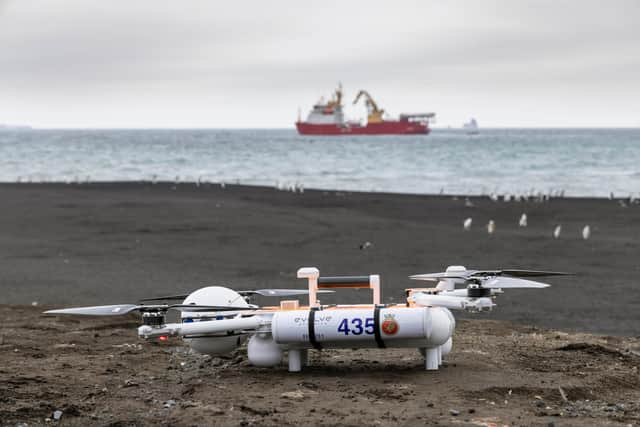
By landing on the uninhabited islands, recording the penguins and using drones, scientists hope for a better understanding of the impact of climate change and other environmental factors on the colonies.
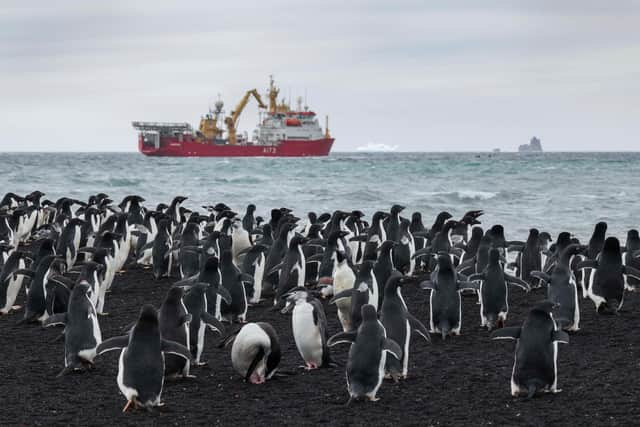

‘Visits by ships to these territories are exceptionally infrequent and hazardous,’ said Captain Michael Wood, Protector’s commanding officer.

The former Portsmouth-based icebreaker and its crew has contended with glacier-covered volcanic mountains, freezing waters, surf and gale-force winds to help scientists from the University of Oxford’s department of zoology and Washington DC-based scientific and educational organisation Oceanites, which has spent nearly three decades building up a comprehensive picture of penguin populations in Antarctica.
Oceanites maintains a continent-wide penguin database known which everyone in the Antarctic Treaty system relies upon and uses penguins as avatars to spread the word internationally about climate change
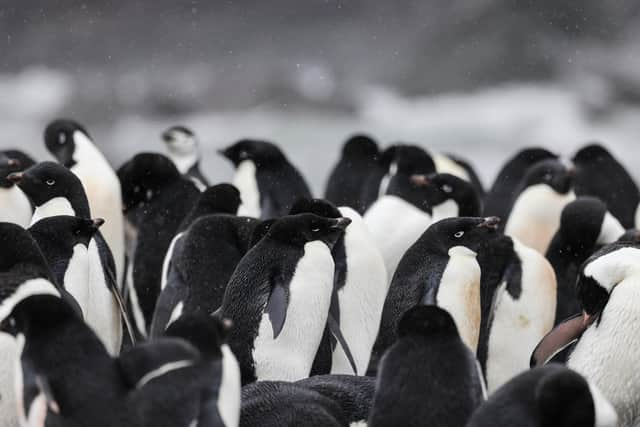
‘The opportunity to visit any of the South Sandwich islands to conduct research on penguins – or any other species – is incredibly limited,’ said Dr Mark Belchier, director of fisheries and environment with the government of South Georgia and the South Sandwich Islands.
‘Any additional data that can be collected opportunistically is incredibly valuable in order to determine trends in population sizes for the various species that live there.’
Scientists have relied on a combination of direct counting, GPS mapping and interpretation of high-resolution commercial satellite imagery to calculate the size of the colonies.
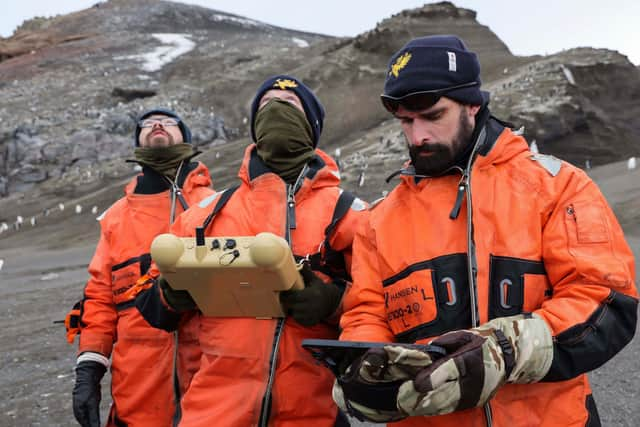
So the rare live footage and imagery captured by HMS Protector and scientists using drones on Saunders, South Thule and Cook islands is vital for more accurate assessments of the population sizes.
Ahead of the ship’s visit, the islands were thought to be home to nearly half of the world’s chinstrap penguins - some 1.3 million breeding pairs - as well as about 95,000 breeding pairs of macaroni penguins, and several thousand breeding pairs of gentoo penguins.
Despite being at the northern edge of their breeding range, an unexpectedly large population of Adélie penguins (about 125,000 breeding pairs) also live there.
The populations have fluctuated in recent decades. At first it was thought that resurgent whale and fur seal numbers following bans on whaling and over-fishing were the cause, eating the krill in the ocean upon which many penguins rely.
The results of the joint study will be made publicly available on http://www.penguinmap.com.
Protector and her 70-strong crew are on a five-year mission to survey the polar oceans and put a stop to illegal fishing in the region.