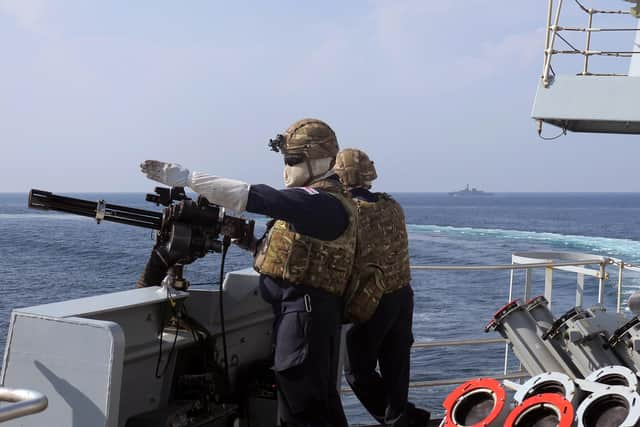
Royal Navy ships attacked from the air and sea in pulse-pounding Gulf drill
ROYAL Navy sailors have had their mettle tested dealing with underwater explosives and aerial assaults from jets in the Gulf.
Portsmouth-based minehunter HMS Chiddingfold, alongside Type 23 frigate HMS Montrose and support ship RFA Cardigan Bay, took part in the action-packed war game off the coast of Oman.
Known as Khunjar Hadd – Arabic for ‘sharp dagger – the challenging work out involved a dozen warships from the Gulf, USA and France.
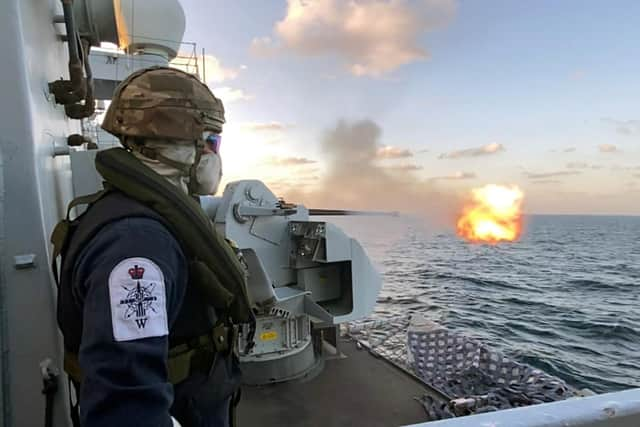

Now in its 26th year, the exercise provide a critical opportunity for the Royal Navy to drill its skills, defending against attacks from above, on and below the waves.
For HMS Montrose, the eight-day drill tested her ability to defend the skies above a task force.
The frigate, which is forward-based in the Gulf, was attacked by fighter jets in an unrelenting assault.
Among the warplanes used included French Rafales, Omani Typhoons and Hawks. I
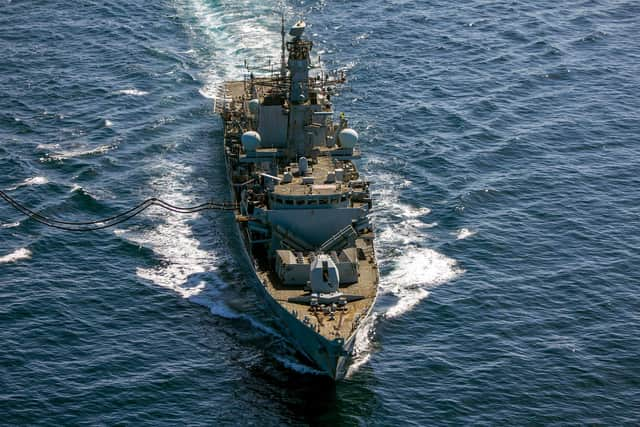
Montrose, which is earmarked to join Portsmouth’s fleet after returning from the Gulf, is armed with the Sea Ceptor missile system, capable of defending an area of 750 square miles – roughly the size of Oxfordshire.
While for glass-hulled Chiddingfold, it was a chance for her ship and crew to put their minehunting skills to the test, working alongside powerful warships from other nations, like US Navy cruiser USS Port Royal.
Sub Lieutenant Andrew Bonham, 26, is Chiddingfold’s navigator. He said: ‘The exercise was a fantastic show of highly coordinated, collaborative force across a range of disciplines – many of which are rarely encountered on a mine countermeasures vessel and therefore we relish the chance to practise them.’
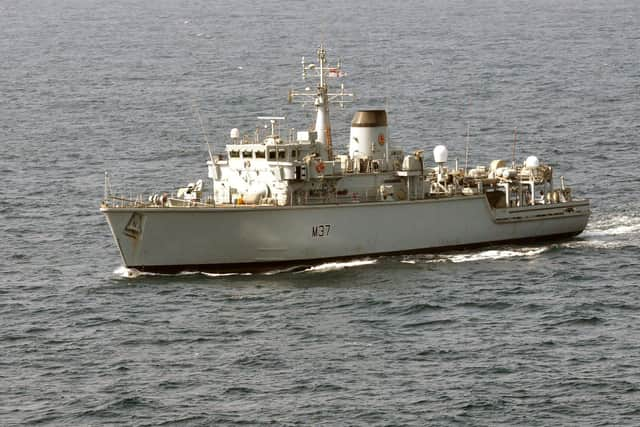
Lieutenant Daniel Fergusson, who’s completing his officer training aboard the minehunter, added: ‘Working with other ships it was great to see how other nationalities practise mine hunting and other disciplines, such as air defence which we don’t normally do. For a small ship, it shows us how capable we are when required.’
HMS Chiddingfold searched ten miles of sea lanes for mines, found two dummy variants and dealt with them. She also ‘rafted up’ with Cardigan Bay – came alongside at sea – to take on fuel and stores.
The Royal Navy’s minehunting force is celebrating 15 years continuously on operations in the Gulf, expanding from two ships initially to five today.
Lieutenant Commander Max Wilmot, chief-of-staff for the UK mine countermeasures force, said: ‘These exercises also provide reassurance that the motorways of the sea are safe for personnel and merchant vessels to transit and allow us to conduct valuable defence engagement with our international partners.’