
'Increasingly brazen' acts by Russia forcing Royal Navy to act - expert calls for 'higher cost' on Putin

Sophisticated spy submarines were spotted loitering over British pipelines and undersea cables
European countries need to “inflict a far higher cost” on Russia in response to the disclosure that Vladimir Putin had been using spy submarines to map critical underwater cables, a defence expert has said.
Katja Bego, a senior research fellow from Chatham House, said the UK and Ireland were “especially reliant” on undersea cables, not only for communication but for energy too.

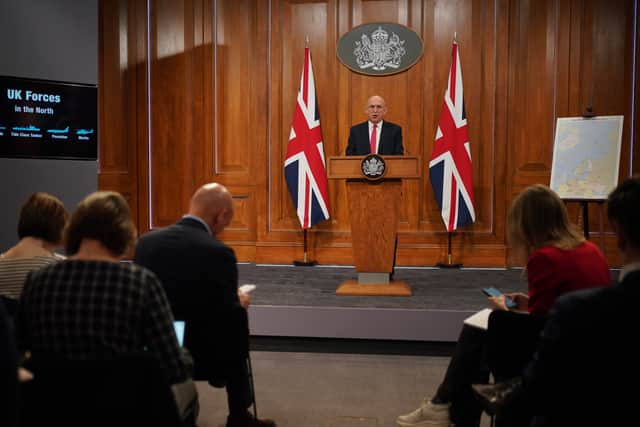
Russia, she said, was carrying out “increasingly brazen incursions”, as defence secretary John Healey revealed the UK had tracked a Russian attack submarine and two spy submarines loitering over critical undersea cables in the North Atlantic.
Ms Bego, who works in the think tank’s Europe Programme, told the Press Association: “These submarines appear to be engaging in mapping activities – spot weak spots, test responses – in preparation for a larger-scale escalation.
“The UK and Ireland as island nations are especially reliant on undersea cables – for communications, but also increasingly for energy. Damaging large numbers of cables at the same time could quite significantly disrupt traffic and supply. This wouldn’t just be a problem for the UK and Ireland, but also the rest of Nato, which also rely on these networks.
“The UK and its allies need to keep investing in strengthening the resilience of undersea cables – we see a lot of efforts there now – but also become more proactive about deterrence. Calling out operations in this manner, like Secretary Healey has just done, is effective. But there are urgent conversations to be had as well about what European countries can do to inflict a far higher cost on Russia in response to these increasingly brazen incursions.”
Mr Healey revealed a Russian attack submarine, which had been monitoring undersea cables for a month before it retreated, was part of the Akula class. It is nuclear-powered and can launch a range of anti-surface vessel torpedoes, according to Naval Technology.
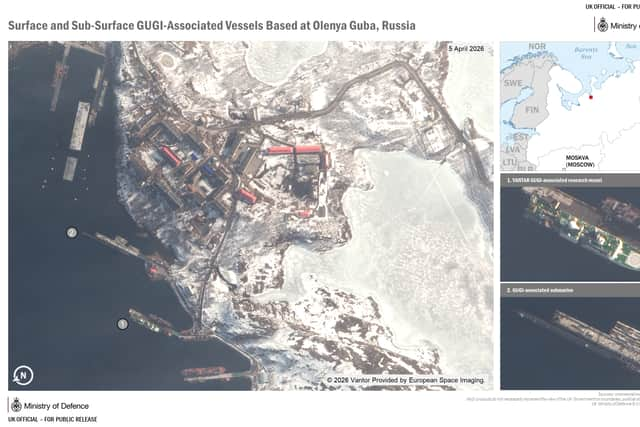
Akula submarines have advanced capabilities such as intelligence gathering and striking land targets, and they are a critical component of the Russian navy. The two spy submarines are specialist submarines from Russia’s ministry of defence deep sea research programme, known as Gugi (Main Directorate of Deep-Sea Research).
The programme is believed to be tasked directly by the Russian president and is designed specifically to conduct sabotage operations of deep-sea infrastructure, according to news outlet Calibre Defence. Gugi operates a number of vessels and specialised submarines including the Belgorod, Paltus, X-Ray, Kashalot and Losharik submarines.
Gugi specialist submarines are titanium-hulled which enables them to sustain the pressure of operating at extreme depths, according to the Royal United Services Institute (Rusi). Russia has also been increasing its activity in the English Channel, with warships and shadow fleet vessels traversing the waterway. The UK has yet to seize any of these vessels.
Dr Sidharth Kaushal, a senior research fellow at Rusi, believes in this instance the Akula submarine was used to draw attention away from Gugi submarines while in UK waters. He said: “By monitoring activity, the Royal Navy can both build a level of awareness about what infrastructure is being mapped and potentially recover any surveillance assets left behind by Russian submarines.
“It can also build a degree of awareness regarding Russian tactics – for example the apparent use of an Akula attack submarine to draw attention away from Gugi submarines in this most recent incident.”