
"Make life horrible at sea": Ex Royal Navy boss calls for Russia challenge after Yantar laser incident

Britain should look to “make life horrible at sea” for Russian spy ships mapping the UK’s critical undersea cables, a former Navy chief has argued.
Recalling first-hand hostile Cold War encounters on the high seas, Lord West of Spithead told the House of Lords there was more that could be done “to make it very uncomfortable” for vessels like Yantar. The surveillance ship was spotted near the North Sea last week, shining lasers into the eyes of RAF pilots when they tried to respond.
HMS Somerset proceeded to track the activities of Yantar. The UK is looking into “military options” if the vessel decides to stray closer to Britain. Ministers have condemned the “highly dangerous and reckless” actions of the Russian ship.
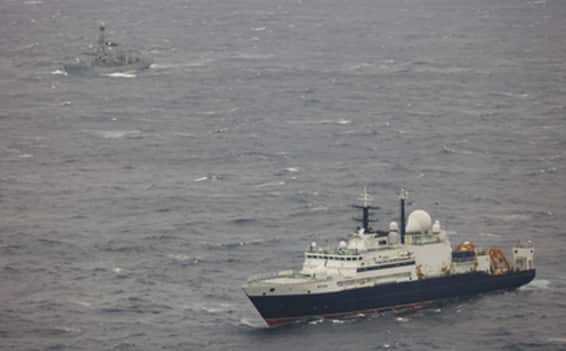

Yantar is among a fleet of vessels that forms part of the Russian ministry of defence deep sea research programme known as GUGI. The agency has both specialist surface ships and submarines that are used to survey underwater infrastructure, but also have the capability to sabotage those vital links.
The UK and its Nato allies have become increasingly concerned about the risk Moscow poses to seabed cables and pipelines, amid heightened tensions following the invasion of Ukraine. Attacks on undersea infrastructure could cause “catastrophic disruption” to the financial and communications systems Britons rely on, the National Security Strategy Committee warned in a September report.
Yantar has been within the UK’s exclusive economic zone, which extends up to 200 nautical miles – about 230 miles – offshore, but has been on the edge of Britain’s territorial waters, within 12 nautical miles (13.8 miles) from the coast. She was previously caught loitering over undersea cables in January this year, and was warned away by a nuclear-powered attack submarine, which surfaced nearby after stealthily tracking the vessel.

Russia has denied it was “interested in British underwater communications” and accused the UK of being “Russophobic” and “whipping up militaristic hysteria”.
Lord West, a former Royal Navy First Sea Lord, recounted being at sea during the Cold War when Russian ships had engaged in “highly dangerous things”, such as ramming attempts and activating their weapons systems. The former defence minister said: “I do believe there’s more that we can do to make it very uncomfortable for a ship like the Yantar. There are things one can do that make life horrible at sea. They’re not all seen and I think we should start thinking about doing some of those.”
Lord Vernon Coaker said there are a whole range of things taking place in regards to the UK strategy to deal with Russia. Former military chief and independent crossbencher Lord Craig of Radley said: “What steps has the Government taken with the Russians? Has the Russian ambassador been called to a meeting in the FCDO (Foreign, Commonwealth and Development Office) to be informed of UK disapproval?”
Lord Coaker said: “Nobody can be in any doubt about the seriousness with which we take the incident that happened. It wasn’t a weapon system but that doesn’t alter the fact that a handheld laser was pointed into the cockpit of one of our planes, that’s of huge significance, of huge importance and the Russians are under no doubt at all about how seriously we take that incident.”

The Bishop of Leeds, the Rt Rev Nick Baines, a former Soviet military specialist who served as a Russian linguist at GCHQ, said: “It is clear that that message is conveyed, but it seems to do nothing to deter the Russians from continuing with their activity. Can the minister say whether our military leaders have come to any conclusions about what an appropriate response will be to what, in the end, could be an act of war?”
Lord Coaker said: “This is a really important question, but I say to everyone that we have to be really careful about the language that we use when we ask, ‘If this happened, what would we do? If that happened, what would we do? Would we see such and such as an act of war? That is not to underplay the seriousness of what is happening, but it is about trying – as any Government would – to be reasonable and sensible in the language that is used.
“Let nobody be in any doubt that the seriousness of this is significant. We know what the Yantar is doing as part of operation GUGI, we know that it is surveying the underwater cables in a peacetime way for potential use in other scenarios in the future and we are making sure the Russians are aware of that.”