
"Critical" Royal Navy project discussed in Portsmouth as the UK faces "evolving landscape" of threats

Important meetings have been held in Portsmouth on how to support the Royal Navy amid an “evolving landscape” of threats.
Around 30 small to medium-sized enterprises (SMEs) came together at Portsmouth Historic Dockyard to discuss Project Cabot. The UK is looking to increase its naval presence - crewed warships and autonomous systems - in the North Atlantic protect the nation from adversaries such as Russia.
Ian McFarlane, sales director for underwater systems at the defence firm Thales UK, told The News: “The Navy is being asked to do more with less, and the threat landscape is evolving in the North Atlantic. It’s not only the typical submarines that we want to track and counter, but also threats to critical underwater infrastructure.


“You have third party actors and shadow vessels that can affect our oil, gas, electricity, and comms. The Navy needs to provide anti-submarine warfare, trawling up and down trying to find something that shouldn’t be there, and go and prosecute it.”
What is Project Cabot? How will the Royal Navy protect the North Atlantic?
Project Cabot is an operation where the Royal Navy will focus on anti-submarine warfare in the North Atlantic by producing autonomous ships with advanced sensors and other technology. As set out on the Thales UK website, the force is expected to commission a persistent barrier to stop adversaries trying to enter allied waters.
As previously set out in the Strategic Defence Review (SDR), the reviewers outlined the new anti-submarine warfare frigates, the Type 26 City-class frigates will operate regularly in the North Atlantic and be supplemented by underwater, surface, and airborne drones, P-8 maritime patrol and reconnaissance aircraft, and attack submarines.
Thales UK produces sonar systems - sea to screen technology - as well as mission systems for ships and submarines, including the combat system for the new Type 31 warships. Mr McFarlane is designed to produce a capability that can find threats and report it to the Navy, so conventional warships and other equipment can move in. to move in with conventional warships or other equipment. He added that it will be utilised along the Continuous At Sea Deterrent (CASD).
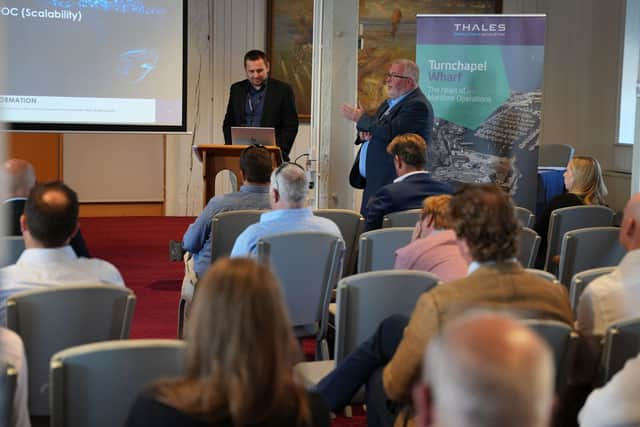

“Cabot’s designed to find that needle in the haystack, and then hand the operation back to the Royal Navy for them to decide what to do with it,” the director said. “The Greenland-Iceland gap remains critical, so that should be the area of focus.”
Will more defence jobs be created in Portsmouth?
The government has pledged to prioritise British-based SMEs for MoD contracts. Mr McFarlane said defence experts met for a series of workshops to analyse how they can deliver Project Cabot for the Royal Navy. he added that the MoD request for quote (RFQ) - which outlines the scheme and its requirements - is expected to be announced in September.
“They want mass and persistence in the North Atlantic,” he said. “Capability at sea, with enough coverage to provide the complete maritime picture - us, the navy, and our allies - and to do that long term.”
Mr McFarlane added that Thales if Thales wins the prime or part of Project Cabot, they could include SMEs in the Portsmouth area - with nine out of the 30 businesses at the meeting based there. it is likely that the company would look to buy autonomous surface ships and subsea air sets, so communication systems and other technology can be attached to them.
“We would expect work for the Portsmouth area on this programme,” he said. “Whether the capability is based there, I’m not sure. It’s a bit early to tell what the structure of the final offer will be, but I do think work will be shared around the UK.”