
Royal Navy: "Brilliant" nuclear submarine HMS Triumph decommissioned with "state-of-the-art" boats on the way

A powerful nuclear attack submarine that has been in he Royal Navy fleet since The Cold War has been decommissioned.
Trafalgar-class submarine HMS Triumph was officially retired at a ceremony on Monday (July 21). She was one of seven vessels which were at the forefront of underwater warfare.
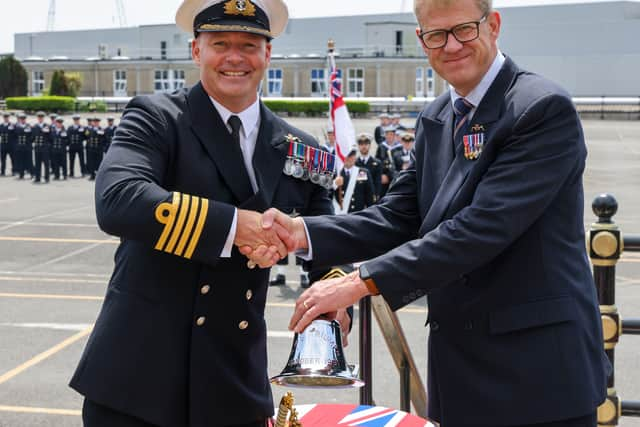
Captain Dave Burrell, who served in a string of T-boats, was the Executive Officer of HMS Triumph and HMS Talent, while also serving as skipper of HMS Trenchent in the North Pole. He was joined at the retirement ceremony by Guest of Honour and Triumph’s Sponsor, Lady Hamilton.
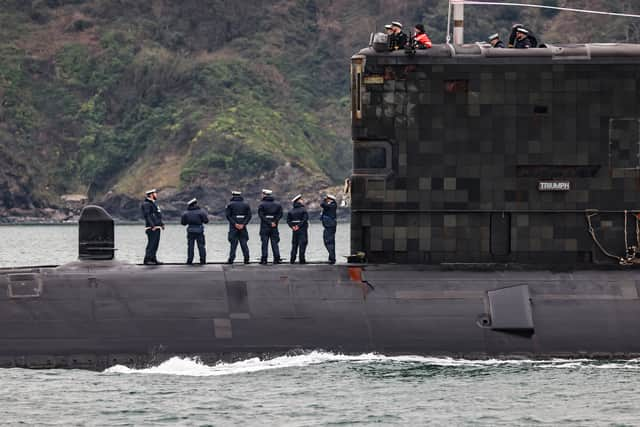

Captain Burrell told all present he was mesmerised by the T-boats from the moment he first stepped aboard HMS Tireless in 2003. “The boat was a marvel, the people inspiring, and the mission was challenging,” he added.
The veteran said the submarines “had become a second home” to him and cemented their reputation as workhorses of the submarine flotilla. He added: “They are the last of the Cold War warriors, although the Cold War never went away. We continued to play our dangerous game. I asked the Royal Navy’s most senior submariners how I should describe the Trafalgar class. They said simply: utterly brilliant submarines.”
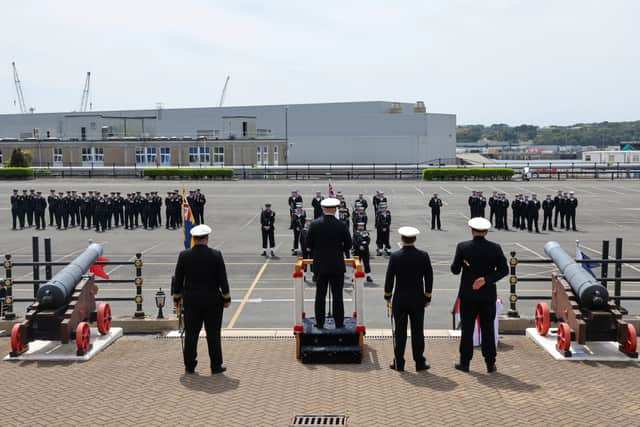
Submarines of all ages converged on Devonport Naval Base for the ceremony. HMS Triumph was the last operational vessel of her class. Crews of the last two T-boats in service, Talent and Triumph, held Divisions at HMS Drake in Devonport, with former Trafalgar crews invited to join them.
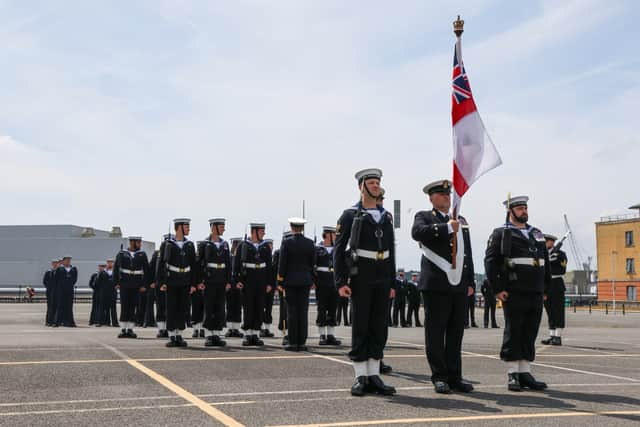
A Colour Party and Guard comprising submariners from HMS Talent – which paid off three years ago but still has crew as part of the complex decommissioning process – and HMS Triumph, as well as veterans from the Royal Naval Associations and Royal British Legion paraded in front of friends and families of the Submarine Service who had gathered for the occasion.
Former nuclear engineer Craig Spacey, who served in HMS Trenchant and HMS Torbay, said: “Are there any interesting stories I can tell? No, we did a lot of missions which we cannot talk about. But the T-boats were great, great camaraderie on board. You’ll probably get the same response from every submariner here: what keeps you in the Service is the people, the fun, the comradeship.”
Second World War veteran John Harlow, who served on HMS Truculent and Teredo, added: “This is absolutely great – I cannot believe it. We are different ages and we talk different languages but I understand what they have gone through being under the water.”
Trafalgar-class submarines were gradually phased out from 2009, making way for their Astute-class counterparts. The government announced in the Strategic Defence Review (SDR) that 12 new “state-of-the-art” nuclear submarines would be built to bolster the country’s nuclear deterrent. HMS Agamemnon and HMS Achilles will eventually replace HMS Talent and Triumph - with the latter having a 34 year career.
The T boat was used to gather intelligence, hit the UK’s foes by launching Tomahawk cruise missile strikes, serve as the springboard for commando raids and much more. Much of HMS Triumph’s career is classified, but she has launched Tomahawk missiles on several occasions, firstly at Taliban targets in Afghanistan in the wake of the 9/11 attacks in 2001 and, a decade later, against Colonel Gaddafi’s forces during the uprising in Libya.
Capt Burrell said: “It is time to rest easy Trafalgar, Turbulent, Tireless, Torbay, Trenchant, Talent and Triumph. It’s now someone else’s turn.”