
Iran: Royal Navy receives 'world class' autonomous mine-hunting ship Adventure amid Strait of Hormuz talks

The Royal Navy has received a new autonomous mine-hunting ship amid talks to reopen the Strait of Hormuz.
Adventure has joined the fleet and is the second of four remotely-controlled boats to be delivered. It is part of the Maritime Mine Counter Measures (MMCM) programme, which boats the latest technology to deal with underwater explosives.
In response to missile strikes from the US-Israeli coalition, Iran has held a stranglehold over the Strait of Hormuz - where roughly 20 per cent of the world’s oil travels through during peace time. Cargo vessels have been hit with projectiles and mines have been laid in the vicinity.
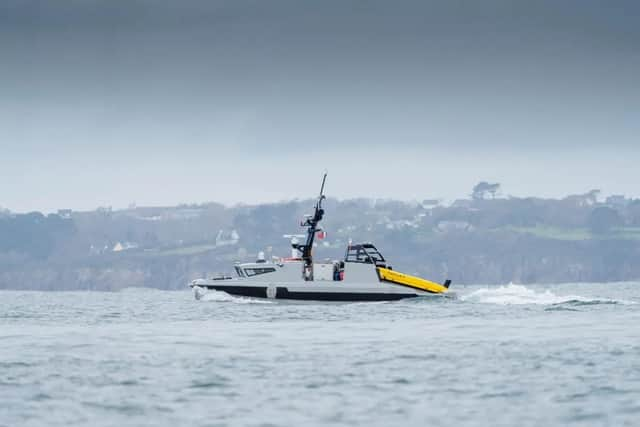

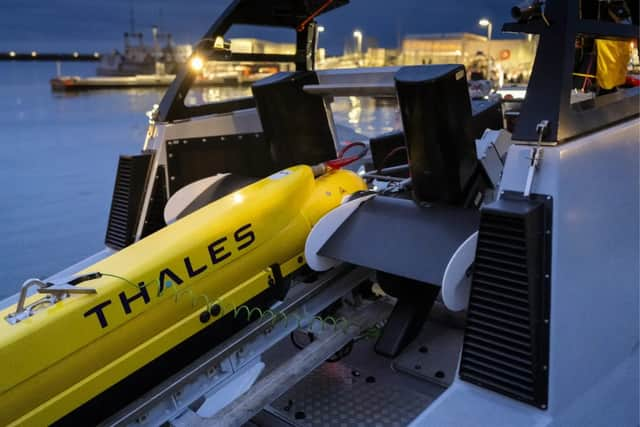
Since these actions, the Royal Navy’s mine-hunting capabilities have been put under the spotlight. The force as a described Adventure as a “primary system” which was “capable of carrying a payload comprising other un-crewed survey/mine warfare systems”.
One of these is SAMDIS, a bright yellow un-crewed vehicle which can rapidly map the seabed to identify and neutralise underwater threats. The Royal Navy said the MMCM programme introduces a “world‑class, autonomous mine countermeasures solution, built around advanced crewless systems and an expanded mission suite designed to enhance safety and operational effectiveness at sea”.
“It’s been designed to allow operators to clear mines in seas up to State 4 (waves as much as 2½ metres/8ft high) and supports detailed seabed mapping in the most complex of maritime settings.”
Adventure has handed over to Commodore Michael Wood, Senior Responsible Owner for the UK programme - part of an Anglo-French partnership - at Turnchapel in Plymouth. He said the advent of the second craft marked “an important step forward – and showed the power of the enterprise – with OCCAR, Royal Navy, the National Armaments Director Group, Thales and Saab working collaboratively and transparently to one purpose, and responding to the urgent need to prepare this world-class capability for any operational deployment.”
The UK is chairing a meeting of military planners from a coalition of nations examining long-term measures to secure the strait. The discussion was expected to focus on plans for an international coalition to make the strait safe for shipping once hostilities have ended.
It followed a meeting of more than 40 nations last week, chaired by foreign secretary Yvette Cooper, that discussed collective action to increase pressure on Tehran. The UK has granted permission for the US to use British military bases to carry out limited defensive operations, only targeting Iran’s missile sites and facilities being used to target shipping in the Strait of Hormuz.
US President Donald Trump threatened that a “whole civilisation” would be wiped out if the strategic waterway was not reopened by 1am UK time on April 8. Downing Street said the UK’s focus was on “de-escalation” and a “negotiated settlement” for the region.