
"Terrible error" awaits Royal Navy as Portsmouth's HMS Middleton expected to leave Middle East abandoning area

The Royal Navy is expected not to operate any ships in the Middle East with the last remaining vessel set to leave.
British naval presence has been slowly decreasing in the region over the past several years. The Daily Telegraph now reports that the last remaining warship, Portsmouth-based minehunter HMS Middleton, is due to return to the UK this year - possibly as early as March. She entered a maintenance period in October 2025.


Admiral Lord Alan West, who served as First Sea Lord between 2002 and 2006, described the decision as a “terrible error” and the UK needs to get something based there “as rapidly as we can”.
He told the national publication: “It’s extremely unfortunate that our Navy has been reduced to such a level that we can’t have a frigate or offshore patrol vessel based in the Gulf because it’s a region that has constant difficulty and trouble.”
Why is the Royal Navy turning away from the Middle East?
HMS Middleton, a Hunt-class vessel commissioned in 1984, has been primarily utilised in the Gulf as part of Operation Kipion. This is a UK deployment designed to maintain peace and stability in the Middle East.
Personnel are often assigned to anti-drug smuggling missions, mine clearance tasks, security patrols, and other operations. Despite these ongoing duties, The Daily Telegraph said HMS Middleton is not expected to be replaced - leaving Britain without a fighting presence there for the first time since 1980.
The number of Royal Navy deployments to the Middle East has fallen from 17 in 2015 to eight in 2025. HMS Lancaster, the last remaining frigate in the region, was retired at the end of last year.
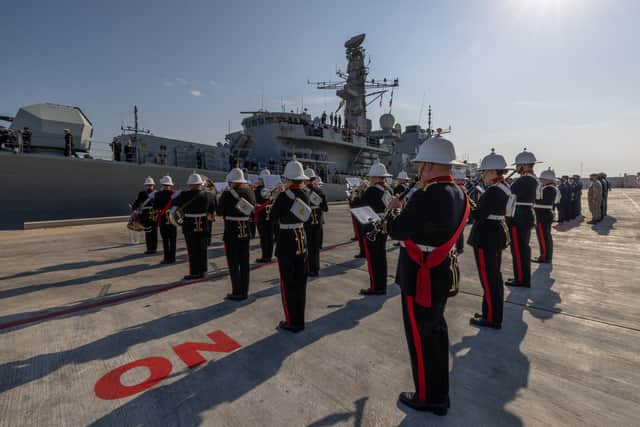
The Type 23 frigate exceeded her lifespan by 18 years, operating on exercises and deployments for nearly 35 years. Focus has moved away from the Middle East given threats closer to home.
The Strategic Defence Review stressed the need for more patrols - involving conventional warships and autonomous systems - in the North Atlantic. This is to protect critical undersea infrastructure and keep an eye on the area amid a growing Russian shadow fleet and submarine force. Moscow’s vessels have been spotted on several occasions this month, including in the English Channel and North Sea.
When asked by the Telegraph about HMS Middleton leaving the Middle East, a Ministry of Defence (MoD) spokesperson said the UK “remains steadfast in our commitment to promoting stability and peace in the Middle East and maintaining a presence in the region”. They added that the military will continue to play a leading role in combatting Daesh, and will retain a long-standing maritime presence through Operation Kipion.