
Royal Navy: HMS Duncan eliminates "aerial threat" close to RAF base near Cyprus while on Mediterranean task

An “aerial threat” was neutralised by a Royal Navy destroyer while on deployment in the Mediterranean.
Portsmouth-based warship HMS Duncan tracked and eliminated the aircraft alongside an RAF Typhoon. The Type 45 destroyer carried out the counter-drone training task - Exercise Aphrodite Trident - with a Typhoon FGR4 from RAF Akrotiri, Cyprus.
Lieutenant Jonny Miller, a flight controller on HMS Duncan, said: “It is a very satisfying feeling to see the hours of preparation and planning that go into an exercise like this come to fruition, especially one as relevant and in tune with the real-life threat as Aphrodite Trident. This exercise has proven that we can defend ourselves, our colleagues and our allies from attack. It really shows why what we do matters.”
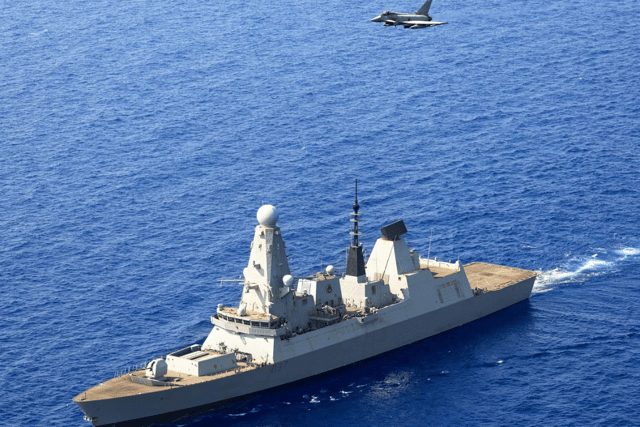

Exercise Aphrodite Trident, held just south of Cyprus, tested tested the crew against uncrewed aerial systems. These have been used by Houthi militants in the Red Sea to attack merchant ships as well as military vessels. The RAF’s 83 Expeditionary Air Group played a vital role in the operation - having strategic oversight and monitoring its progress via satellite in a Combined Air Operations Centre (CAOC).
HMS Duncan’s Wildcat helicopter took flight to simulate an enemy drone in attack mode. She flew in a pattern directly RAF Akrotiri. After receiving an alert for the immediate attack, the Typhoon fighter jet scrambled to rendezvous with HMS Duncan under tactical guidance of the ship’s Flight Controllers.
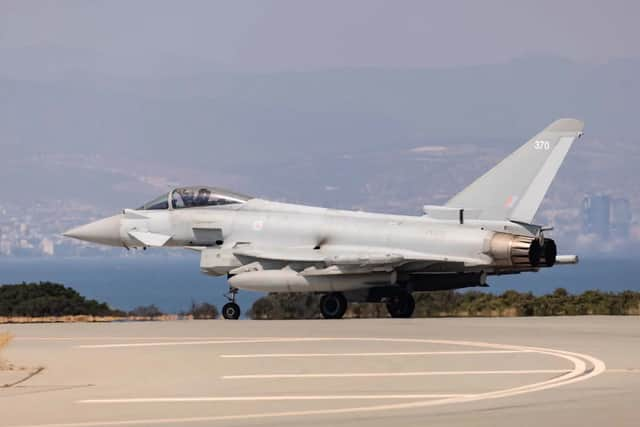
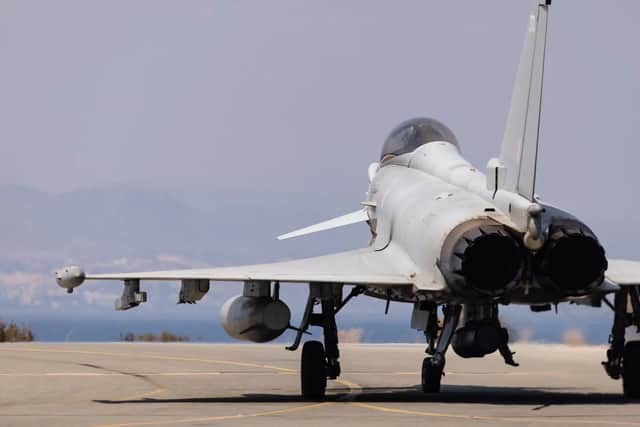
These officers specialise in overseeing fast jet missions, ensuring that threats are dealt with from a safe distance and far away from vulnerable units or areas. HMS Duncan used her Sampson radar to track the low flying “drone” as it sped towards its targets. The crew established a data link with the Typhoon and transmitted her radar’s target track to the jet’s onboard sensors. This allowed the jet to navigate towards the target and “eliminate the threat”, the Royal Navy said.
RAF Typhoon Detachment Commander Wing Commander Morris added: “A Typhoon pilot on a scramble has to deal with many dynamic tasks in a very short period of time. HMS Duncan’s capabilities provide us the ability to quickly meld voice comms with a digital picture in the cockpit thus reducing the time to identify and engage targets whilst maximising distance from the defended asset. This was a great opportunity to work with HMS Duncan and prove the Voice and Data communications for potential scenarios in the Eastern Mediterranean.”