
"Engineering issue" plagues F-35B fighter jet after India emergency landing on HMS Prince of Wales op

Mechanical gremlins are plaguing a fighter jet that had to make an emergency landing during a huge Royal Navy deployment.
An F-35B aircraft had to divert its course for safety reasons during routine tasking over the weekend. The jet was housed on HMS Prince of Wales, the Royal Navy flagship currently leading the UK Carrier Strike Group in the Indo Pacific on Operation Highmast.
The fighter jet touched down at the civilian Thiruvananthapuram International Airport in Kerala, India, on Saturday (June 14). Personnel sought permission from airport authorities and landed safely at 9.30pm, according to the Hindustan Times.
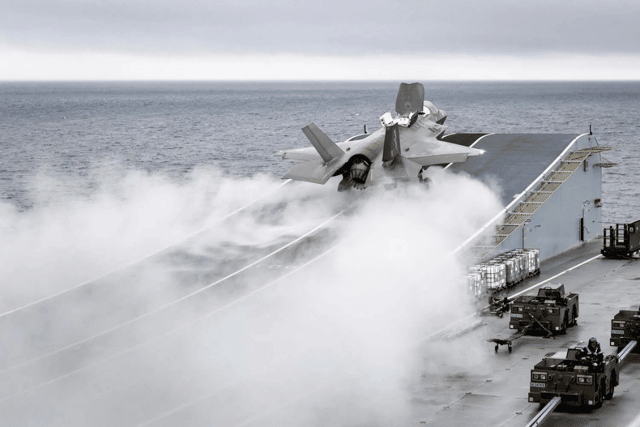

Despite the aircraft arriving at the airport without incident, it has remained in Kerala and not returned yet to HMS Prince of Wales. The Ministry of Defence (MoD) has confirmed the F-35 “developed an engineering issue” while situated at the airport.
Engineers aboard a Merlin helicopter have been deployed to assess and repair the fighter jet. No forecasts have been given for when the aircraft will be serviceable, or when it will return to the aircraft carrier.
Why did the F-35B fighter jet have to make an emergency landing?
Adverse weather conditions forced the aircraft to land at Thiruvananthapuram International Airport and not return to HMS Prince of Wales. The decision was made to prioritise the safety of the personnel piloting the capability.
The Indian Air Force issued a official statement on Sunday (June 15). They said: “A Royal Navy F-35B fighter recovered off an emergency landing at Thiruvananthapuram International Airport on the night of June 14, 25.
“A Royal Navy F-35B fighter recovered off an emergency landing at Thiruvananthapuram International Airport on the night of June 14, 25. On having declared a diversion off an emergency, the F35B was detected and identified by the IAF's IACCS network and cleared for the recovery. IAF is providing all necessary support for the rectification and subsequent return of the aircraft.” The diversion was described by an IAF spokesperson as a “normal occurrence”.